
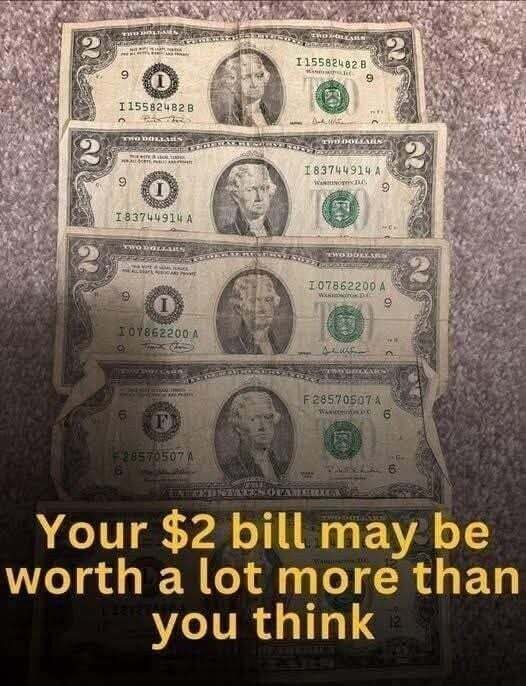
Your Two Dollar Bill Could Be Worth Far More Than Face Value
A two dollar bill may seem like nothing more than an unusual piece of pocket change, but some versions can be worth far more than two dollars.
Many people casually spend these bills, drop them into tip jars, or hand them to cashiers without looking closely at the details. Yet certain notes can attract serious attention from currency collectors, especially when they have rare dates, unusual serial numbers, printing quirks, or strong condition.
The humble two dollar bill has long been treated as a novelty by the public. Because it is not commonly seen in everyday transactions, many people assume it is either outdated, purely symbolic, or worth only its printed face value.
That assumption can be costly.
In the collecting world, specific two dollar bills are considered valuable pieces of American currency history. Some examples can be worth hundreds or even thousands of dollars depending on age, condition, scarcity, and collector demand.
Why the Two Dollar Bill Is Often Misunderstood
The two dollar bill occupies a unique place in American money.
Unlike one dollar bills, five dollar bills, or twenty dollar bills, it rarely appears in ordinary purchases. This limited circulation has helped create confusion around it.
Some people mistakenly believe the note is no longer printed. Others think it is only issued for special occasions. Many treat it as a curiosity rather than a legitimate piece of currency.
Because of that unusual reputation, people often fail to examine two dollar bills carefully. They may keep one in a drawer for luck, give it as a small gift, or spend it without considering whether it has collector value.
Collectors, however, pay attention to details that most people overlook.
In numismatics, the study and collection of coins and paper money, value is rarely based on denomination alone. A two dollar bill can be ordinary, but it can also be rare depending on when it was printed, where it was issued, what condition it is in, and what appears in its serial number.
The Series Date Matters
The first detail to check is the series date printed on the bill.
This date can help reveal whether the note is a modern piece of currency or an older issue that may carry a premium.
Bills from the late nineteenth century and early twentieth century are often far more valuable than modern two dollar bills. The earliest two dollar notes were issued in the eighteen sixties, and early large-size notes from the late eighteen hundreds are especially sought after by collectors.
These older bills are physically larger than the paper money commonly used today. Their size, design, age, and historical significance can make them highly desirable.
Depending on condition, some of these antique notes can bring impressive prices at auction.
Even if a two dollar bill is not from the nineteenth century, it may still be worth checking carefully. Mid-century bills from the nineteen fifties or earlier can carry added value, especially when preserved in excellent condition.
Older Does Not Always Mean Valuable
Age is important, but it is not the only factor.
Some older bills may be common enough that they do not command huge prices unless they are in exceptional shape. Other bills may be valuable because of a combination of age, scarcity, unusual markings, or collector interest.
This is why it is important not to rely on the date alone.
A bill from an earlier period should be examined for condition, serial number, printing features, and other identifying details.
Collectors often look for notes that stand out in more than one way. A bill that is old, crisp, and unusual will usually attract more attention than one that is old but heavily worn.
The more desirable details a note has, the greater its potential collector value may be.
Condition Can Make or Break the Value
Condition is one of the most important factors in determining whether a two dollar bill is worth more than face value.
A note that has been folded, crumpled, torn, stained, softened by humidity, or carried in a wallet for years may lose much of its collector appeal.
Collectors prize bills described as crisp and uncirculated. These notes look as though they were never used in daily commerce.
The corners should be sharp. The paper should feel clean and firm. The surface should be free from smudges, stains, heavy creases, tears, writing, or discoloration.
A two dollar bill in excellent condition can be much more desirable than the same bill in rough shape.
Even small flaws can affect value. A crease, a rounded corner, or a visible mark may reduce what a collector is willing to pay.
Why Crisp Bills Are So Important
Paper money is fragile compared with coins.
Once a bill has been folded, rubbed, handled repeatedly, or stored poorly, the damage usually cannot be reversed without harming the note further.
This makes truly crisp examples more desirable.
A two dollar bill that has stayed flat, clean, and protected may be far more attractive to collectors than one that has circulated through cash registers and pockets.
Condition also helps tell the story of how a bill was preserved. A note kept carefully in a safe place can retain the original appearance collectors want.
In some cases, condition may be the difference between a bill being worth only a small premium and being considered a significant collectible.
Rare Serial Numbers Can Increase Value
After checking the date and condition, the next detail to examine is the serial number.
This is where an ordinary-looking two dollar bill can become far more interesting.
Collectors often value notes with unusual or visually appealing serial number patterns. These are sometimes called fancy serial numbers.
Low serial numbers can be desirable, especially those beginning with several zeros. A bill with a very early number in a printing run may attract attention because it feels more distinctive than a standard note.
Repeating patterns can also matter. A sequence such as one two three one two three may stand out to collectors because of its symmetry and memorability.
Radar serial numbers can also be valuable. These are numbers that read the same forward and backward.
Solid serial numbers, where every digit is the same, can be especially exciting to collectors. A note with a number made entirely of one repeated digit is far more unusual than an ordinary serial number.
Why Serial Numbers Matter to Collectors
Serial numbers give each bill a unique identity.
Most serial numbers are random-looking and ordinary. They help identify the bill but do not add much collector appeal.
Fancy serial numbers are different because they create patterns that are rare, attractive, or easy to recognize.
Collectors may seek these notes to complete specialized sets or simply because they enjoy owning unusual examples.
For casual holders, this means a two dollar bill should never be judged only by its age. A modern bill with an extraordinary serial number may be more interesting than an older bill with no special features.
Checking the serial number takes only a few seconds, but it can make a major difference in identifying whether a note deserves closer inspection.
Star Notes Are Worth Checking
Another important detail is the presence of a star next to the serial number.
These bills are known as star notes.
When a bill is damaged during production, it may be replaced with another note bearing a star symbol. That star identifies it as a replacement note.
Because star notes are printed in smaller quantities than standard notes, collectors often pay closer attention to them.
A star note is not automatically worth a fortune, but it can be a sign that the bill is less common than a regular issue.
Star notes from older series may be especially interesting, particularly when they are also in strong condition.
If you find a two dollar bill with a small star near the serial number, do not ignore it. That tiny symbol may be one of the most important features on the note.
Printing Location and Series Details
The series and printing location can also influence collector interest.
Two dollar bills are connected to different Federal Reserve banks, and some issues may be scarcer than others.
Collectors may look at the Federal Reserve seal, the series year, and the signatures printed on the front of the bill.
The signatures can help identify the period in which the bill was produced. Certain combinations may be more desirable to collectors depending on scarcity and demand.
Some notes were printed in smaller runs because there was less demand for two dollar bills compared with more commonly used denominations.
That lower production can sometimes make specific series or issuing locations more interesting.
These details may not be obvious at first glance, but they can provide important clues about a bill’s origin and possible value.
Printing Errors Can Create Collector Interest
Printing errors can also turn ordinary currency into something unusual.
Collectors are often interested in notes with mistakes or irregularities, especially when the error is clear and authentic.
Errors can take different forms, including misalignment, unusual ink issues, or other production problems.
Not every odd-looking bill is a valuable error, and not every imperfection adds value. Damage after circulation is very different from a true printing error.
A tear, stain, or worn corner does not make a bill rare. In fact, it usually lowers value.
However, a genuine printing error that occurred during production may be worth professional review.
Do Not Clean or Repair a Bill
If you suspect your two dollar bill may be valuable, do not attempt to clean it.
Never wash, iron, press, tape, or repair a bill in an effort to make it look better.
Cleaning can damage the paper texture and destroy original qualities that collectors want preserved.
Even if a bill appears dirty or creased, amateur restoration can reduce its value dramatically.
The best approach is to handle the note as little as possible.
If you believe it may be collectible, place it in a protective sleeve designed for paper currency. Keep it away from moisture, heat, and direct sunlight.
The goal is to preserve the bill in its current condition until a knowledgeable professional can evaluate it.
Proper Storage Matters
Paper money can deteriorate when stored poorly.
Humidity can soften or stain the paper. Sunlight can fade the ink. Frequent handling can transfer oils from fingers and gradually wear down the surface.
A bill tucked loose inside a drawer may become bent or damaged over time.
Using a high-quality archival-grade sleeve can help protect the note from unnecessary wear.
It is also wise to store potentially valuable bills flat rather than folded.
Keeping them in a dry, stable environment can help preserve their condition for future appraisal or sale.
Professional Grading Can Help
If a two dollar bill appears especially rare or valuable, a professional grading service may be useful.
Currency grading organizations can authenticate a note and assign it a formal condition grade.
This process gives buyers confidence that the bill is genuine and that its condition has been evaluated by experts.
Professional grading usually involves a cost, so it may not be necessary for every ordinary bill.
However, if a note appears old, crisp, rare, or unusual, grading can help establish credibility before selling.
A professionally graded bill may be easier to market because collectors can rely on an independent assessment rather than a seller’s personal opinion.
Avoid Relying Only on Online Guesswork
Online forums and casual advice can be useful for learning basic information, but they should not be the final authority when real money may be involved.
Photos can be misleading, and small condition details may be difficult to judge through a screen.
Some people overestimate the value of common notes, while others may not recognize a rare feature.
If you believe a bill could be worth a significant amount, it is better to seek a reputable appraisal or professional grading opinion.
This can help prevent selling a valuable note too cheaply or spending money grading something that has little collector demand.
Knowledge matters in currency collecting, and careful evaluation is better than guessing.
Where to Look for Hidden Two Dollar Bills
Many people already have two dollar bills tucked away without realizing it.
They may be inside old birthday cards, savings jars, forgotten wallets, desk drawers, lockboxes, family keepsake envelopes, or inherited collections.
Because these bills are often treated as novelties, people sometimes save them for years without checking whether they have any special features.
That makes old household storage places worth reviewing.
If you come across a two dollar bill, take a moment to inspect it carefully before spending it.
Look at the series date, condition, serial number, star symbol, and any unusual printing details.
Most two dollar bills will still be worth only face value or a modest premium, but some may be far more interesting.
What to Check First
Start with the date printed on the bill.
Older notes, especially those from the late nineteenth century, early twentieth century, or mid-century periods, deserve closer attention.
Next, check the condition. A crisp, clean, uncirculated bill with sharp corners is more promising than one that is worn, folded, or stained.
Then examine the serial number for low numbers, repeating patterns, radar patterns, or solid digits.
Look for a star near the serial number, which may indicate a replacement note.
Finally, review the Federal Reserve seal, signatures, and any unusual printing characteristics.
These steps do not require expertise, but they can help identify whether a bill is worth further research.
The Humble Bill That Could Surprise You
The two dollar bill is easy to overlook because its face value is so small.
Yet collectors know that value in paper money often depends on details most people ignore.
A rare date, an exceptional condition grade, an unusual serial number, a star note, or a genuine printing error can transform an ordinary-looking bill into something far more desirable.
This does not mean every two dollar bill is a treasure. Most are not.
But the possibility is real enough that spending one without looking may be a mistake.
A few seconds of inspection could reveal a note worth saving, researching, or showing to an expert.
Check Before You Spend
The next time a two dollar bill passes through your hands, do not treat it as meaningless loose change.
Pause before placing it in a cash register, tip jar, or vending envelope.
Look at its date. Feel the condition carefully without damaging it. Study the serial number. Search for a star symbol or anything unusual about the printing.
That simple habit costs nothing, but it could prevent you from unknowingly giving away a valuable collectible.
The overlooked bill at the bottom of your wallet may be ordinary, but it may also be a rare piece of currency history.
In the world of paper money collecting, small details can make a big difference.
So before you spend that two dollar bill, take one extra look. It may be worth much more than two dollars.