
China Unveils Mosquito-Sized Drone as Questions Grow Over Invisible Surveillance
A Flying Machine Small Enough to Escape Notice
A miniature flying robot developed in China is attracting international attention because of how easily it could go unnoticed.
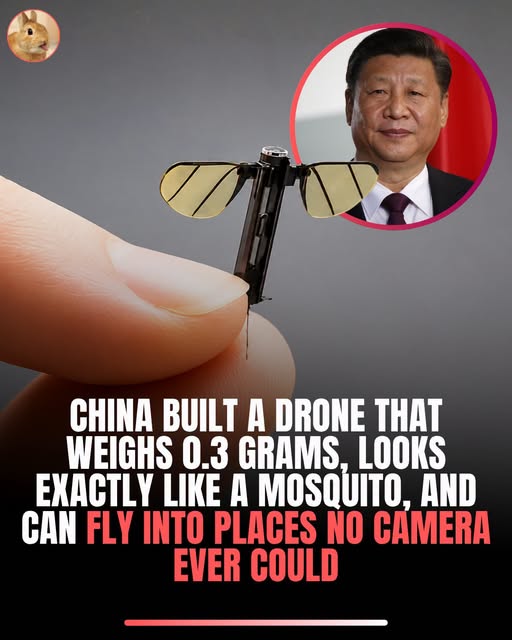
The device weighs only 0.3 grams and has been designed to resemble a mosquito, allowing it to rest between two fingertips while carrying technology that until recently would have seemed impossible at such a small scale.
Its unveiling has highlighted the rapid progress of drone engineering and intensified debate over what could happen when surveillance systems become so small that most people would never realize they were nearby.
Military drones have already transformed modern conflict by supporting reconnaissance, precision strikes, battlefield monitoring, and intelligence collection.
The newest development suggests that the next stage of that transformation may involve aircraft that are no longer immediately recognizable as machines.
Researchers Push Drone Miniaturization Further
The mosquito-like drone was created by engineers at China’s National University of Defence Technology.
Its design reflects a broader effort to reduce unmanned aerial systems to a scale where they can move through spaces that would be difficult or impossible for conventional drones to enter.
Traditional military and commercial drones are usually visible, audible, or both.
Even relatively small models can attract attention because of their propellers, movement, shape, and mechanical noise.
The new Chinese device takes a different approach by imitating an insect that people are accustomed to seeing in ordinary environments.
Instead of attempting to hide through paint, altitude, or complex camouflage, it relies primarily on its size and appearance.
That could allow it to blend into surroundings in a way that larger aircraft cannot.
The Drone Is Demonstrated on Chinese Television
The tiny aircraft was publicly shown on Chinese state television by student researcher Liang Hexiang.
During the demonstration, he held the device carefully between his fingers, making its extremely small dimensions immediately clear.
“Here in my hand is a mosquito-like type of robot. Miniature bionic robots like this one are especially suited to information reconnaissance and special missions on the battlefield,” Liang said while showcasing the drone.
The machine’s insect-like appearance was one of the most noticeable parts of the presentation.
Its body is narrow, while its wings and legs resemble the delicate structure of a small flying insect.
The resemblance is intentional rather than decorative.
By copying familiar natural forms, the designers aim to reduce the chance that the drone will be recognized as a surveillance platform.
Why Its Appearance Matters
A machine that resembles a mosquito could potentially move through homes, offices, military facilities, urban areas, and other sensitive locations without immediately being identified.
People might ignore it, mistake it for a real insect, or fail to see it altogether.
That makes appearance an important part of the drone’s function.
In conventional systems, engineers often focus on stronger motors, better cameras, longer range, or more durable construction.
With insect-scale aircraft, the challenge is different.
The goal is to remain useful while becoming so small and visually ordinary that detection becomes far more difficult.
The mosquito design provides a glimpse of how future drones might rely on biological imitation to enter spaces discreetly.
Tiny Size Is the Main Strategic Advantage
The drone’s greatest strength is not speed or firepower, but its ability to disappear into an environment.
Large unmanned aircraft can be tracked by radar, heard from a distance, or seen clearly in the sky.
Smaller commercial drones are harder to detect, but they still often make a noticeable buzzing sound and remain visually distinct.
A 0.3-gram flying robot changes that balance.
Its presence could be overlooked even at close range, particularly in places where insects are common.
This could make it valuable for gathering information in crowded, confined, or highly monitored environments.
Rather than flying high above a target, the device could potentially operate near walls, ceilings, doorways, windows, or narrow gaps.
Potential Use in Battlefield Reconnaissance
The drone has been presented as a system suited to intelligence collection and special battlefield missions.
In military settings, information often determines whether an operation succeeds or fails.
Soldiers may need to know what lies beyond a wall, inside a building, or around a corner before moving forward.
A miniature flying machine could provide that information without requiring a person to enter a dangerous area.
It could also reduce the likelihood that opposing forces notice they are being observed.
Larger reconnaissance drones may reveal that surveillance is underway, while an insect-sized device could remain hidden during the same task.
This possibility helps explain why military researchers in several countries are investing heavily in micro-drone technology.
Confined Spaces Could Become Accessible
Many environments are unsuitable for traditional drones because of limited room, obstacles, or the risk of collision.
Narrow corridors, damaged buildings, ventilation spaces, tunnels, and crowded interiors can all restrict the movement of larger aircraft.
A drone modeled after a mosquito could potentially pass through very small openings.
That ability could allow it to enter locations that currently require stationary cameras, human inspection, or larger robotic systems.
Its small frame may also make it easier to perch on a surface rather than remain constantly airborne.
Landing or resting could conserve energy while allowing sensors to continue collecting information.
Possible Search-and-Rescue Applications
Although the drone has drawn attention for its military potential, similar technology could also be useful in emergency response.
Search-and-rescue teams often work in unstable buildings, disaster zones, collapsed structures, and other dangerous environments.
Entering those areas can place rescuers at serious risk.
A miniature aircraft could potentially move through cracks or openings to search for trapped survivors.
It might also provide information about conditions before rescue workers enter.
Even limited visual or environmental data could help teams understand whether an area is safe, where a person may be located, or which path offers the best access.
The same small size that makes the device difficult to detect in military operations could make it valuable in locations where larger equipment cannot fit.
Shrinking a Drone Is a Major Engineering Challenge
Creating a drone this small requires far more than reducing the dimensions of an existing aircraft.
Every component must be redesigned to operate at an extremely low weight.
Power systems, controls, communication equipment, sensors, structural materials, and flight mechanisms all need to function inside a body smaller than many everyday objects.
At the same time, the completed machine must remain light enough to fly.
Adding even a small amount of weight can affect lift, stability, and battery performance.
This creates a difficult balance between capability and size.
Engineers must decide which functions are essential and how to include them without making the aircraft too heavy.
How the Mosquito-Like Drone Flies
The aircraft uses two leaf-shaped wings that flap rapidly to produce lift.
This method imitates the movement of insects more closely than the spinning propellers used on most familiar drones.
Three extremely thin legs extend from the body.
Those legs may help the machine land, balance, or rest on surfaces when it is not flying.
The exterior appears simple because of its tiny dimensions, but the internal design is likely far more complicated.
Flight at such a small scale requires precise control because minor changes in air movement can have a major effect.
The drone must remain stable while its wings move rapidly and while its limited power supply supports both flight and onboard systems.
Battery Life and Range Remain Difficult Problems
Miniaturization offers important advantages, but it also creates serious limitations.
Smaller aircraft have less space for batteries, which can reduce flight time and operational distance.
Any battery light enough for a 0.3-gram drone must provide power without overwhelming the aircraft’s lifting capability.
This means energy use must be controlled carefully.
Communication systems and sensors also consume power, making endurance one of the most difficult challenges.
A drone may be able to fly discreetly, but its usefulness depends on how long it can remain active and how far it can travel.
Future development will likely focus on improving efficiency while preserving the machine’s extremely small size.
Weather and Air Movement Create Additional Risks
Environmental conditions have a much greater effect on aircraft at this scale.
A light breeze that would barely influence a conventional drone could push a mosquito-sized machine off course.
Rain, dust, temperature changes, and indoor air currents may also interfere with stable flight.
These conditions could limit when and where the drone can be used effectively.
Its delicate wings and legs may also require protection from impact or damage.
Engineers must therefore design not only for flight, but also for durability under difficult operating conditions.
China Is Part of a Wider International Race
China is not the only country developing miniature unmanned aircraft.
Governments, universities, and defense researchers around the world have spent years working on smaller drones for surveillance, military operations, and scientific research.
The Chinese mosquito-like design is notable because of its extremely low weight and insect appearance, but it belongs to a much broader technological competition.
As components become smaller and more efficient, more countries are exploring systems that can operate quietly and discreetly.
The race is not simply about building the smallest device.
It is also about creating a machine that can remain stable, transmit useful information, and function reliably in real environments.
The Black Hornet Already Serves NATO Forces
Norway’s Black Hornet reconnaissance drone is one of the best-known micro-drone systems already in military use.
It is larger than the newly revealed Chinese mosquito drone, but still compact enough to fit in the palm of a hand.
NATO forces use the Black Hornet to provide soldiers with real-time surveillance.
Its small size allows troops to observe nearby areas without exposing themselves directly.
The platform demonstrates that micro-drones can move beyond laboratory experiments and become practical battlefield tools.
The Chinese design pushes the same concept to a far smaller scale.
Harvard’s RoboBee Shows Another Path
Researchers at Harvard University have developed RoboBee, an experimental flying robot inspired by bees.
The project has demonstrated capabilities such as hovering, landing, and moving between water and air.
RoboBee reflects the growing interest in using insect movement as a model for robotic flight.
Natural insects are extremely efficient at navigating complex spaces, maintaining balance, and adjusting to sudden changes.
Engineers study those abilities to create machines that can reproduce similar movement.
The Chinese mosquito-like drone follows the same general principle of borrowing from nature to solve technical challenges.
United States Military Research Continues
The United States Air Force has also discussed work involving insect-sized unmanned aircraft.
Relatively few details have been released publicly, but the acknowledged interest confirms that this field has major strategic importance.
Small drones could support surveillance, communication, target observation, and other missions where larger systems would be too obvious.
The limited public information also reflects the sensitive nature of the technology.
Devices designed to avoid detection are likely to be developed under strict secrecy, particularly when intended for military use.
Privacy Concerns Are Difficult to Ignore
The engineering achievement behind a 0.3-gram flying machine is remarkable, but its stealth also creates serious concerns.
A device that looks like an ordinary insect could potentially carry a camera, microphone, or other sensor into places where people expect privacy.
Unlike visible surveillance systems, an insect-like drone might operate without anyone knowing it was present.
This possibility raises questions about homes, workplaces, meetings, hospitals, schools, and other private or sensitive environments.
The smaller these systems become, the harder it may be for individuals to recognize or avoid them.
Detection Could Become a Major Challenge
Existing security systems are often designed to identify larger aircraft, electronic transmissions, or obvious recording devices.
A mosquito-sized drone may not fit those traditional detection methods.
Its tiny body could be difficult to see on cameras or distinguish from insects.
Its low power requirements may also reduce the strength of signals that security equipment can identify.
This creates a new challenge for governments, businesses, and individuals seeking to protect restricted spaces.
As the technology develops, new systems may be needed to detect movement, sound, heat, or communication patterns associated with micro-drones.
The Line Between Innovation and Intrusion
Miniature drones could provide important benefits in rescue operations, scientific research, dangerous inspections, and military reconnaissance.
At the same time, their ability to enter spaces unnoticed makes misuse a serious possibility.
The same design that could help locate a survivor inside a collapsed structure could also be used to observe someone without consent.
This dual-use nature makes the technology difficult to evaluate in simple terms.
Its value depends heavily on who controls it, where it is deployed, and what information it is designed to collect.
A Glimpse of a Future Filled With Invisible Machines
The mosquito-like drone represents more than a single engineering experiment.
It shows how quickly robotics, sensor technology, and unmanned flight are moving toward devices that can blend into ordinary surroundings.
Future machines may resemble flies, bees, birds, or other natural creatures.
As those designs improve, the difference between living insects and robotic systems could become increasingly difficult to recognize.
That future may bring new tools for lifesaving missions and dangerous work.
It may also create an environment where surveillance is no longer visible, obvious, or easy to escape.
The 0.3-gram drone unveiled in China demonstrates that this possibility is no longer limited to science fiction.
It is becoming a real technological challenge with military, civilian, ethical, and privacy consequences that are likely to grow as the machines become smaller and more capable.