
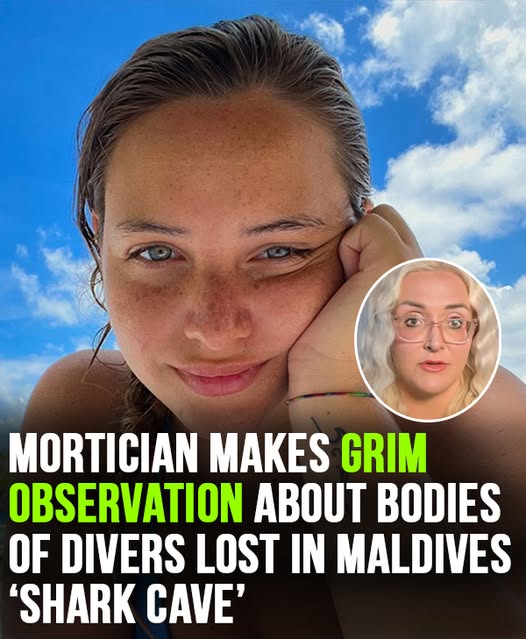
Mortician Explains What May Have Happened to Bodies of Divers Trapped in Maldives Cave Tragedy
The deaths of five Italian divers inside an underwater cave system in the Maldives have shocked people around the world.
The tragedy unfolded in a cave located at least 60 feet below the surface, where the divers became trapped during what turned into a devastating and fatal incident.
As investigators continue working to determine exactly what went wrong, new attention has turned to the difficult recovery effort and the conditions the victims’ bodies may have experienced while underwater for several days.
A mortician and online creator known as Lauren the Mortician has now explained how warm tropical salt water, cave depth, equipment, pressure, and decomposition may have affected the bodies after the divers died.
Five Divers Killed in Maldives Cave
The victims were identified as 52-year-old marine biologist Monica Montefalcone, her 22-year-old daughter Giorgia Sommacal, marine biologist Federico Gualtieri, 31, researcher Muriel Oddenino, 31, and diving instructor and boat captain Gianluca Benedetti.
The group died inside the underwater cave system, leaving families, colleagues, and the wider diving community grieving.
The tragedy was made even more painful by the fact that the rescue operation also claimed another life.
A member of the Maldives National Defence Force search-and-rescue team died during operations connected to the incident.
The loss of the rescuer highlighted how dangerous the environment remained even after the original dive had ended in disaster.
Underwater cave recovery operations can be highly complex, particularly when visibility, depth, equipment, and confined passages are involved.
Bodies Returned to Italy
Four of the victims’ bodies were flown back to Milan on May 23.
Italian prosecutors are continuing a manslaughter investigation as authorities work to reconstruct the events that led to the deaths.
The investigation is expected to examine what happened inside the cave, how the divers became trapped, and whether any preventable factors contributed to the tragedy.
Questions remain about the conditions inside the cave system and the sequence of events that caused the group to fail to surface.
As the legal and investigative process continues, public attention has also focused on the recovery itself.
The details surrounding the location and condition of the bodies have led many people to wonder what happens when someone dies underwater and remains there for several days.
Mortician Shares Explanation
Mortician and online creator Lauren, known as Lauren the Mortician, discussed the tragedy from a mortuary science perspective.
She explained that bodies remaining underwater for nearly a week, especially in warm tropical salt water, undergo significant physical changes.
“From a mortuary science perspective, a week underwater is a long time, especially in warm tropical salt water, because decomposition does not stop underwater. It just changes,” she said.
Her explanation focused on how the underwater environment affects decomposition differently from conditions on land.
Many people imagine that bodies immediately float after death, especially in dramatic underwater settings, but Lauren said the reality is more complicated.
Several factors can influence whether a body initially sinks, later rises, or remains in a particular position within a cave system.
Why Bodies May Sink First
Lauren explained that many bodies sink at first after death, particularly in the case of divers.
Divers are often wearing heavy equipment, including tanks, weight systems, wetsuits, and other gear designed to help control movement and buoyancy underwater.
“Most bodies actually sink at first, especially divers because they’re wearing heavy tanks, weight systems, wet suits, gear, and equipment specifically designed to help control buoyancy underwater.”
This equipment can significantly influence what happens to a body after death.
A diver’s gear is not incidental. It is designed to affect how the body behaves underwater while the person is alive and actively controlling movement.
After death, however, that same equipment can continue influencing the body’s position, movement, and buoyancy.
In a cave setting, those factors can become even more complicated because the environment is confined and shaped by rock ceilings, floors, passages, and limited water movement.
How Decomposition Changes Buoyancy
As decomposition progresses, bacteria inside the body naturally produce gases.
Over time, those gases can build up and change buoyancy.
This is one reason a body that initially sinks may later begin to rise or float, depending on conditions.
However, Lauren explained that underwater decomposition does not behave exactly like decomposition in open air.
The surrounding environment matters greatly.
Temperature, pressure, salinity, depth, clothing, equipment, body position, and trapped air can all influence what happens.
In warm tropical salt water, decomposition continues, but the way gases accumulate and affect buoyancy can vary widely.
That variation may help explain why the victims’ bodies were not all found in the same position inside the cave.
The Role of Depth and Pressure
Lauren said the depth of the cave was a major factor in the physical changes after death.
At roughly 165 feet, water pressure is intense.
That pressure can compress gases inside the body, which may delay the bloating and floating that people often associate with decomposition.
In other words, even if decomposition gases begin forming, the surrounding pressure at that depth can affect how quickly those gases expand and change the body’s buoyancy.
This makes underwater death at significant depth different from situations in shallower water.
The cave’s depth, combined with the divers’ gear and the time spent underwater, created conditions that could cause bodies to behave differently from one another.
Lauren emphasized that the process is not uniform and can vary dramatically depending on many small details.
A Recovery Detail Stands Out
One detail from the recovery operation stood out to Lauren.
“One of the divers was found floating against the roof of the cave while the other three were found lower toward the cave floor.”
At first, that difference might seem confusing to people unfamiliar with underwater recovery.
However, Lauren said it is scientifically plausible.
The fact that one body was found higher against the cave roof while others remained lower does not necessarily mean the victims experienced entirely different circumstances.
Instead, it may reflect how individual body composition, equipment, trapped air, decomposition gases, and positioning can vary from one diver to another.
Even inside the same cave, each person’s body may respond differently after death.
Why Bodies Behave Differently Underwater
Lauren explained that underwater buoyancy after death can be influenced by many variables.
These include body composition, residual trapped air inside equipment, gases produced through decomposition, the position of the body, currents, weights, and small differences in gear setup.
“Underwater buoyancy after death can dramatically vary depending on your body composition, how much residual trapped air you have inside your equipment, your own bodily decomposition gases, the positioning of the body, currents, weights, and even tiny differences in their gear setup.”
Those factors help explain why divers who entered the same cave system together may not have been found in identical positions days later.
One diver may have had slightly more trapped air in equipment. Another may have had a different weight setup. Another may have been positioned in a way that affected how gases accumulated or how the body moved.
In a confined underwater cave, even small differences can matter.
Six Days Underwater
Lauren said that because of these variables, the divers’ bodies likely behaved very differently during the six days they remained underwater.
The time period is important because decomposition does not pause simply because a body is submerged.
Instead, the process continues under different environmental conditions.
Warm tropical salt water adds another layer to the situation, because temperature can influence decomposition.
At the same time, depth and pressure can delay or alter some of the physical effects people might expect to see.
This combination makes the recovery details difficult for the public to interpret without specialized knowledge.
Lauren’s comments helped explain why the bodies may have been found in different locations or positions within the same cave system.
The Complexity of Underwater Cave Recovery
Recovering bodies from an underwater cave is extremely challenging.
Divers involved in recovery efforts must navigate the same dangerous environment where the original victims died.
They may face limited visibility, narrow passages, depth-related risks, equipment challenges, and emotional pressure from the urgency of the mission.
The fact that a Maldives National Defence Force search-and-rescue member also died during operations connected to the incident shows the severity of the risk.
Recovery teams must work carefully because moving through underwater caves can be dangerous even for trained professionals.
The tragedy therefore involved not only the loss of the five Italian divers, but also the loss of a rescuer who was part of the effort to bring them back.
Questions Continue Around the Tragedy
The deaths have raised many questions about what happened inside the cave.
Investigators are working to determine how the group became trapped and what factors may have contributed to the fatal outcome.
The manslaughter investigation in Italy suggests that authorities are examining whether any responsibility may be assigned in connection with the dive.
At the same time, public discussion has focused on the technical and physical realities of the accident.
People want to understand how experienced divers could die in such a setting, why the recovery was so difficult, and what the condition of the bodies may reveal about the final circumstances.
Lauren’s explanation addresses only the mortuary science aspect, not the full cause of the incident.
Remembering the Victims
The five victims came from scientific, research, and diving backgrounds.
Monica Montefalcone was a marine biologist, and her daughter Giorgia Sommacal was only 22 years old.
Federico Gualtieri, 31, was also a marine biologist, while Muriel Oddenino, 31, was a researcher.
Gianluca Benedetti was a diving instructor and boat captain.
The loss of people connected to marine science, research, and diving has made the tragedy especially painful for communities that value the ocean and understand both its beauty and danger.
The deaths have also reminded many people that even skilled individuals can face overwhelming risk in underwater environments.
A Tragedy With Lasting Impact
The Maldives cave tragedy continues to resonate because it combines beauty, danger, expertise, and sudden loss.
An underwater cave can appear fascinating and mysterious, but it can also become deadly when conditions change or something goes wrong.
The divers’ deaths have now become the subject of investigations, recovery analysis, and public grief.
The return of four bodies to Milan on May 23 marked an important step for families seeking to mourn their loved ones properly.
Yet many questions remain unanswered.
Authorities are still working to understand the sequence of events inside the cave, while experts and commentators continue explaining the risks and realities of what happened afterward.
Mortuary Science Offers One Piece of the Picture
Lauren’s explanation offered insight into what may have happened after the divers died, but it does not answer every question about the tragedy.
Her comments focused on decomposition, buoyancy, depth pressure, gear, and why bodies may behave differently underwater.
Those details help explain why one diver could be found floating near the cave roof while others remained closer to the floor.
They also show why assumptions based on movies or dramatic imagery often do not match reality.
Underwater decomposition is complex. It depends on conditions that may vary even within the same environment.
In the Maldives cave, warm tropical salt water, significant depth, diving equipment, trapped air, weights, and decomposition gases all may have played roles in what recovery teams found.
Investigation Still Underway
The heartbreaking incident remains under investigation as authorities continue working to determine exactly what went wrong.
The manslaughter inquiry in Italy adds legal seriousness to the case, while the recovery details have deepened public interest in the physical realities of the tragedy.
For the families of the victims, the scientific explanations cannot reduce the pain of loss.
For the diving community, the case is another reminder of how unforgiving underwater cave environments can be.
For the public, Lauren’s explanation has provided a clearer understanding of why the bodies may have been affected differently after days spent underwater.
The Maldives cave tragedy remains a devastating event, marked by the deaths of five Italian divers and a rescuer who also lost his life during the recovery operation.
As investigators continue their work, the story stands as a sobering reminder of the dangers hidden beneath even the most beautiful waters.