
New Images Reveal Underwater Cave Where Five Italian Divers Died in Maldives Tragedy
New images from inside an underwater cave in the Maldives have revealed the dangerous conditions surrounding a diving tragedy that claimed the lives of five Italian divers.
The photographs show parts of the cave system where the group died after failing to surface from a dive. Investigators are continuing to examine the circumstances of the incident, while Italian prosecutors pursue a manslaughter investigation connected to the deaths.
The tragedy has drawn international attention because of the number of victims, the difficult recovery operation, and the questions now being raised about safety, equipment, depth limits, and decisions made before the dive began.
Five Italian Divers Lost Their Lives
The incident unfolded in an underwater cave located at least 60 feet below the surface in the Maldives.
The five victims were identified as 52-year-old marine biologist Monica Montefalcone, her 22-year-old daughter Giorgia Sommacal, marine biologist Federico Gualtieri, 31, researcher Muriel Oddenino, 31, and diving instructor and boat captain Gianluca Benedetti.
The group was reported missing after they failed to return to the surface from the dive.
Four of the victims’ bodies were later repatriated to Milan on Saturday, May 23, as legal authorities continued looking into the case.
The deaths have left families, colleagues, and the diving community grieving while investigators work to understand how a recreational excursion turned fatal inside a cave environment.
First Images From Inside the Cave
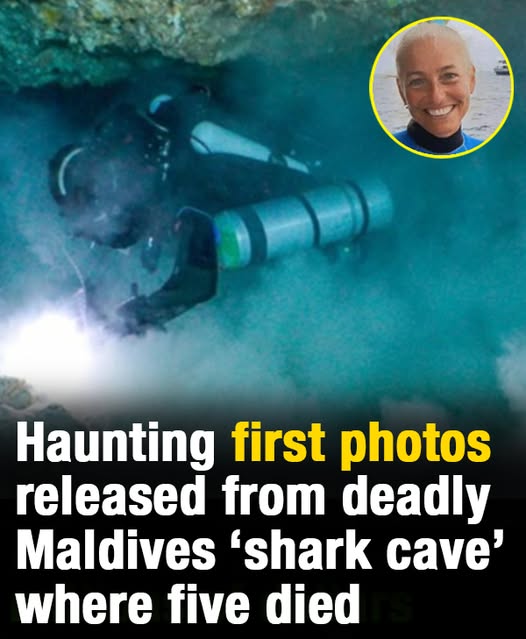
The first images taken inside the cave have now been released, offering a closer look at the underwater setting where the tragedy occurred.
The photographs were captured by Finnish recovery diver Sami Paakkarinen, who took part in the search for the victims.
The images are being described as haunting because they show the confined and hazardous environment the divers were navigating before they died.
Some of the photographs were taken close to the cave entrance, where sunlight could still be seen filtering through the water.
Other images show deeper sections of the cave system, where visibility appears far more limited and conditions become more difficult to manage.
Recovery Diver Describes the Situation
Paakkarinen, who helped with the recovery mission, explained that underwater caves can become deadly very quickly when something goes wrong.
He said the divers were only around 15 minutes from reaching the surface when disaster struck.
“Unfortunately, in most cave diving accidents, the main cause is always human error,” Paakkarinen said.
His comments have become a key part of the discussion around the tragedy because they point to the risks of cave diving and the importance of proper planning, equipment, and training.
Cave diving is considered especially dangerous because divers cannot simply ascend directly to the surface if they become disoriented, run low on air, or experience panic.
Instead, they must find their way back through the cave system, often under low visibility and intense pressure.
Where Benedetti Was Found
The first photographs from near the cave entrance are particularly important because this is reportedly where Gianluca Benedetti was found.
He had become separated from the rest of the group.
Investigators believe he may have tried to escape from the cave but ran out of air near the mouth of the passage.
That detail has added to the emotional weight of the case, suggesting that at least one member of the group may have been close to reaching the way out.
The fact that Benedetti was found apart from the others may also be significant for investigators trying to reconstruct the final moments of the dive.
His role as both a diving instructor and boat captain has made the circumstances of his death an especially important part of the ongoing inquiry.
Visibility May Have Collapsed Inside the Cave
The second set of images reveals conditions deeper inside the cave, where visibility becomes much worse.
Paakkarinen explained that in underwater cave environments, even small movements can create serious danger.
A diver’s fins can stir up sediment from the floor of the cave. Once that sediment rises into the water, it can cloud the surrounding area and make it nearly impossible to see.
In a cave, this can become life-threatening within seconds.
If visibility collapses, divers may lose sight of their surroundings, their direction of travel, and even one another.
Investigators believe sediment may have played a role in causing the group to become disoriented.
The Risk of Disorientation
Disorientation inside an underwater cave is one of the most serious dangers divers can face.
Unlike open-water diving, cave diving requires a diver to navigate through a confined space where the exit may not be visible.
If the water becomes cloudy, even experienced divers can lose track of direction. A passage that seemed clear moments earlier can suddenly become confusing and dangerous.
In such conditions, panic can make the situation worse. Air supplies can be consumed more quickly, communication becomes harder, and separation from other divers becomes more likely.
The new photographs showing the darker and more obscured areas of the cave help explain why the recovery diver described the environment as dangerous.
The images also support concerns that the group may have struggled to find their way out after visibility deteriorated.
Questions About Equipment
Paakkarinen also raised concerns about the equipment found with the victims.
He said the divers did not appear to have been using gear suited for underwater cave exploration.
“The equipment we found them with wasn’t optimal, they weren’t using underwater caving gear,” he said.
That statement has become one of the most serious elements in the discussion about what may have gone wrong.
Cave diving requires specialized preparation because the environment is far less forgiving than ordinary recreational diving.
Equipment choices can determine whether divers are able to navigate safely, manage emergencies, and find the exit if visibility is reduced.
The Missing Safety Line
One piece of equipment now being discussed is a diving reel or guide rope.
Paakkarinen said the lack of a safety line may have played a critical role in the tragedy.
“In general, for those who visit caves, it’s known that it’s not very wise to do so without a safety line.”
A safety line can guide divers back toward the entrance if visibility becomes poor or if they become disoriented.
Without one, a diver inside a cave may have no reliable way to retrace the route back out.
If sediment was stirred up and the group had no guide rope, the cave could have become a maze where finding the exit was extremely difficult.
Legal Questions Continue
Italian prosecutors are continuing a manslaughter investigation into the deaths.
The investigation is expected to examine the decisions made before the dive, the role of the excursion operator, the equipment used, and whether safety rules were followed.
The Italian company that sold trips aboard the yacht involved in the excursion has said the operator allegedly did not know the group intended to exceed the legal recreational diving depth limit.
The company also said the dive would not have been permitted if those plans had been known.
That statement places the planned depth and nature of the dive at the center of the inquiry.
Investigators must now determine who knew what before the group entered the water and whether the dive should have been allowed to proceed.
Licence Suspended During Investigation
Maldivian authorities have indefinitely suspended the operating licence of the Duke of York liveaboard while the investigation continues.
The suspension signals the seriousness of the case and the need for officials to review the circumstances surrounding the excursion.
Liveaboard diving trips often involve remote locations, multiple dives, and reliance on operators to manage safety procedures.
When a fatal incident occurs, authorities typically examine everything from planning and briefing to equipment checks and emergency response.
In this case, the deaths of five divers have placed the operation under intense scrutiny.
The licence suspension remains in place as authorities continue assessing responsibility and safety failures.
Recovery Mission Brings Another Death
The tragedy deepened further during the recovery mission.
A member of the Maldives National Defence Force search-and-rescue team died during diving operations connected to the incident.
That death added another layer of grief to an already devastating event.
Recovery operations in underwater caves can be extremely dangerous, even for trained professionals.
Search-and-rescue divers must enter the same hazardous environment where the original accident occurred, often under difficult visibility and emotional pressure.
The death of a rescuer highlights how dangerous the cave remained even after the victims had already been located.
A Cave Known for Danger
The underwater site has been described as a so-called “shark cave.”
While the name itself draws attention, the deeper concern in this tragedy appears to involve cave conditions, visibility, equipment, and navigation.
The released photographs show an environment that could quickly become difficult to escape if a problem occurred.
The cave entrance, where light was still visible, appears far less threatening than the darker passages deeper inside.
That contrast matters because a cave can seem manageable at first, only to become dangerous once divers move farther from the exit.
The images now give investigators and the public a clearer sense of the conditions the victims faced.
Human Error Under Review
Paakkarinen’s statement that most cave diving accidents involve human error is likely to remain significant as the investigation continues.
Human error can include many possible factors, such as entering an environment without proper equipment, misjudging conditions, losing orientation, exceeding planned limits, or failing to use safety lines.
It does not necessarily point to one single mistake. Instead, fatal diving accidents often involve a chain of decisions and conditions that combine into disaster.
In this case, investigators are examining whether the group had the proper cave-diving gear, whether a guide line was used, whether the legal recreational diving depth limit was exceeded, and whether the operator had full knowledge of the dive plan.
The answers may determine whether criminal responsibility is assigned.
They may also influence future safety rules for similar excursions.
A Community in Mourning
The five Italian victims included scientists, researchers, a young woman, and an experienced diving professional.
Their deaths have created grief across families, friends, colleagues, and the wider diving community.
Monica Montefalcone and her daughter Giorgia Sommacal died together in the tragedy.
Federico Gualtieri and Muriel Oddenino were both in their early thirties and connected to scientific and research work.
Gianluca Benedetti’s death has drawn particular focus because of his experience as a diving instructor and boat captain.
Together, their deaths have turned the Maldives cave incident into one of the most devastating diving tragedies connected to the area.
Images Add Clarity to the Investigation
The newly released photographs do not answer every question, but they provide important visual context.
They show the entrance area where light could still be seen and where Benedetti was reportedly found.
They also show deeper areas where visibility becomes dramatically reduced.
Those images help explain why sediment, disorientation, and lack of a safety line are being discussed as possible contributing factors.
They also show why cave diving requires specialized preparation and equipment.
For investigators, the images may help reconstruct the route taken by the group and the conditions they encountered before they failed to surface.
The Investigation Remains Ongoing
The deaths of the five Italian divers remain under investigation, with Italian prosecutors examining the case as a manslaughter inquiry.
Authorities in the Maldives have also taken action by suspending the operating licence of the liveaboard connected to the trip.
The central questions remain unresolved. Investigators must determine whether safety procedures were followed, whether the dive plan exceeded legal limits, and whether the divers entered the cave with appropriate equipment.
The role of visibility, sediment disturbance, air supply, separation, and missing guide equipment will also remain part of the inquiry.
The recovery diver’s account has brought attention to the dangers inside the cave, while the released images have shown the environment where the tragedy unfolded.
For now, the underwater cave remains at the center of a painful investigation into how five lives were lost during what should have been a controlled diving excursion.