
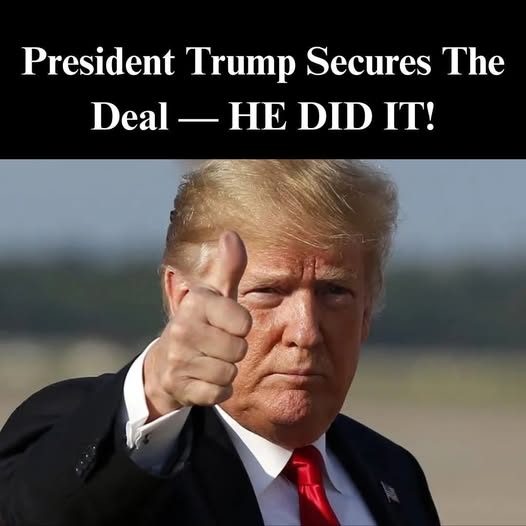
Trump Announces Arctic Negotiation Framework as Tariff Threat Against Europe Is Suspended
President Donald Trump has announced the creation of what he described as a “framework of a future deal” concerning Greenland and the broader Arctic region, signaling a sudden shift in a tense diplomatic standoff between the United States and several European nations.
The announcement, shared through Truth Social, followed a series of private discussions with NATO Secretary-General Mark Rutte during meetings connected to the World Economic Forum. The development marks a notable change in tone after days of escalating economic pressure directed at European governments.
The new framework temporarily halts planned tariffs that had threatened to deepen divisions between the United States and its allies. Trump described the emerging arrangement as one designed to benefit both the United States and NATO member states.
Tariff Threats Sparked Growing Trade Dispute
The negotiations follow a week of intense diplomatic friction that had raised fears of a wider transatlantic trade conflict. The administration had warned that eight European nations could face a 10 percent tariff on exports to the United States.
Officials indicated that the tariffs would increase to 25 percent by February 1 if European governments continued opposing American efforts to secure greater strategic control or acquisition rights involving Greenland, an autonomous territory under Danish authority.
The threat of economic penalties sent shockwaves through European capitals. Governments across the region viewed the measures as a form of economic pressure tied to territorial ambitions.
With the announcement of the Arctic negotiation framework, those tariff measures have now been paused. The suspension is intended to create space for further diplomatic discussions as the negotiations move forward.
The temporary reprieve has eased immediate concerns about a trade escalation that could have disrupted economic ties between the United States and Europe.
Arctic Issue Reframed as NATO Security Concern
The developing framework represents a shift in how the Greenland issue is being presented on the international stage. Rather than focusing on territorial acquisition, the discussion is now framed around broader security concerns in the Arctic region.
Trump stated that the framework extends beyond Greenland alone and includes strategic considerations across the entire Arctic.
“We have formed the framework of a future deal with respect to Greenland and, in fact, the entire Arctic Region,” Trump wrote.
He also emphasized that the arrangement would ultimately be “a great one.”
This reframing has helped ease tensions that had begun to strain relations within the Western alliance. European lawmakers had previously responded to the tariff threat by suspending work on a separate trade agreement between the United States and the European Union.
Members of the European Parliament argued that the tariff ultimatum violated existing trade commitments and described it as a form of territorial pressure.
By shifting the discussion toward NATO security and Arctic cooperation, the negotiations have opened a path for dialogue without abandoning the broader strategic goals associated with the region.
High-Level Team Assigned to Continue Negotiations
Although details of the proposed framework have not been publicly released, the discussions are moving into a new stage led by senior members of the administration.
Three prominent officials have been tasked with advancing the negotiations: Vice President JD Vance, Secretary of State Marco Rubio, and Special Envoy Steve Witkoff.
The group is expected to focus on technical aspects of the potential agreement, including security arrangements and infrastructure cooperation across the Arctic.
Their involvement signals the importance the administration places on securing a long-term strategic role in the region.
As the talks continue, the negotiators are expected to examine possible mechanisms for expanded cooperation between the United States, NATO allies, and regional partners.
Missile Defense Proposal at Center of Arctic Strategy
A major component of the negotiations revolves around a proposed missile defense initiative known as the “Golden Dome.”
The concept involves establishing a defensive system designed to span the Arctic region, creating a protective shield against potential missile threats.
The proposal reflects broader strategic calculations tied to the changing Arctic environment.
As polar ice continues to recede, new shipping routes and access to resources are transforming the region into a central arena for geopolitical competition.
Greenland’s geographic position makes it particularly valuable from a defense perspective. The island sits along key routes between North America, Europe, and Asia.
Its location provides strategic advantages for surveillance operations and early-warning defense systems.
For U.S. planners, Greenland is often viewed as a critical outpost capable of supporting long-term military and security infrastructure.
This strategic significance has played a central role in the renewed focus on Arctic defense planning.
NATO Role Raises Questions About Sovereignty
NATO Secretary-General Mark Rutte has served as the primary intermediary in the discussions with Washington, helping facilitate conversations aimed at reducing tensions.
His involvement has drawn attention from observers who note that NATO’s founding charter focuses on collective defense rather than territorial negotiations.
During comments to European media, Rutte stated that he was “committed to finding a way forward” in the discussions.
At the same time, he emphasized that Greenland’s political status under Danish sovereignty remained unchanged.
Rutte clarified that the question of sovereignty “did not come up” during the talks.
Instead, the discussions appear to focus on a security-centered approach that emphasizes defense cooperation and shared strategic interests.
This model allows NATO members to strengthen coordination in the Arctic without directly challenging Denmark’s authority over Greenland.
The approach also avoids crossing political boundaries that have historically made proposals for Greenland’s purchase controversial.
Concerns Raised in Greenland and Denmark
Despite the diplomatic progress described by Washington, officials in Greenland and Denmark have expressed reservations about the emerging framework.
Lawmakers and local leaders have voiced concerns that discussions about the territory’s future appear to be taking place without direct involvement from Greenland’s own representatives.
Critics argue that decisions affecting the region must involve both the Greenlandic government in Nuuk and Danish authorities in Copenhagen.
One Danish critic stated, “Any agreement concerning Greenland’s future requires the consent of both Nuuk and Copenhagen.”
The statement reflects broader concerns that negotiations conducted without local participation could undermine principles of self-determination.
Political leaders in the region have also emphasized that Greenland’s population must be involved in any discussions regarding long-term strategic arrangements.
These concerns highlight the complex political landscape surrounding the Arctic negotiations.
Economic and Resource Stakes in the Arctic
Beyond military considerations, the Arctic region holds significant economic importance due to its vast natural resources.
Greenland is believed to contain major reserves of rare-earth minerals and hydrocarbons that are vital for modern technologies.
These resources play a key role in industries ranging from electronics and renewable energy to defense manufacturing.
The increasing global demand for such materials has heightened international interest in Arctic development.
As a result, the region is becoming an important focal point in global competition for energy and critical minerals.
Supporters of the negotiations argue that securing access to these resources could strengthen economic stability and technological independence.
However, critics caution that aggressive geopolitical strategies could strain relationships with allies whose cooperation is necessary to maintain stability in the Arctic.
Market Reaction and Diplomatic Uncertainty
Financial markets reacted positively to news that the tariff measures would be suspended during the negotiation process.
U.S. stock indices recorded gains as investors interpreted the move as a sign that the immediate threat of a trade confrontation with Europe had eased.
The improved market sentiment reflects broader relief that economic tensions between the United States and its allies may be avoided.
However, the long-term outcome of the negotiations remains uncertain.
The current arrangement is widely described as a preliminary understanding rather than a finalized agreement.
Observers note that many of the most significant details have yet to be formalized.
The “Davos Framework” and Future Negotiations
The emerging agreement has been informally referred to as the “Davos Framework,” reflecting the setting where the discussions took place.
At this stage, the framework remains largely a verbal understanding among the parties involved.
Individuals familiar with the talks indicate that several potential elements are being explored as negotiations continue.
These include expanded access for U.S. and NATO forces to Greenland’s deep-water ports and increased cooperation related to natural resource development.
Another element under discussion involves restrictions intended to prevent rival powers from investing in Arctic infrastructure.
Such measures would aim to limit involvement by Moscow and Beijing in regional projects.
Military coordination is also expected to play a central role, including the possibility of larger NATO exercises across Arctic territories.
Uncertain Road Toward a Formal Agreement
As the negotiations move forward, Vice President JD Vance and Secretary of State Marco Rubio will play leading roles in shaping the next phase of discussions.
Their task will involve translating the current framework into a more concrete agreement that satisfies strategic goals while respecting international legal norms.
Diplomats and policymakers around the world are closely monitoring the talks as they evolve.
The immediate threat of tariffs has been removed for now, easing the pressure that had strained relations between the United States and Europe.
At the same time, the larger geopolitical contest for influence in the Arctic continues to grow.
The negotiations surrounding Greenland and the Arctic region represent only one part of a broader global shift toward competition in previously inaccessible areas.
Whether the current framework develops into a formal treaty remains uncertain, but the discussions have already reshaped the diplomatic landscape of the High North.
For now, the pause in economic confrontation offers an opportunity for diplomacy to proceed.
The long-term outcome will depend on whether the proposed framework can evolve into a lasting agreement that balances security interests, sovereignty concerns, and international cooperation.