
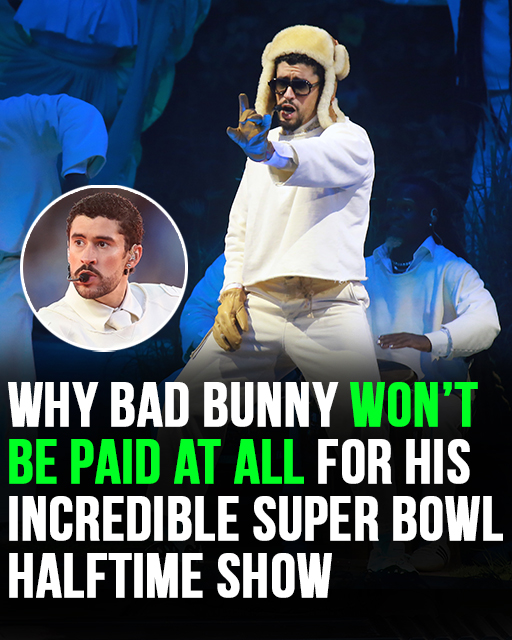
Why Bad Bunny Won’t Receive a Paycheck for His Super Bowl Halftime Performance
Bad Bunny delivered one of the most widely discussed Super Bowl halftime performances in recent memory, commanding global attention with a show that dominated conversation before, during, and after the game. Despite the massive scale of the event and the cultural impact of his appearance, the performance did not come with a personal paycheck.
For many viewers, the idea that an artist of his stature would step onto the most watched stage in sports without direct compensation seems counterintuitive. Yet this arrangement is not unique to Bad Bunny. It reflects a long-established structure that applies to every Super Bowl halftime headliner, regardless of fame or commercial success.
The halftime show is considered one of the most prestigious performance opportunities in entertainment, but it does not operate like a conventional paid engagement. Instead, it follows a different economic logic, one built around visibility rather than a performance fee.
The NFL’s Longstanding Halftime Compensation Model
Super Bowl halftime performers are not paid a salary or appearance fee by the NFL. This policy has remained consistent for decades and applies to all artists who accept the role of headliner.
Whether the performer is an emerging act or an established global superstar, the terms remain the same. There is no negotiation for personal payment tied to the appearance itself.
Rather than offering direct compensation, the NFL provides something less tangible but potentially more valuable: unparalleled exposure. While most artists push back against offers that substitute exposure for payment, the Super Bowl exists in a category of its own.
With tens of millions of viewers watching live and many more engaging through highlights, social media clips, and post-game analysis, the halftime show delivers a level of visibility that few other platforms can approach.
What the NFL Does Pay For
Although performers do not receive a personal fee, they are not expected to finance the show themselves. The NFL assumes responsibility for all production and travel-related expenses associated with the halftime performance.
This includes the cost of stage construction, lighting systems, sound engineering, choreography, rehearsals, transportation, and on-site logistics. The scope of these productions is enormous, requiring precision and coordination to assemble and dismantle the stage in a matter of minutes.
As a result, artists do not face out-of-pocket expenses when participating. Even elaborate, high-energy performances are fully supported by the league’s budget.
For Bad Bunny, this meant delivering a large-scale production without the financial burden that would normally accompany an event of this magnitude.
The Influence of Sponsorship on the Halftime Show
Sponsorship plays a central role in funding the Super Bowl halftime spectacle. Apple Music currently serves as the title sponsor, paying the NFL approximately $50 million per year as part of its agreement.
Within this framework, a substantial portion of funding is directed toward the performance itself. The production budget is reported to be around $15 million, allocated exclusively to execution rather than artist compensation.
This budget supports every visible and invisible element of the show. Set design, visual effects, dancers, backup performers, security teams, marketing coordination, and the labor required to build and remove the stage are all covered.
Despite the scale of this investment, none of the budget is designated as a salary or appearance fee for the headlining artist.
Why Artists Continue to Accept the Offer
Given the absence of direct payment, it is natural to question why artists agree to perform. The answer lies in the long-term benefits that typically follow a Super Bowl halftime appearance.
While the show is reserved for artists who have already achieved significant success, it often triggers another wave of public interest. In the days and weeks after the game, performers frequently see substantial increases in music streaming, album sales, merchandise purchases, and ticket demand.
The halftime show also solidifies an artist’s position as a global figure. Appearing in this slot places them within a small and exclusive group trusted with one of the most visible entertainment moments in the world.
For many performers, the opportunity functions less as a single event and more as a catalyst for sustained momentum.
Exposure at a Global Scale
The Super Bowl consistently ranks among the most watched broadcasts of the year. The halftime show, in particular, attracts viewers who may not otherwise engage with football.
This expanded audience includes casual viewers, international fans, and people drawn primarily by the entertainment component. As a result, the performer’s reach extends far beyond their existing fan base.
The impact does not end when the broadcast concludes. Performances are replayed, shared, analyzed, and debated across digital platforms for days or even weeks.
In effect, the halftime show becomes a multi-platform promotional event, generating sustained attention that continues long after the final whistle.
A Recent Illustration of the Halftime Effect
The commercial impact of a halftime performance is clearly demonstrated by recent history. Last year’s halftime show drew an audience of 133.5 million viewers, making it the most-watched halftime performance to date.
In the immediate aftermath, the artist involved experienced a significant surge in streaming activity across multiple platforms. Music consumption spiked as new listeners explored the catalog and longtime fans revisited previous releases.
This pattern has become increasingly familiar. Super Bowl halftime performers routinely see measurable boosts in engagement, reinforcing the strategic value of the appearance.
The scale of this effect helps explain why the opportunity remains attractive even without a direct performance fee.
Bad Bunny’s Momentum Before the Halftime Show
In Bad Bunny’s case, the benefits of Super Bowl exposure were already emerging before he took the stage. His recent Grammy wins generated renewed attention and heightened anticipation for his halftime performance.
Following the awards ceremony, online interest in his tour surged dramatically. Search activity related to his tour increased by 1,567 percent within a 24-hour period.
This spike occurred as excitement built around his upcoming Super Bowl appearance, illustrating how major cultural moments can amplify one another.
The halftime show, in this context, did not operate in isolation. It became part of a larger sequence of events that collectively expanded his visibility.
Social Media Growth and Long-Term Reach
The increased attention extended beyond music searches and streaming numbers. Bad Bunny’s social media presence also saw substantial growth during this period.
He gained more than 900,000 new followers on Instagram in a short timeframe, bringing his total following to over 50.9 million.
Growth at this scale enhances long-term earning potential by strengthening direct connections with fans. A larger audience supports touring, merchandise sales, collaborations, and future releases.
The Super Bowl halftime show accelerates this process by introducing the artist to viewers who may not actively follow music trends or award ceremonies.
Immediate Pay Versus Long-Term Value
The debate over halftime performer compensation ultimately comes down to perspective. While artists do not receive immediate payment, they gain access to a promotional platform that would be nearly impossible to purchase outright.
If approached as a traditional advertising opportunity, the cost of reaching such a massive audience would far exceed what most artists could afford.
By covering production expenses and guaranteeing a global audience, the NFL removes financial risk while maximizing exposure.
For established artists, this trade-off often aligns with broader career strategies, particularly when timed alongside tours, album releases, or major milestones.
The Weight of Prestige and Cultural Impact
Beyond financial considerations, performing the Super Bowl halftime show carries significant prestige. The invitation itself is widely viewed as a validation of an artist’s influence and reach.
The performance becomes part of the artist’s cultural legacy, frequently referenced in career retrospectives and public discussions.
For performers whose impact extends beyond music into fashion, culture, and identity, the halftime show holds symbolic importance that goes beyond monetary value.
It positions the artist within a historical continuum of performers who have shaped the event’s legacy.
An Ongoing Debate About Fairness
Despite its long history, the NFL’s approach to halftime performer compensation continues to spark debate.
Critics argue that artists who contribute immense value to the broadcast should receive direct payment, particularly given the enormous revenue generated by the Super Bowl.
Supporters of the current system counter that the exposure and long-term gains outweigh the absence of a performance fee.
They point to consistent post-show increases in sales, streams, and cultural relevance as evidence that the arrangement benefits performers.
Bad Bunny’s Performance in Perspective
Bad Bunny’s halftime appearance will likely be remembered for its energy, spectacle, and cultural significance.
It also serves as another example of how the Super Bowl operates outside traditional entertainment economics.
While he will not receive a check for the performance itself, the surge in attention, engagement, and fan interest surrounding the event may prove far more valuable over time.
In the world of the Super Bowl halftime show, compensation is measured less by what an artist earns that night and more by the momentum that follows. When the stadium lights dim and the broadcast ends, that momentum is often just beginning.
комплексное продвижение сайтов москва [url=https://dettka.com/kakimi-metrikami-izmerit-effektivnost-digital?strategii-dlya-stolichnogo-biznesa/]комплексное продвижение сайтов москва[/url] .
интернет агентство продвижение сайтов сео [url=https://morevokne.ru/?p=33900]интернет агентство продвижение сайтов сео[/url] .
профессиональное продвижение сайтов [url=https://in.gallerix.ru/journal/internet/201811/zakazat-raskrutku-sayta-v-moskve-kak-vybrat-nadezhnogo-podryadchika-bez-finansovyx-riskov/]профессиональное продвижение сайтов[/url] .
поисковое seo в москве [url=https://web-lesson.ru/prodvizhenie-sajta-agentstvo-moskva-kak-vybrat-gramotno-agentstvo/]поисковое seo в москве[/url] .
реферат нейросеть [url=https://nejroset-dlya-referatov-1.ru/]реферат нейросеть[/url] .
нейросеть студент бот [url=https://nejroset-dlya-referatov.ru/]нейросеть студент бот[/url] .
умная нейросеть для учебы [url=https://nejroset-dlya-referatov-1.ru/]nejroset-dlya-referatov-1.ru[/url] .
цветы на дом недорого заказать с доставкой [url=http://dostavka-cvetov-moskva495.ru]http://dostavka-cvetov-moskva495.ru[/url] .
букет цветов с доставкой по москве недорого курьером на дом [url=http://dostavka-cvetov-moskva495.ru/]http://dostavka-cvetov-moskva495.ru/[/url] .
ии для школьников и студентов [url=https://nejroset-dlya-referatov-9.ru/]ии для школьников и студентов[/url] .