
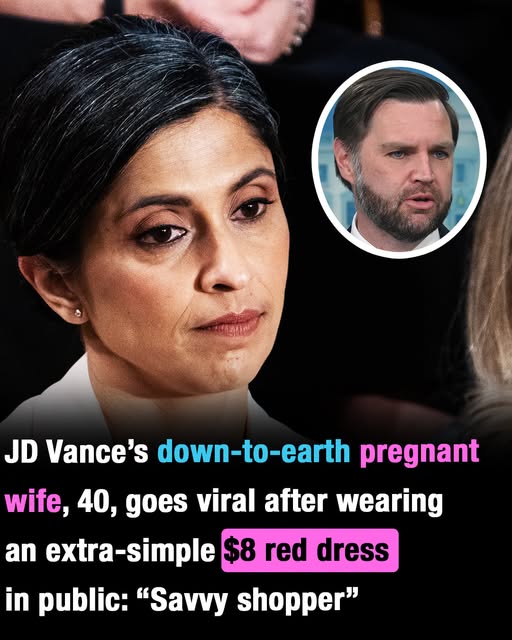
Usha Vance Responds After Coral Maternity Dress Becomes Focus of Political Debate
Usha Vance’s appearance in a Father’s Day edition of Storytime with the Second Lady drew attention for reasons that extended beyond the family-centered message of the video.
The segment, released on June 21, featured the second lady alongside Vice President JD Vance as the couple spoke warmly about family life while preparing for the arrival of their fourth child.
The conversation included lighthearted remarks about parenting, growing children, and the couple’s excitement over welcoming another baby. It also prompted public discussion about Usha’s maternity outfit after her fitted coral dress became the subject of political interpretation.
A Father’s Day Conversation About Family
During the Father’s Day edition of Storytime with the Second Lady, Usha Vance joined her husband in a setting designed around reading, parenting, and family connection.
At 40, Usha is expecting the couple’s fourth child. Her husband, Vice President JD Vance, is 41. Their exchange during the clip reflected the couple’s focus on their growing family and the coming return to life with a newborn.
Reflecting on the baby on the way, Usha told the vice president, “Luckily, there’s going to be a new baby for you to read to. So, you’re going to have many more years ahead of you.”
JD Vance answered with a smile and connected the moment to his own feelings about fatherhood. “That’s right. That’s why I so desperately wanted to have a fourth baby is because I was sick of my kids growing up and I was not yet ready to be out of the baby phase.”
The exchange presented a personal side of the vice president and second lady, centering on the ordinary rhythms of family life, children growing older, and the emotional attachment many parents feel toward the earliest years of raising a child.
The Father’s Day setting gave the conversation a relaxed tone, but attention soon shifted from the couple’s comments to the clothing Usha wore during the video.
The Coral Maternity Dress Draws Attention
In the clip, Usha wore a fitted coral maternity dress with a cowl neckline. The dress clearly showed her baby bump and appeared to be a simple, practical maternity choice for a public-facing family video.
What might otherwise have remained a brief wardrobe detail quickly became part of a larger discussion about image, pregnancy, and political messaging.
The dress became the focus of commentary after The New York Times examined the public pregnancies of several women connected to the current White House political environment.
The discussion centered on the idea that pregnancy, when presented visually in public life, can carry meaning even without formal speeches, policy announcements, or direct political statements.
The article, titled “The Politics and Power of the Pregnancy Image,” was written by chief fashion critic Vanessa Friedman. It connected the pregnancies of three “prominent women in the MAGA movement” to broader public messaging about family and fertility.
The women named in that discussion were Usha Vance, White House Press Secretary Karoline Leavitt, and Katie Miller, the wife of White House deputy chief of staff Stephen Miller.
Friedman wrote that the pregnancies of the three women “shows how much is said by an expectant silhouette, without anyone saying a word.”
Pregnancy, Public Image, and Political Meaning
The June 24 article argued that the visible pregnancies of Usha Vance, Karoline Leavitt, and Katie Miller formed a shared image that could be read within a political and cultural framework.
“Ever since Vance, Leavitt and Miller revealed their pregnancies, their public appearances have showcased their growing stomachs,” Friedman wrote.
She added that the appearances “offer an image of idealized womanhood that gives literal shape to the pronatalist movement.”
The argument placed pregnancy at the center of a conversation about political symbolism, suggesting that the appearance of expectant women in prominent public roles can reinforce messages about family, motherhood, and fertility.
Friedman also wrote, “Together, the women have created a notably consistent, and somewhat paradigm-shifting, picture of the White House’s family and fertility platform.”
That framing transformed Usha’s coral maternity dress from a clothing item into a point of debate over whether public pregnancy can function as a form of political communication.
In that interpretation, the dress was not only a garment worn during a Father’s Day video. It became a visible marker of a larger public image connected to family values, parenthood, and the vice president’s stated emphasis on having more children in the United States.
Usha Vance Previously Discussed Dressing for Public Life
Usha had already addressed the way her wardrobe changed after becoming second lady.
In March, she discussed the shift from a more casual pregnancy experience to one that now required a more polished public appearance.
“I have to dress up a lot more,” she told NBC News in March. “I enjoyed my last pregnancy – there were a lot of sweatpants. I was working from home and sometimes put a blazer on over what was under.”
Those comments highlighted a practical difference between private life and public office. A pregnancy that might once have unfolded largely at home, with casual clothing and limited visibility, now takes place under regular public attention.
For Usha, that meant dressing for official events, public appearances, and media-facing moments while also managing the physical realities of pregnancy.
Her remarks also suggested that the wardrobe expectations surrounding her role had become more formal than during her previous pregnancy. The demands of being second lady placed her clothing choices in front of a national audience, even when those choices were ordinary or inexpensive.
JD Vance’s Public Emphasis on Family
The broader conversation around Usha’s maternity image also connected to JD Vance’s public statements about family and children.
At the 2025 March for Life rally, the vice president declared, “I want more babies in the United States of America,” a line that became part of the discussion surrounding his family-centered political messaging.
Friedman connected that message to Usha’s visible pregnancy, arguing that her public appearances helped reinforce and personalize her husband’s views on family life.
Within that interpretation, Usha’s role was not only ceremonial. Her appearances also served to represent and humanize the vice president in the eyes of the public.
The pregnancy, made visible through her public wardrobe, became part of the couple’s shared image. Their family life, including the expectation of a fourth child, gave a personal dimension to the vice president’s public emphasis on children and parenthood.
Friedman wrote that Usha’s role “is also to represent and humanize the vice president.” She added that “By spotlighting her pregnancy, she is doing exactly that.”
She then pointed directly to the Father’s Day video and the coral dress, writing, “She is wearing a stretchy coral dress that hugs her stomach, making what she is talking about very clear.”
Usha Vance Responds With Humor
Usha did not allow the discussion to remain focused entirely on political symbolism.
Instead, she responded publicly with humor, revealing that the dress at the center of the debate was a low-cost maternity item from Old Navy.
Her June 24 post on X addressed the attention directly and undercut the idea that the outfit had been chosen as part of a carefully constructed political image.
“Now that we know the political significance of my $8.75 coral maternity dress from Old Navy, can’t wait to hear what the New York Times has to say about my elastic-waistband pants and compression socks!” she wrote.
The post appeared alongside an image of Usha wearing the coral dress during Storytime with the Second Lady.
Her response turned the conversation away from high-level political interpretation and back toward the everyday reality of maternity clothing. By emphasizing the price and retailer, she presented the outfit as practical rather than strategic.
The remark also introduced a note of sarcasm into the discussion, especially through her reference to elastic-waistband pants and compression socks, two items commonly associated with comfort during pregnancy.
The Dress Cost Less Than Nine Dollars
Usha followed her post by sharing the receipt for the maternity dress.
The receipt showed that the coral dress was originally priced at $44.99. It had later been discounted to $12.49.
After an additional coupon was applied, the final price came to $8.75.
That detail became central to her response because it sharply contrasted with the larger meaning that had been attached to the dress. A garment interpreted as a symbol of political and cultural messaging was, in practical terms, a deeply discounted maternity purchase.
The price also helped frame the dress as accessible and ordinary. Rather than an expensive designer look or a custom wardrobe decision, it was an affordable item from a widely known retail chain.
By sharing the receipt, Usha provided a direct answer to the speculation over her clothing choice. The document showed the financial reality behind the outfit and supported her point that the dress was not a grand fashion statement.
Old Navy Dress Sells Out
The attention surrounding the coral maternity dress produced an unexpected result.
After the Father’s Day video, the June 24 fashion discussion, and Usha’s response on X, the dress was no longer available on Old Navy’s website.
The item has since sold out.
The sellout added another layer to the story. A dress that entered public discussion as part of a debate over pregnancy, image, and politics ended by becoming a sought-after retail item.
The chain of events showed how quickly a small detail from a public appearance can move into a broader conversation. A Father’s Day video about reading to children and preparing for a new baby led to analysis of public pregnancy, a response from the second lady, and heightened interest in a discounted maternity dress.
For Usha Vance, the episode combined personal family news, public office, political commentary, and everyday maternity wear into a single viral moment.
Her response made clear that she viewed the attention with humor rather than seriousness. By pointing to the dress’s $8.75 price tag, she emphasized the practical side of her wardrobe choice and challenged the larger meaning assigned to it.
The discussion began with a family conversation about a fourth child and ended with a sold-out dress from Old Navy. In between, it became a public example of how pregnancy, clothing, and political identity can become intertwined when private family life unfolds in the national spotlight.