
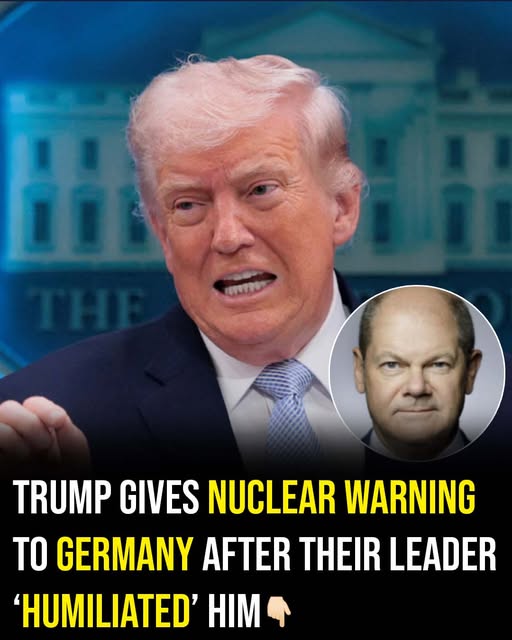
Donald Trump Rebukes Friedrich Merz After German Chancellor Says U.S. Has “No Strategy” on Iran
Trump and Merz Clash Over Iran Conflict
German Chancellor Friedrich Merz has drawn a forceful public response from Donald Trump after criticizing the United States’ handling of Iran and saying Washington appears to have “no strategy” in the conflict.
The exchange highlights growing tension between the United States and some of its European allies as the war with Iran continues to shape diplomatic relationships. Foreign leaders who previously relied on familiar methods to maintain favorable relations with Trump are now facing a more complicated political environment.
The conflict has created pressure abroad and at home for several governments. Leaders are being forced to weigh expectations from Washington against domestic political and economic concerns. In many cases, the priorities of their own voters are becoming harder to ignore.
Merz has generally supported Trump’s position on Iran. His government has allowed the United States full access to military bases in Germany for strikes, and he has pledged minesweepers to help secure the Strait of Hormuz once the conflict formally ends.
Even with that alignment, the war has created difficulties for Merz inside Germany. The conflict has placed additional pressure on the German economy and has weakened his political support at home.
Those domestic strains formed the backdrop for Merz’s remarks to students in Marsberg on April 27. During the appearance, he openly criticized the American approach to Iran and questioned whether the United States had a clear plan for what came next.
Merz Questions the U.S. Approach
Speaking in Marsberg, Merz suggested that Iran had been able to frustrate American diplomatic efforts. He described the Iranian side as highly skilled at avoiding meaningful negotiations while still forcing the United States to engage in unsuccessful diplomatic travel.
“The Iranians are obviously very skilled at negotiating, or rather, very skillful at not negotiating, letting the Americans travel to Islamabad and then leave again without any result,” he said, according to the Guardian.
The Chancellor then made his criticism more direct. He argued that the United States appeared to lack a coherent strategy in the confrontation with Iran.
“The Americans obviously have no strategy,” Merz continued, per the New York Times. “And the problem with such conflicts is always that you don’t just have to go in, you also have to get out again. We saw that very painfully in Afghanistan for 20 years. We saw that in Iraq. So this situation is, as I said, at least ill-considered, and I do not see at the moment what strategic exit the Americans are choosing now.”
Merz’s comments placed the current Iran conflict in the context of earlier U.S. military engagements. By referencing Afghanistan and Iraq, he emphasized the danger of entering a conflict without a clear exit strategy.
His remarks were especially pointed because Germany has been assisting the United States during the conflict. The comments showed that support for U.S. operations did not mean Merz was unwilling to challenge Washington’s decision-making publicly.
The Chancellor went further by describing the situation as humiliating for the United States. His language framed the diplomatic deadlock not merely as a tactical problem, but as a broader embarrassment.
“An entire nation is being humiliated by the Iranian leadership, especially by these so-called Revolutionary Guards. And so, I hope that this ends as quickly as possible,” he added.
Diplomatic Efforts Struggle to Move Forward
Merz’s criticism came after a period of failed diplomatic efforts involving Iran. Attempts to restart or advance talks had not produced meaningful progress, and that lack of movement added weight to his comments.
On April 25, Trump canceled a planned trip by American negotiators to Islamabad. The trip had been expected to involve indirect talks with an Iranian delegation, but the planned engagement did not go ahead.
Despite the cancellation, Trump maintained a confident public posture. The next day, on April 26, he addressed the situation in an interview and insisted that the United States still held the stronger position.
“We have all the cards. If they want to talk, they can come to us, or they can call us.”
That statement reflected Trump’s view that Iran, rather than the United States, should be responsible for taking the next step. It also showed his preference for projecting strength even when diplomatic efforts had stalled.
Earlier in April, another attempt at talks had also failed to produce results. A round of discussions in Islamabad led by U.S. Vice-President JD Vance ended without significant progress, deepening concerns that diplomacy had reached a standstill.
The repeated lack of progress became central to Merz’s criticism. His argument was not only that negotiations were failing, but that the United States did not appear to have a visible path toward resolving the conflict or ending its involvement.
That concern is especially important in conflicts that expand beyond their original goals. Merz warned that entering a confrontation is only part of the challenge. Ending it, he suggested, can be far more difficult when no clear strategic exit exists.
Trump Responds on Truth Social
Trump responded quickly after Merz’s remarks became public. His reply was direct, personal, and aimed both at the German Chancellor and at Germany more broadly.
The tone was a sharp shift from earlier in the year. Trump had described Merz as a “friend” after meeting him at the White House in early March, but the public criticism over Iran triggered a much harsher response.
Posting on Truth Social, Trump rejected Merz’s comments and accused him of misunderstanding the stakes of Iran’s nuclear ambitions. He framed the issue as a matter of global danger rather than diplomatic disagreement.
“The Chancellor of Germany, Friedrich Merz, thinks it’s OK for Iran to have a nuclear weapon. He doesn’t know what he’s talking about!” Trump wrote. “If Iran had a nuclear weapon, the whole world would be held hostage.”
Trump’s statement did not directly engage with Merz’s argument about strategy and exit planning. Instead, it reframed the dispute around the question of whether Iran should be allowed to obtain a nuclear weapon.
He then defended his administration’s handling of the crisis, presenting his actions as necessary and overdue. Trump argued that he was confronting a problem that other leaders had failed to address.
“I am doing something with Iran, right now, that other nations, or presidents, should have done long ago.”
That line reflected Trump’s broader claim that his approach was stronger and more decisive than those of past leaders. It also suggested that he viewed criticism from allies as misplaced, particularly at a moment when he believed he was acting on a long-delayed priority.
Trump also broadened his response beyond Iran and targeted Germany’s overall condition. His remarks moved from foreign policy into a wider criticism of the country led by Merz.
“No wonder Germany is doing so poorly, both economically, and otherwise!”
A Strained Moment Between Allies
The exchange between Trump and Merz illustrates the strain created when allies support a military effort but disagree over its direction. Germany has provided meaningful cooperation, including access to military bases and a pledge involving minesweepers for the Strait of Hormuz.
At the same time, Merz’s comments show that cooperation does not eliminate concern. His warning focused on the need for a defined exit strategy and the risks of being drawn into a conflict without a clear endpoint.
The political challenge for Merz is intensified by the effect of the war on Germany’s economy. As the conflict weighs on domestic conditions, support for the Chancellor has eroded, making his relationship with Washington more politically sensitive.
For Trump, Merz’s comments represented a public challenge from a leader who had previously aligned with his Iran approach. That may explain the force of his response and the decision to criticize not only Merz, but Germany itself.
The dispute also shows how the war with Iran is reshaping diplomatic calculations. Leaders who once sought to remain close to Trump must now consider whether appearing too supportive of Washington could create problems at home.
In that environment, public criticism from an allied leader carries more weight. Merz’s remarks did not signal a complete break with the United States, but they did show a willingness to question American strategy openly.
Failed Talks Remain at the Center of the Dispute
The collapse or failure of diplomatic efforts remains one of the central issues behind the clash. Trump has argued that the United States is in a strong position and that Iran must be the side to seek talks.
Merz, however, framed the situation differently. He argued that Iran’s leadership had managed to avoid real negotiations while leaving the United States looking ineffective.
The canceled April 25 trip to Islamabad and the earlier unsuccessful round led by JD Vance gave Merz a basis for criticizing the diplomatic process. From his perspective, those setbacks suggested that the United States was not achieving results.
Trump’s response showed that he rejected that interpretation. Rather than treating the stalled talks as evidence of weakness, he emphasized power, pressure, and the danger of Iran obtaining a nuclear weapon.
The disagreement therefore centered on both substance and style. Merz focused on planning, negotiation, and exit strategy. Trump focused on strength, urgency, and the need to act where others had not.
That divide reflects a broader difference in how leaders may interpret the same conflict. One side may view continued pressure as necessary leverage, while another may see the absence of diplomatic progress as evidence of strategic confusion.
United Kingdom Visit Offers a Different Tone
While the relationship with Germany appeared strained, the United States was experiencing a warmer public moment with the United Kingdom. A royal visit by King Charles and Queen Camilla brought a more ceremonial and positive atmosphere.
The visit was intended to strengthen ties between the United States and the United Kingdom. During the trip, King Charles addressed Congress and emphasized the lasting connection between the two countries.
He described the relationship as a “bond of kinship,” using language that focused on shared history and continuity. The tone stood in contrast to the public disagreement between Trump and Merz.
The visit also included a symbolic gift. King Charles presented Donald Trump with a large brass bell bearing Trump’s name.
The bell was connected to H.M.S. Trump, a British World War II submarine. The vessel helped protect Allied interests and later served in the Pacific.
The submarine “doesn’t appear to have a connection to President Trump’s family,” was scrapped in 1971.
Charles described the bell as his “personal” gift and said he hoped it would “stand as a testimony to our nation’s shared history and shining future.”
The King also referred to his own naval background while noting the submarine’s wartime role. He then added a lighter remark connected to the bell itself.
“And should you ever need to get hold of us, just give us a ring.”
Contrasting Diplomatic Signals
The two developments presented sharply different images of America’s relationships with key allies. With Germany, the focus was on disagreement, frustration, and a public exchange over Iran. With the United Kingdom, the focus was ceremony, symbolism, and shared history.
That contrast matters because the Iran conflict is not unfolding in isolation. It is affecting how allied leaders speak to Trump, how they manage cooperation with Washington, and how they respond to public pressure inside their own countries.
Merz’s criticism showed that even supportive allies may reach a point where they feel compelled to challenge U.S. strategy. His comments made clear that he saw the lack of progress with Iran as dangerous and damaging.
Trump’s reply showed that he was unwilling to accept that criticism quietly. By accusing Merz of not understanding the issue and attacking Germany’s condition, he escalated the disagreement rather than softening it.
At the same time, the royal visit from the United Kingdom demonstrated that other diplomatic relationships could still be presented in a positive and traditional form. The gift of the bell and the language of kinship offered a public display of closeness.
Together, these moments show how the Iran conflict is changing the diplomatic environment around Trump. Some leaders are offering support, some are raising concerns, and some are using symbolic gestures to reinforce ties at a time of wider uncertainty.
The dispute between Trump and Merz is likely to remain notable because it involved a direct criticism of U.S. strategy from a major European leader who had otherwise cooperated with Washington’s Iran policy.
It also showed how quickly personal diplomacy can shift. A leader described as a friend in early March became the target of an angry public response after challenging the direction of American policy in late April.
For now, the disagreement underscores the growing pressure surrounding the war with Iran. Military cooperation, stalled negotiations, domestic economic concerns, and public political messaging are all now part of the same larger diplomatic struggle.
Merz’s central concern was that the United States had entered a dangerous conflict without showing how it intended to leave it. Trump’s central response was that action against Iran was necessary and overdue.
The clash between those two positions has turned a policy disagreement into a broader public confrontation between Washington and Berlin, even as other alliances continue to be reinforced through ceremony and symbolism.