
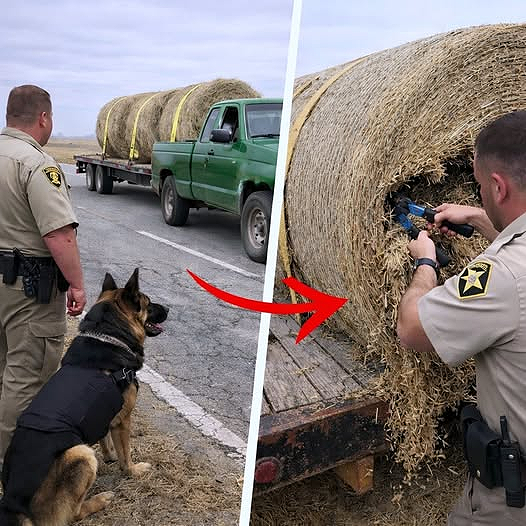
The asphalt ribbon of Highway 80 stretched across the flat, endless expanse of the Texas plains, sharp and unyielding beneath a sky heavy with iron-gray clouds. To most travelers, it was just a long, lonely road. To Deputy Ryan Miller, it was a line of sight into human deception and danger, a stretch of land where predators often lurked behind the innocent mask of rural traffic. Beside him, in the custom kennel that occupied the rear of his cruiser, Duke—a seventy-pound Belgian Malinois with a coat of amber and coal—shifted restlessly. Duke’s impatience wasn’t idle; Miller knew that in their world, restlessness often preceded chaos.
Miller carried with him a guilt that had hardened into a constant, driving force. Five years earlier, a moment of leniency had haunted him—a white van stopped for a broken tail light, released with only a warning. Days later, he learned that van had been transporting kidnapped children. That failure transformed him. Since then, every vehicle he observed carried more than metal and paint; it carried secrets, lies, and the subtle betrayals of human behavior. Miller’s eyes could read the slight sag of a trailer axle, the unnatural stiffness in a driver’s hands, the micro-expressions that betrayed a hidden story.
The silence of the afternoon cracked when a faded blue Ford pickup appeared on the horizon. It hauled a flatbed trailer loaded with round hay bales, a familiar scene in the agricultural heartland. But Miller’s gaze was drawn to the truck’s tires. The rear sidewalls bulged under a weight that didn’t match the airy, golden hay above.
“Way too heavy, Duke,” Miller murmured, sliding the cruiser into drive.
For the next two miles, he trailed the pickup, noting the driver’s rigid, mechanical posture. The man refused to glance in his mirrors, clinging to the “ostrich effect”—the desperate hope that ignoring danger would make it disappear. When the rear tire finally drifted across the white fog line, Miller had his probable cause. He activated his lights, and the truck eased onto the gravel shoulder, a cloud of dust marking its halt.
As he approached, a pungent mixture of sweat and stale smoke greeted him through the rolled-down window. The driver, Stephen Kovich, was a man etched with anxiety. Knuckles bone-white on the steering wheel, he offered a fumbling explanation about delivering premium alfalfa to a nonexistent ranch. Miller’s instincts screamed danger.
“Step out of the vehicle, Mr. Kovich,” he commanded.
Duke leapt from the cruiser, shifting into alert mode. The Malinois, trained in both narcotics detection and human tracking, moved with precision. Bypassing the usual hiding spaces, he zeroed in on the central bale, barking frantically—a “living find” alert that left no room for doubt.
Kovich protested, claiming the dog would ruin the hay, but Miller ignored him. Up close, the physics of the load confirmed his suspicion. The straps were buried deep, the bales far denser than hay could account for. Pressing against the surface revealed the unforgiving resistance of wood. A steel cargo probe clanged against a solid core.
With a folding cutter, Miller slashed through the net wrap, peeling away hay to reveal plywood panels painted a muddy brown. He jammed a crowbar into a slit and pried open the first panel. A terrified human eye met his flashlight beam from the darkness.
“Oh, my God,” Miller whispered as a muffled whimper echoed from the crate.
Panic overtook Kovich. He lunged for a shotgun hidden behind the seat, but Miller’s command was instant: “Duke, Fass!”
The dog launched like a projectile, clamping onto Kovich’s trigger arm, sending the shotgun clattering to the asphalt. Within seconds, Miller had him secured in handcuffs, but the rescue was only beginning.
One by one, Miller pried open the bales. The first concealed a young woman, curled in a fetal position. The next revealed a man and a teenage boy, their breaths shallow. Another held a mother and two small children, their faces pale and panicked from oxygen deprivation. By the fourth bale, Miller’s knuckles were raw, lungs burning, yet he continued until eight people—packed like sardines into wooden coffins—were freed.
Calling for emergency backup, he saw a black Chevrolet Tahoe idling across the median. Two men in tactical vests emerged, rifles in hand—enforcers likely sent to clean up the operation. Alone, with eight victims and his dog, Miller grabbed the PA microphone.
“State Police air support is overhead! Drop your weapons or you will be engaged!”
The bluff, amplified by Duke’s ferocious barking, held. The armed men hesitated, calculated, and ultimately retreated, disappearing in a cloud of dust.
Backup arrived minutes later. Paramedics swarmed the victims, providing oxygen and emergency care. Miller slumped against the truck tire, adrenaline draining, and watched as people who had endured horrors beyond imagination were finally safe.
The investigation dismantled a major human smuggling ring, but for Miller, the triumph was personal. Two days later, he visited the hospital. The young woman from the first bale, now sitting upright, spotted him. Wobbling on unsteady legs, she embraced his tactical vest and sobbed, “Thank you,” a word heavy with relief and gratitude.
“I didn’t see you,” Miller said softly, showing her a photograph of Duke. “He did.”
Stepping into the Texas sun, Miller felt the weight of past mistakes lift. He wasn’t the officer who had let a white van pass unchecked. He was the man who could look at a hay bale and discern a human soul trapped within. Sliding into the driver’s seat beside Duke, he returned to Highway 80, ready to confront the next shadow, vigilant and unyielding.
The plains stretched endlessly ahead, but for Miller and his companion, every mile was a chance to protect, to intercept, and to ensure that no human life would be hidden, ignored, or forgotten on their watch.