
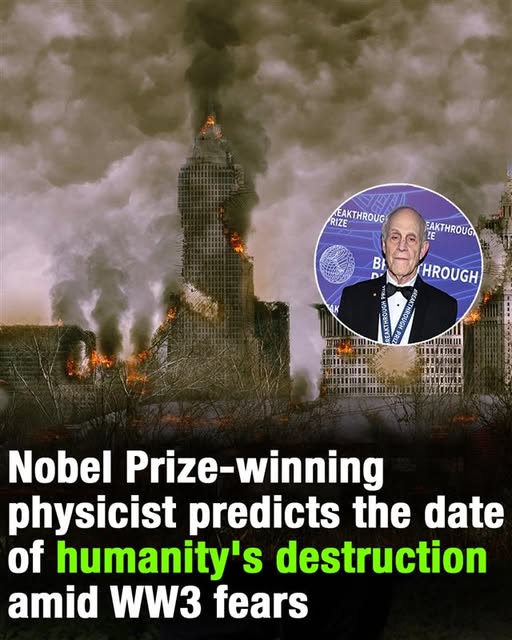
Nobel Laureate Warns of Potential Global Catastrophe Within Decades
Scientist Raises Alarm Over Humanity’s Future
A Nobel Prize-winning physicist has issued a stark warning about the future of humanity, suggesting that the world may face a catastrophic turning point within the next few decades.
David Gross, who was awarded the Nobel Prize in Physics in 2004, expressed concern that escalating global tensions and rapidly advancing technology are creating conditions that could threaten human survival.
His remarks come at a time when geopolitical instability and technological developments continue to dominate international discussions.
Concerns Rooted in Rising Global Tensions
The warning reflects growing unease about conflicts across different regions and the potential consequences of strained relationships between major powers.
Issues related to nuclear weapons and emerging technologies remain central to global security debates, adding to uncertainty about long-term stability.
Gross highlighted how these factors, combined with the absence of strong international agreements, contribute to an increasingly fragile environment.
Nuclear Threat Remains a Persistent Risk
In a recent interview, the physicist pointed to the enduring risk posed by nuclear weapons, noting that the danger did not disappear after the Cold War ended.
He recalled earlier estimates suggesting a consistent annual probability of nuclear conflict, even during periods of relative stability.
“Even after the Cold War ended, when we had strategic arms control treaties, all of which have disappeared, there were estimates that there was a 1% chance of nuclear war every year,” he said.
Gross suggested that the situation may have worsened in recent years as global dynamics have shifted.
“I feel it’s not a rigorous estimate that the chances are more likely 2%. So that’s a 1 in 50 chance every year.”
This assessment underscores the idea that even small annual risks can accumulate into significant long-term threats.
Long-Term Outlook Points to Limited Timeframe
The physicist emphasized how compounding probabilities over time can lead to alarming projections about the future.
“Currently, I spend part of my time trying to tell people…that the chances of you living 50 [more] years are very small. Due to the danger of nuclear war, you have about 35 years,” he said.
This estimate suggests a potential tipping point around the year 2061 if current trends continue without meaningful change.
Global Landscape Described as Increasingly Unstable
Gross pointed to a range of developments that he believes illustrate a decline in global stability over recent decades.
He described a world where cooperation has diminished and tensions have intensified across multiple regions.
“Things have gotten so much worse in the last 30 years, as you can see every time you read the newspaper,” he said.
He continued by outlining a series of concerns related to international relations and military developments.
“In the last 10 years, there are no treaties anymore. We’re entering an incredible arms race. We have three super nuclear powers. People are talking about using nuclear weapons; there’s a major war going on in the middle of Europe; we’re bombing Iran; India and Pakistan almost went to war.”
These factors, he argued, contribute to a heightened level of risk that did not exist to the same extent in previous decades.
Role of Artificial Intelligence Raises Additional Concerns
Beyond nuclear weapons, Gross also highlighted the growing influence of artificial intelligence in decision-making processes related to global security.
He warned that increasing reliance on automation could introduce new risks, particularly in high-stakes situations.
“The agreements, the norms between countries, are all falling apart,” he said. “Weapons are getting crazier. Automation, and perhaps even AI, will be in control of those instruments pretty soon.”
The speed at which automated systems can operate may reduce the ability of human decision-makers to intervene during critical moments.
Gross suggested that this could lead to scenarios where machines play a central role in decisions with potentially irreversible consequences.
“It’s going to be very hard to resist making AI make decisions because it acts so fast. If you have 20 minutes to decide whether to send a few hundred nuclear armed missiles to both China and Russia for ‘our dear president,’ the military might feel that it’s wiser to make AI make that decision,” he explained.
He also noted concerns about the reliability of such systems, adding that “if you play with AI, you know that it sometimes hallucinates.”
Doomsday Clock Reflects Heightened Risk Level
The broader sense of concern is echoed by the Doomsday Clock, a symbolic measure used to represent the world’s proximity to a global catastrophe.
Established in 1947 by scientists involved in early nuclear research, the clock has long served as an indicator of threats posed by human-made technologies.
Initially set at seven minutes to midnight, the clock’s position has been adjusted over time to reflect changing levels of risk.
Each year, experts assess global conditions, including nuclear tensions, climate issues, and technological developments, to determine whether the hands should move closer to or further from midnight.
For 2026, the clock was set at 85 seconds to midnight, marking the closest point it has reached since its creation.
This adjustment signals a heightened perception of danger across multiple areas of concern.
Experts Warn of Growing Global Pressures
In explaining the most recent update, members of the Science and Security Board emphasized that the world is facing increasing challenges without sufficient action to address them.
“A year ago, we warned that the world was perilously close to global disaster and that any delay in reversing course increased the probability of catastrophe,” the board stated.
They noted that instead of easing tensions, major countries have become more confrontational and divided.
“Rather than heed this warning, Russia, China, the United States, and other major countries have instead become increasingly aggressive, adversarial, and nationalistic.”
The statement also highlighted concerns about leadership and policy decisions contributing to the current situation.
“Far too many leaders have grown complacent and indifferent, in many cases adopting rhetoric and policies that accelerate rather than mitigate these existential risks.”
These observations align with broader concerns about the direction of global affairs.
Warning Intended to Encourage Awareness and Action
While the Doomsday Clock reflects serious concerns, it is not designed to serve as a precise prediction of future events.
Instead, it aims to raise awareness about the risks facing humanity and the need for collective action to address them.
Melissa Parke, Executive Director of ICAN, emphasized this point in her remarks.
“The Doomsday Clock is not a prediction, it’s a warning,” she said. “Nuclear weapons, wars from Ukraine to Gaza, the climate crisis and runaway technologies are all part of the problem – but they are all created by humanity.”
Her statement underscores the idea that the same forces contributing to these risks can also be redirected toward solutions.
Possibility of Change Remains
Despite the seriousness of the warnings, there remains an emphasis on the potential for positive change through coordinated global efforts.
Parke pointed to existing frameworks that aim to reduce risks associated with nuclear weapons and other threats.
“That means we can also change course. The Treaty on the Prohibition of Nuclear Weapons (TPNW) is a clear path to turn back the hands of the clock,” she added.
The broader message highlights the role of policy decisions, international cooperation, and public awareness in shaping future outcomes.
Efforts to address these challenges could influence whether current projections become reality or are ultimately avoided.
Uncertain Future Leaves Room for Debate
The warning issued by Gross has contributed to ongoing discussions about the trajectory of global development and the risks associated with modern technology and geopolitical tensions.
While some view such projections as cautionary, others see them as an opportunity to reassess priorities and strengthen efforts to reduce potential threats.
The conversation surrounding these issues continues to evolve as new developments shape the global landscape.
Conclusion
The projection of a possible global catastrophe within the next few decades reflects a convergence of concerns related to nuclear weapons, technological advancements, and international relations.
As these factors continue to interact, the importance of careful decision-making and cooperation becomes increasingly clear.
Whether the future follows the path outlined in these warnings will depend on the actions taken in the years ahead.