
Mitch McConnell’s Return to Public View Fuels Debate Over His Health and Recovery
When a major political figure disappears from public view for an extended period, speculation often spreads faster than confirmed information. That was the case after 84-year-old Senate veteran Mitch McConnell remained largely unseen for nearly a month.
His absence created a wave of online rumors about his condition. Some people questioned whether he had suffered a serious medical emergency, while others began circulating increasingly dramatic theories about why no recent images of him had appeared.
McConnell finally addressed the public on July 12. In a Facebook statement, the Kentucky senator explained that a fall had sent him to the hospital and required a lengthy period of recovery.
McConnell Explains His Hospitalization
McConnell described the incident directly in his message.
“Last month, I took a fall which landed me in the hospital,” McConnell wrote, addressing his constituency and a nervous Capitol Hill. “My doctors have confirmed that I didn’t break any bones or suffer a concussion. I didn’t have a heart attack or a stroke. I don’t have any tumors or hemorrhages. But I was briefly unconscious and was taken to the hospital.”
The statement addressed several of the most serious possibilities that had circulated during his absence. He said doctors found no broken bones, concussion, heart attack, stroke, tumors, or hemorrhaging.
Even so, the fall was serious enough to leave him briefly unconscious and require hospital treatment.
McConnell also disclosed that he developed a mild case of pneumonia during his stay. After leaving the hospital, he moved to a rehabilitation center to continue recovering.
He said he planned to “keep working hard to get back on the Senate floor.”
A Photograph Was Meant to Reassure the Public
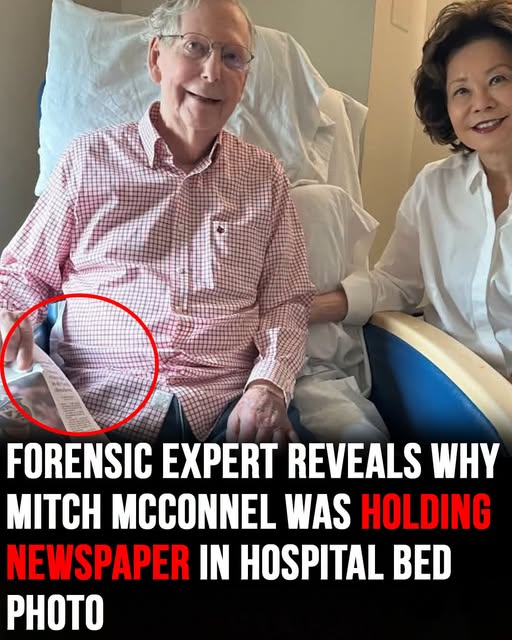
McConnell’s written explanation was accompanied by a photograph that appeared designed to show he was alert and recovering.
In the image, the senator sits upright in bed beside his wife, former Cabinet secretary Elaine Chao. He is smiling and holding the Sunday sports section of The Washington Post in his right hand.
The newspaper immediately attracted attention because it appeared to provide a visible indication of when the photograph had been taken.
Rather than calming online discussion, however, the image intensified it.
Some viewers compared the newspaper to a traditional proof-of-life prop. Others claimed the picture looked staged, heavily altered, or entirely created with artificial intelligence.
The photograph quickly became the center of a debate that extended far beyond McConnell’s original health update.
Artificial Intelligence Claims Spread Online
The highly specific newspaper date became a source of suspicion for people already doubtful about McConnell’s condition.
Online users questioned whether the image had been carefully manufactured to create the appearance that the senator was recovering normally.
Some focused on his hands, facial features, posture, and the placement of the newspaper. Others argued that the entire composition looked too deliberate to be spontaneous.
Claims that the photograph was generated by artificial intelligence began spreading across social media.
The discussion reflected a wider climate in which photographs of public figures are frequently examined for signs of digital manipulation.
In this case, however, one forensic analyst concluded that the image did not appear to be a complete AI fabrication.
Dr. G Examines the Image
Dr. G, a clinical and forensic psychologist who analyzes behavioral signals and digital authenticity, tested the photograph using several AI-detection tools.
His assessment was that the image did not appear to have been generated entirely through artificial intelligence.
“Based on all of the AIs that I ran this through, it does not appear to be AI generated,” Dr. G concluded. “That doesn’t mean it wasn’t manipulated, but it doesn’t look like something that was fabricated out of absolutely nothing. If it was, they really screwed up. This would be a crazy way to compose an entirely fake picture.”
His conclusion rejected the strongest version of the online conspiracy theory.
He did not claim that every part of the image was untouched or that no editing had occurred. Instead, he said the photograph did not resemble a scene created entirely from nothing.
For Dr. G, the more important issue was not whether the picture was fake. It was what the image might reveal about McConnell’s physical condition.
The Newspaper Becomes the Central Clue
The Sunday sports section was clearly intended to establish the timing of the photograph.
“Obviously, they want to show that it is from the day where the picture was taken,” Dr. G noted.
The paper served as a visible date marker, allowing viewers to connect the image with McConnell’s recent statement.
Yet Dr. G argued that the way McConnell held the newspaper may have unintentionally communicated more than the date.
The senator’s grip appeared awkward and strained rather than casual. The paper was not raised high or held in a relaxed reading position.
Dr. G believed the position suggested McConnell may have been using as much strength as he could manage.
A Strained Grip Raises Questions
Dr. G drew attention to the unusual way the newspaper rested in McConnell’s hand.
“Have you ever held a newspaper this way?” Dr. G asked. “Even if you’re trying to pose for a picture and you’re holding it in an unusual way… I really think that’s as high as he can hold it. I think that’s absolutely the best that he can do right now.”
His interpretation transformed the newspaper from a reassurance device into a possible sign of weakness.
Instead of showing a fully recovered senator comfortably reading, the photograph may have captured someone struggling to maintain the pose.
Dr. G described the senator’s appearance as consistent with “extreme frailty and weakness.”
The conclusion was based on body positioning and visible effort rather than direct medical evidence.
The photograph therefore became subject to two opposing interpretations. McConnell’s camp appeared to present it as proof of recovery, while Dr. G viewed it as evidence that the recovery remained difficult.
McConnell’s Age and Medical History Add Context
At 84, McConnell has already faced several public questions about his health and physical resilience.
He is also a polio survivor, a history that has shaped his mobility throughout his life.
A fall serious enough to cause brief unconsciousness would be significant for any person. At his age, the recovery process may require additional monitoring, rehabilitation, and physical support.
His mild pneumonia added another complication to the hospital stay.
McConnell’s statement did not provide detailed information about the length of hospitalization, the exact circumstances of the fall, or the goals of his rehabilitation.
The lack of those details left viewers to examine the photograph for clues about his present condition.
The Missing Wedding Ring Attracts Attention
Dr. G also focused on McConnell’s left hand, where his wedding ring was absent.
McConnell and Chao have been married since 1993, making the missing ring noticeable to people familiar with their public appearances.
There are practical medical reasons why jewelry may be removed during hospitalization.
“Sometimes when you’re in the hospital, they’re concerned your hands are going to swell… so they might remove jewelry,” Dr. G explained.
Swelling can make rings difficult or unsafe to wear, and medical staff may remove them as a precaution.
However, McConnell had already been transferred to a rehabilitation facility when the photograph appeared. Dr. G questioned why the ring had not been replaced by that point.
The Ring’s Absence Is Interpreted as a Sign of Frailty
Dr. G did not suggest that the missing ring indicated a personal problem between McConnell and Chao.
Instead, he connected it to the senator’s medical condition.
“One would think, particularly if his wife came to see him, that he would have his wedding ring on. The absence of that to me speaks to how frail he really is in this situation.”
The interpretation depends on the idea that McConnell remained physically vulnerable enough for medical precautions to continue after leaving acute hospital care.
The ring alone cannot establish the severity of his condition.
Combined with the strained newspaper grip and his posture, however, Dr. G viewed it as part of a larger pattern.
Elaine Chao’s Position Becomes Another Focus
Elaine Chao sits close beside her husband in the photograph.
At first glance, her position appears supportive and affectionate. Dr. G believed it may also have served a physical purpose.
Her arm is placed directly behind McConnell’s back.
He interpreted that placement as a possible attempt to help the senator remain upright long enough for the photograph to be taken.
“It looks like she is trying to prop him up so it’s as good a picture as possible,” Dr. G observed. “This seems like one where they are trying to get a picture, and this is the absolute best they could possibly do.”
If that interpretation is correct, the photograph may have required careful positioning and support.
A Carefully Managed Public Appearance
The image presents McConnell smiling, sitting upright, holding a recent newspaper, and accompanied by his wife.
Every visible element communicates continuity and stability.
The senator appears conscious, engaged, and aware of the public concern surrounding his absence.
Yet the photograph may also show the effort required to create that reassuring image.
McConnell’s posture, grip, missing ring, and Chao’s arm placement became central to Dr. G’s analysis.
Rather than interpreting the picture as a triumphant return, he saw a carefully managed attempt to present the strongest possible version of the senator’s condition.
The Difference Between Recovery and Full Strength
McConnell’s statement made clear that he survived the fall without several major injuries or medical events.
That does not necessarily mean he had returned to his previous level of physical strength.
Rehabilitation exists to help patients regain mobility, balance, endurance, and independence after hospitalization.
The fact that McConnell remained in a rehabilitation facility indicated that his recovery was still underway.
His promise to return to the Senate floor also suggested that he had not yet reached that point.
The photograph may therefore have accurately shown both improvement and continuing weakness.
Why the Public Wanted Proof
McConnell’s position in national politics made his extended absence especially noticeable.
As a longtime senator and one of Washington’s most recognizable figures, his health has implications beyond his personal life.
When weeks passed without a clear public appearance, uncertainty created ideal conditions for speculation.
A written statement alone was unlikely to satisfy every observer.
The photograph attempted to provide the visual confirmation many people had demanded.
Its reception showed that even photographic evidence may not end suspicion in an environment shaped by artificial intelligence and widespread distrust.
The Proof-of-Life Comparison
The newspaper’s placement reminded some online users of images in which captives are photographed holding a current publication to prove they are alive.
That comparison gave the photograph an unsettling quality for people already concerned about McConnell’s condition.
The paper appeared so deliberate that viewers interpreted it as a message rather than an ordinary object.
Its purpose seemed obvious: to show that the photograph was recent.
Once that intention was recognized, people began asking why such proof was considered necessary.
The answer may have been simple. McConnell had been absent long enough that a dated newspaper offered a direct way to challenge rumors.
Online Suspicion Continued Despite the Analysis
Dr. G’s conclusion that the image did not appear fully AI-generated did not automatically settle every question.
Digital photographs can be adjusted without being entirely fabricated.
Lighting, color, facial appearance, and background details can all be altered while the underlying photograph remains real.
Dr. G acknowledged that possibility when he said the image still could have been manipulated.
His main point was that the scene appeared to have a real photographic foundation.
The larger issue then shifted from authenticity to presentation.
The Image May Reveal More Than Intended
Public images of political figures are often selected carefully.
Campaign teams and advisers typically choose photographs that communicate confidence, strength, and control.
McConnell’s image appeared to have the same goal.
The smile, newspaper, upright posture, and presence of his wife all worked together to create a reassuring scene.
Dr. G argued that the same details also exposed how physically demanding the pose may have been.
The picture may therefore have been authentic while still presenting a carefully controlled version of reality.
McConnell’s Promise to Return
Despite the concerns raised by the photograph, McConnell’s message remained focused on recovery and a return to work.
He did not announce a retirement, permanent withdrawal, or change in political plans.
His stated goal was to regain enough strength to resume his duties on the Senate floor.
The rehabilitation process was presented as a temporary stage rather than the conclusion of his public career.
Whether he can return at the pace he expects will depend on his continued recovery.
The photograph alone cannot determine how quickly that process will unfold.
A Public Figure Facing Private Vulnerability
McConnell has spent decades projecting discipline and political control.
The hospital and rehabilitation update placed him in a far more vulnerable position.
His temporary disappearance from public life allowed rumors to develop because the public had little direct information about his health.
When he finally responded, he attempted to provide both a medical explanation and visual reassurance.
The result revealed the difficulty of managing a health crisis while remaining a powerful public figure.
Any sign of weakness can become the subject of political discussion, online analysis, and conspiracy theories.
The Photograph Did Not End the Debate
McConnell’s July 12 message answered several immediate questions.
He confirmed that he had fallen, lost consciousness, spent time in the hospital, experienced mild pneumonia, and entered rehabilitation.
He also denied suffering a heart attack, stroke, concussion, broken bones, tumors, or hemorrhaging.
The photograph showed him alive, conscious, and accompanied by Chao.
Even so, it did not provide a complete picture of his physical condition.
Dr. G’s analysis suggested that the senator may have been considerably weaker than the image was intended to show.
A Real Image With a Sobering Message
The strongest online claim was that the photograph had been generated entirely through artificial intelligence.
Dr. G’s testing did not support that conclusion.
His analysis instead produced a more restrained but still serious interpretation.
The photograph may be real, but it appears to show an elderly senator using significant effort to sit upright and hold a newspaper while his wife supports him from behind.
The missing ring and strained posture added to the impression of continuing medical vulnerability.
Rather than proving that McConnell had fully recovered, the image may have shown the difficult work of recovery in progress.
The Senator’s Future Remains Tied to His Rehabilitation
McConnell’s statement made clear that his immediate focus was regaining enough strength to return to public duties.
The nearly month-long absence had already demonstrated that the fall was more consequential than a minor interruption.
His transition to rehabilitation suggested that continued treatment and physical recovery were necessary.
The image beside Chao may have been the strongest public appearance possible at that stage.
For supporters, it showed resilience and determination.
For skeptics, it showed a carefully posed scene designed to conceal weakness.
For Dr. G, it showed both authenticity and profound frailty.
A Photo Intended to Calm Washington Created New Questions
McConnell returned to public view with a detailed explanation, a promise to recover, and a photograph meant to quiet speculation.
Instead, the image became a new source of debate.
The newspaper invited accusations of staging. The senator’s posture raised concerns about weakness. His missing wedding ring and Chao’s supporting arm became evidence in a wider visual analysis.
The photograph may not have been artificial, but it was clearly constructed to send a message.
That message was that McConnell remained alive, alert, and determined to return.
The details identified by Dr. G suggested another message beneath it: the 84-year-old senator was still enduring a serious and physically demanding recovery.
What began as an attempt to end nearly a month of rumors ultimately revealed how difficult it has become for public figures to control the meaning of a single image.
McConnell’s post confirmed that he had survived the fall without several feared medical emergencies. It also showed that the path back to the Senate floor may be more difficult than a smiling photograph and a Sunday newspaper were intended to suggest.