
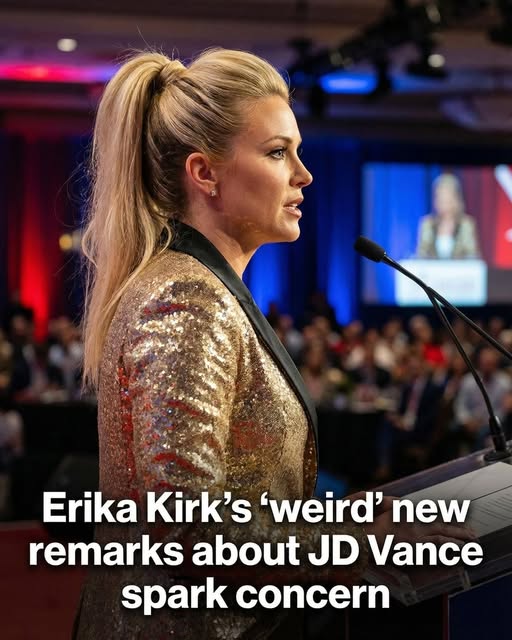
The opening night of AmericaFest 2025 at the Phoenix Convention Center emerged as a defining moment in the landscape of American conservative politics. Erika Kirk, recently appointed CEO of Turning Point USA and widow of the organization’s late founder Charlie Kirk, took center stage to deliver a keynote address that is already reverberating across political circles and shaping the early contours of the 2028 presidential election.
In a declaration that captured the attention of both grassroots supporters and political strategists, Erika Kirk publicly endorsed Vice President JD Vance for the 2028 Republican nomination. Standing before a stadium of cheering attendees, she stated, “We are going to get my husband’s friend JD Vance elected for 48 in the most resounding way possible.” The endorsement represents more than a personal favor; it signals a deliberate effort to consolidate the “America First” movement and give Vance a significant head start in a Republican field expected to be highly competitive.
Leadership Transition and Strategic Continuity
Erika Kirk’s ascent to the helm of Turning Point USA follows the tragic assassination of her husband, Charlie Kirk, in September 2025. Since assuming leadership, she has prioritized continuity while charting a vision for organizational growth. Analysts have noted that her approach balances political influence with strategic financial stewardship, focusing on mobilizing young conservative voters while strengthening Turning Point USA’s presence in battleground states.
One of Kirk’s primary initiatives, referred to internally as “building the red wall,” targets pivotal states such as Arizona, Nevada, and New Hampshire. By concentrating resources and digital outreach in these areas, the organization aims to create a political infrastructure capable of sustaining influence through 2028 and beyond. The endorsement of Vance can be seen as a calculated move to leverage this infrastructure, providing him with an institutional advantage before rivals begin building comparable support networks.
Political observers highlight that Turning Point USA’s control over digital messaging, social media influence, and grassroots mobilization makes Kirk’s endorsement a critical asset for Vance. The organization’s reach, particularly among younger demographics, positions it as a force multiplier, capable of shaping early voter perceptions and potentially “freezing” the field against competitors who lack comparable institutional backing.
Personal and Political Drama
The lead-up to Erika Kirk’s speech has been marked by intense public and private scrutiny. Social media discussions revisited an October event at the University of Mississippi, where Erika Kirk and JD Vance shared a highly visible embrace. Critics speculated about the nature of their relationship, though both Kirk and Vance dismissed such rumors, framing them as distractions from substantive political objectives.
Vance and his wife, Usha, were notably supportive in the aftermath of Charlie Kirk’s death, even assisting in escorting his remains back to Arizona. This personal history underscores the complex intersection of private grief and public responsibility that Erika Kirk navigates as she assumes a leadership role within one of the country’s most prominent conservative organizations. Her public profile now extends beyond organizational management into the broader sphere of national politics, where strategic endorsements carry both symbolic and practical weight.
Tensions Within the Conservative Movement
Erika Kirk’s rise has not been without friction. A well-documented public disagreement with conservative commentator Candace Owens has captured national attention. Owens has criticized the official investigation into Charlie Kirk’s death, promoting various conspiracy theories that Erika Kirk has repeatedly labeled “untrue” and “distracting.” Despite a four-hour private meeting mediated in part by Megyn Kelly, the dispute remains unresolved.
Owens continues to question the conclusion that the assassin, Tyler Robinson, acted alone. Kirk, meanwhile, has expressed unwavering confidence in law enforcement findings. This conflict reflects broader tensions within the GOP as the party recalibrates its identity beyond the Trump era. Loyalty, ideology, and strategic influence often collide in these moments, illustrating the complex dynamics that define modern conservative politics.
The friction between Owens and Kirk also highlights a generational and philosophical divide within the conservative movement. While Owens represents a segment of the base focused on skepticism toward institutional authority, Kirk emphasizes strategic unity and disciplined mobilization. How these competing visions interact may shape not only Turning Point USA’s trajectory but also the broader contours of the Republican primary leading into 2028.
Moments of Levity Amid High Stakes
Amid the high-stakes political maneuvering, Kirk’s keynote included a lighter moment that quickly became a viral talking point. While praising a student during her address, she accidentally used the word “grift” instead of “grit.” She laughed off the slip, attributing it to a “long day,” but the brief moment humanized her to a public audience already attuned to the pressures of her role.
Such moments underscore the delicate balance Erika Kirk must maintain between personal composure and public leadership. Stepping into a position historically defined by her husband’s charisma and influence, she faces scrutiny from both supporters and critics alike. Yet, her ability to navigate these moments with poise reflects a growing confidence in her public-facing leadership.
Expanding the Republican Coalition
Kirk’s strategy for the 2028 election extends beyond the immediate endorsement of JD Vance. She has articulated a specific focus on reaching young women, a demographic historically inclined toward liberal candidates. By positioning herself as a “unifying force” and a steward of Charlie Kirk’s legacy, she seeks to broaden the GOP coalition while maintaining a firm commitment to conservative principles.
Turning Point USA’s approach under Erika Kirk’s leadership combines traditional grassroots mobilization with modern digital outreach. From social media campaigns to campus engagement, the organization aims to influence voter behavior in key swing states. This dual approach not only solidifies support for Vance but also lays the groundwork for sustained organizational influence through successive election cycles.
The endorsement and its accompanying strategies illustrate a calculated approach to political power that emphasizes both loyalty and ideology. By aligning the organization’s mission with a specific candidate, Kirk is signaling a disciplined, long-term commitment to shaping the Republican Party’s future.
Looking Ahead to AmericaFest’s Keynote
As AmericaFest 2025 continues, the focus now shifts to JD Vance’s upcoming Sunday keynote address. The tone set by Erika Kirk’s endorsement has established expectations of strategic cohesion and organizational unity behind Vance’s campaign. The event serves as both a launchpad and a testing ground for broader messaging aimed at conservative voters nationwide.
Analysts suggest that the combination of Turning Point USA’s mobilization capabilities and early endorsement could influence candidate positioning and fundraising priorities across the Republican field. By signaling strong institutional support for Vance, Kirk has effectively altered the dynamics of the 2028 primary, making her a key figure in the unfolding political narrative.
The broader implications of her leadership extend to the ideological direction of the GOP itself. Erika Kirk embodies a blend of personal loyalty, political pragmatism, and generational appeal. Her stewardship of Turning Point USA demonstrates an understanding of how organizational influence can translate into electoral advantage, particularly in a party navigating post-Trump realignment.
Conclusion
Erika Kirk’s public endorsement of JD Vance at AmericaFest 2025 is a moment that intertwines personal legacy, organizational leadership, and national politics. From managing grief and high-profile disputes to shaping the strategy of a major conservative institution, she has positioned herself as a central figure in the 2028 Republican landscape.
The combination of strategic endorsements, targeted voter engagement, and media presence underscores Turning Point USA’s continued role as a powerhouse in shaping conservative youth politics. As Vance prepares to address the conference, the message from Erika Kirk and the organization is unmistakable: they are prepared, unified, and committed to advancing their vision for the next stage of American conservatism.
With the 2028 election already taking shape, Erika Kirk’s leadership and strategic decisions will remain under close scrutiny, highlighting the intersection of personal legacy and political influence in a moment of profound consequence for the GOP.