
Demi Moore’s Cannes Appearance Sparks Debate Over Fitness, Thinness, and Hollywood Body Standards
A Red Carpet Look That Started a Wider Conversation
Demi Moore’s appearance at the 79th Cannes Film Festival has become the center of a heated online discussion. The debate did not focus only on fashion, jewelry, or her role at the festival.
Instead, much of the reaction centered on how her body was described after several outlets praised her “toned arms” during her red carpet appearance.
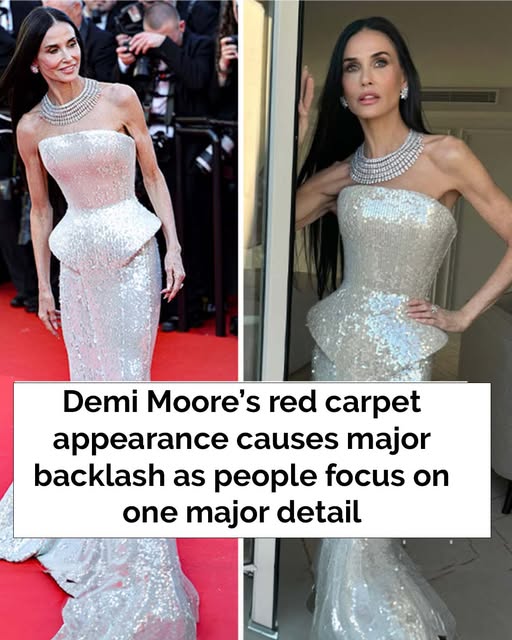
Moore attended the opening ceremony of the Cannes Film Festival on May 12 as one of the nine jury members for the year. For the event, she wore a strapless sequin Jacquemus gown, paired with a diamond Chopard necklace and floral earrings.
The outfit received plenty of attention because it was elegant, polished, and highly visible on the red carpet. Many observers praised the overall styling and the glamour of the look.
But the conversation quickly shifted away from the gown. Viewers began focusing on Moore’s noticeably slim figure, especially her arms, and the way they were being framed in media coverage.
What began as red carpet commentary soon became a broader argument about celebrity bodies, aging, fitness language, and the responsibility of entertainment media when describing women’s appearances.

Criticism of the “Toned Arms” Description
The backlash grew after a headline described Moore’s arms as “toned.” Many social media users argued that the word was misleading.
Some critics said the description appeared to glamorize extreme thinness by presenting it as a fitness achievement. They felt the language blurred the difference between visible muscle tone and a very low level of body fat.
One person reacted harshly online, writing, “That’s not toned. That’s fucking disgusting. She looks like a skeleton,”
Another user added, “That’s not “toned”, that is “emaciated,”
The comments were blunt and emotional. While some people focused on concern, others expressed anger toward the way Moore’s appearance was being discussed by the media.
A third person responded to the headline by writing, “That isn’t toned. That is malnourishment,”
These reactions helped push the conversation beyond one celebrity outfit. The debate became less about Moore herself and more about the words used to describe thinness in public-facing media.
A Debate About Hollywood Beauty Standards
The discussion soon expanded into a larger conversation about Hollywood beauty standards. Many users argued that the entertainment industry has long rewarded thinness while presenting it as discipline, youthfulness, or health.
Moore’s Cannes appearance became one more example used in a wider debate about how women’s bodies are evaluated in public. Some viewers felt that praise for her arms reflected a long-standing tendency to celebrate extremely slim bodies, especially among older women in Hollywood.
Others argued that commenting on her body at all was unfair. They believed the conversation risked becoming another form of public judgment, even when framed as concern.
Still, the central disagreement remained the use of the word “toned.” Critics said the word suggested strength and muscle definition, while what they saw looked more like thinness.
That distinction mattered to many people because fitness language can influence how audiences understand health, aging, and beauty.
In a culture where celebrity images are widely circulated, even one red carpet description can become part of a bigger pattern of body messaging.
Comparisons to Athletic Celebrity Physiques
As the debate grew, many users began posting photos of celebrities known for visibly athletic physiques. The list included Hannah Waddingham, Madonna, Emily Blunt, Cameron Diaz, Angela Bassett, and Jennifer Aniston.
These comparisons were used to argue that there is a visible difference between muscular definition and simply having very low body fat.
Supporters of that argument pointed to shoulders, biceps, and triceps as areas where genuine strength training often creates visible structure. They suggested that bodies shaped by resistance training tend to show muscle volume and definition rather than only sharp angles or prominent bones.
The comparisons also raised questions about how women’s bodies are described differently depending on age, fame, and public image.
Some viewers argued that a strong physique should not be confused with a fragile or extremely thin appearance. Others cautioned that people should not diagnose or judge a person’s health based on photographs alone.
The debate showed how difficult it can be to discuss celebrity bodies without crossing into speculation, cruelty, or harmful assumptions.
Age Becomes Part of the Discussion
Moore’s age, 63, also became part of the online conversation. Some people defended her appearance by pointing out that aging naturally changes body composition.
As people grow older, muscle mass, skin elasticity, body fat distribution, and overall appearance can change. Some users argued that Moore should not be criticized for looking different at this stage of life.
One person wrote, “She’s getting older, people get older. But there comes a time when maybe sleeveless is no longer the way to go and that’s ok. Embrace the sleeves, Demi,”
That comment reflected one type of response: a mixture of age-related explanation and style judgment.
Other users pushed back against that argument too. They said age alone did not explain the discussion, especially when other women in the same age range are known for visibly strong, muscular physiques.
Angela Bassett, 67, was among the examples mentioned in the debate. Some commenters used her as a comparison to argue that older women can still display clear athletic muscle tone.
This added another layer to the conversation. The debate was no longer simply about thinness, but also about how society expects women to age, dress, and present their bodies in public.
What “Toned” Actually Means
A major part of the discussion centered on the meaning of the word “toned.” In everyday language, the term is often used loosely to describe a slim or defined appearance.
In fitness and medical settings, however, the word carries a more specific meaning. It generally refers to building lean muscle while maintaining a healthy level of body fat so that muscle definition becomes visible.
True muscle definition usually involves visible structure in areas such as the shoulders, biceps, and triceps. It is not simply the appearance of thinness or prominent bones.
This distinction became important because many critics believed Moore’s arms were being described in a way that confused low body fat with muscular fitness.
The concern was that using “toned” incorrectly could create unrealistic or unhealthy standards. If very thin arms are praised as toned, audiences may begin to associate visible frailty with fitness.
That misunderstanding can be harmful, especially in a culture already filled with pressure around weight, aging, and appearance.
Fitness Experts Explain Muscle Tone
Fitness professionals have often explained that muscle tone is not simply an aesthetic label. It has to do with the body’s ability to maintain tension, posture, and functional strength.
Melody D., Fitness Specialist and Instructor at Obé Fitness, explained the concept this way: “Muscle tone refers to the ability of your muscles to create tension and force at rest. Muscle tone provides structure for your body and helps maintain your posture, and it has everything to do with your muscle’s potential ability, not aesthetics or the appearance of your muscle composition.”
That explanation highlights the difference between how the word is used casually and what it actually means in relation to muscles.
Muscle tone is connected to function, not only visual appearance. A person may look slim without having significant muscle development.
Likewise, a person can have strong muscle tone without fitting the narrow appearance standards often celebrated in entertainment media.
This is why experts often encourage people to think about strength, posture, endurance, and health rather than only the visual outline of a body part.
Thinness and Muscle Definition Are Not the Same
Fitness experts also note that rapid or severe weight loss without strength training can reduce both body fat and muscle mass. This may create a more angular or frail appearance rather than the structured look associated with muscle definition.
That distinction is central to the debate over Moore’s Cannes appearance. Many viewers argued that the word “toned” should be reserved for visible signs of strength and muscle development.
When a person loses both fat and muscle, the body can appear smaller without necessarily appearing stronger. This is very different from the look created by resistance training, balanced nutrition, and healthy body composition.
Exercise physiologist Mary Thoman from UT MD Anderson Cancer Center explained how the term is usually used in fitness conversations.
“When people use the word ‘toning,’ it generally means working on muscular endurance… Keep in mind that we do need some fat on our bodies to be healthy, and women more so than men.”
Her point adds an important health context. Body fat is not automatically negative. The human body needs a certain amount of fat to function properly, and women generally require more than men for healthy biological function.
Hollywood’s Softer Word for Muscular
The word “toned” is also common in Hollywood because it can function as a softer alternative to “muscular.” Some women may want visible definition without being described as bulky or overly muscular.
Celebrity trainer Gunnar Paterson has spoken about this pattern in fitness language. He said, “I don’t have women coming in saying ‘I want big arms.’ It’s ‘I want more definition in my arms,’”
He also added, “The common denominator of the women coming through my gym has always been a**, abs, arms. These days, it’s an arm thing.”
His comments show how arm definition has become a major focus in celebrity fitness culture. Red carpet fashion often highlights shoulders and arms, especially when gowns are strapless or sleeveless.
This may help explain why Moore’s arms became such a focal point at Cannes. Her strapless gown placed that area in full view, and media coverage quickly turned it into a point of discussion.
But the controversy shows that audiences are paying closer attention to the difference between true strength and language that may romanticize thinness.
How Visible Arm Definition Is Usually Built
Plastic surgeons Dr. Lee Thornton and Dr. Mark Elliott from Meridian Plastic Surgery have emphasized that visible arm definition typically comes from a combination of resistance training, hydration, and overall body composition.
They explained that “lifting weights,” doing “bodyweight exercises,” and “drinking plenty of water” can all support muscle definition and healthy weight management.
Their explanation also points to an important limitation. Fat loss cannot be targeted to only one body part in a simple or guaranteed way.
They noted that “it’s nearly impossible to target specific areas on your body specifically for fat loss. The best way to get your arms in the shape you’d like is to focus on weight loss in general.”
This helps clarify why arm appearance depends on more than one factor. Genetics, age, training habits, hydration, body fat levels, and overall muscle mass all contribute to how arms look.
Because of that complexity, reducing the conversation to a single word like “toned” may oversimplify what people are actually seeing.
The Risk of Glamorizing Extreme Thinness
The strongest criticism directed at the coverage was that it risked glamorizing extreme thinness. Some users argued that labeling a very slim appearance as “toned” may encourage unhealthy ideals.
Body image discussions are especially sensitive because celebrity photos often influence public perception. When media language presents thinness as strength, it may create confusion about what healthy fitness looks like.
There is also a long history of women in entertainment being judged harshly for their bodies. Some are criticized for aging, some for gaining weight, and others for appearing too thin.
This creates a difficult environment where nearly every visible change becomes a public debate. The discussion around Moore reflects both concern about media messaging and the broader problem of public body scrutiny.
Some people believe the solution is to avoid detailed commentary on celebrity bodies altogether. Others argue that when media outlets use potentially harmful language, it is fair to challenge that framing.
The debate around Moore shows how quickly these two views can collide.
Concern, Criticism, and Cruelty
Not all responses to Moore’s appearance were framed carefully. Some comments expressed concern about the language used by media outlets, while others turned into direct attacks on her body.
This distinction matters. Criticizing a headline is different from insulting a person’s appearance.
The most constructive part of the debate focused on the misuse of the word “toned” and the larger issue of beauty standards. The least constructive part involved mocking or shaming Moore herself.
Public conversations about women’s bodies can easily become cruel, even when they begin with legitimate concerns. Moore became the center of a debate she did not necessarily invite simply by appearing at a public event.
That is one reason some people urged caution. A person’s health cannot be accurately judged from a few photos, and public speculation can become invasive.
Still, the conversation about media framing remains important because headlines shape how audiences interpret bodies, fitness, and aging.
Aging Under the Red Carpet Spotlight
The Cannes discussion also revealed the pressure older actresses face. Women in Hollywood are often expected to age gracefully, remain stylish, maintain slim figures, and avoid looking either too old or too altered.
These expectations can be contradictory and impossible to satisfy. If a woman appears youthful, people may question how. If she appears older, people may criticize that too.
If she is thin, the conversation may turn to health. If she gains weight, the conversation may turn to discipline or appearance.
Moore’s case demonstrates how red carpet visibility can turn a single public appearance into a much larger cultural argument. The scrutiny was not only about her arms; it was about aging, femininity, beauty ideals, and the language used to praise women.
For many observers, the debate reflected frustration with an industry that still places enormous focus on women’s physical presentation.
Even at an event centered on film, the body of a female jury member became a dominant topic of conversation.
The Broader Meaning of the Backlash
The reaction to Moore’s Cannes appearance shows that audiences are becoming more critical of how celebrity bodies are described. Many people no longer accept traditional entertainment language without questioning its implications.
Terms like “toned,” “ageless,” “flawless,” and “fit” may seem complimentary, but they can also carry hidden messages about what kinds of bodies are valued.
In this case, critics argued that the praise blurred the line between health and extreme thinness. They wanted a clearer distinction between muscle definition and simple weight loss.
The debate also showed that audiences are increasingly aware of fitness misinformation. People are asking whether a description matches the physical reality being shown.
This shift could lead to more careful media language in the future. Instead of relying on vague praise, coverage may need to be more precise and less focused on judging women’s bodies.
Fashion, Fitness, and Public Perception
Moore’s Cannes look combined high fashion with public body scrutiny. Her strapless sequin gown, diamond necklace, and floral earrings were meant for a formal red carpet appearance, but the exposed silhouette led many observers to focus on her arms.
That focus shows how fashion can shape public perception of the body. A sleeveless or strapless outfit naturally draws attention to shoulders, collarbones, and arms.
When the person wearing it is a major celebrity, those details may become amplified through photography and headlines.
For Moore, the red carpet moment became less about the full styling and more about a contested interpretation of her physical appearance.
The result was a debate that moved from fashion commentary to health language, fitness terminology, and Hollywood’s long-running obsession with women’s bodies.
Why the Word Choice Matters
The word “toned” may seem harmless, but the reaction to Moore’s appearance shows why language matters. Words used in entertainment coverage can normalize certain ideals.
If thinness is repeatedly described as tone, audiences may begin to associate a smaller body with a stronger body, even when the two are not the same.
Fitness professionals generally connect tone with muscle function, muscular endurance, and visible structure supported by healthy body composition. That is more specific than simply being slim.
Using the term loosely can distort public understanding of fitness. It can also create pressure on people who believe they must become smaller to appear healthier or more attractive.
The backlash, then, was not only about Demi Moore. It was about the way one celebrity image can reflect a larger system of beauty messaging.
A Debate With No Simple Answer
The online conversation around Moore’s Cannes appearance does not have one easy conclusion. Some people were concerned about media language. Others defended her right to appear however she chooses.
Some users criticized what they saw as unhealthy beauty standards. Others argued that body-shaming her in response only repeated the same problem from another angle.
Both concerns can exist at the same time. It is possible to question media descriptions without attacking an individual woman’s body.
It is also possible to acknowledge that aging changes the body while still rejecting the idea that thinness should automatically be called fitness.
The strongest takeaway from the debate may be the need for more responsible language and less personal cruelty.
Celebrities will continue to appear on red carpets, and audiences will continue to react. But the way those reactions are framed can either deepen harmful standards or encourage more thoughtful discussion.
The Cannes Moment That Became a Cultural Conversation
Demi Moore’s appearance at the 79th Cannes Film Festival began as a glamorous red carpet moment. She arrived as one of the year’s nine jury members, wearing a strapless sequin Jacquemus gown with Chopard jewelry.
But the response quickly turned into a debate about how the media describes women’s bodies. The phrase “toned arms” became the center of criticism from people who felt the description glamorized extreme thinness.
Fitness experts have emphasized that real tone involves muscle function, endurance, structure, and healthy body composition. Thinness alone is not the same thing as strength.
The discussion also raised larger questions about aging, Hollywood expectations, and the pressure placed on women to appear both youthful and physically ideal at every stage of life.
Moore’s red carpet appearance may eventually fade from the news cycle, but the debate it triggered reflects an ongoing cultural shift. Audiences are paying closer attention to the language used around bodies, health, and beauty.
In the end, the controversy was not only about one actress at one festival. It was about how society defines fitness, how media praise can shape expectations, and why describing women’s bodies with care matters more than ever.