
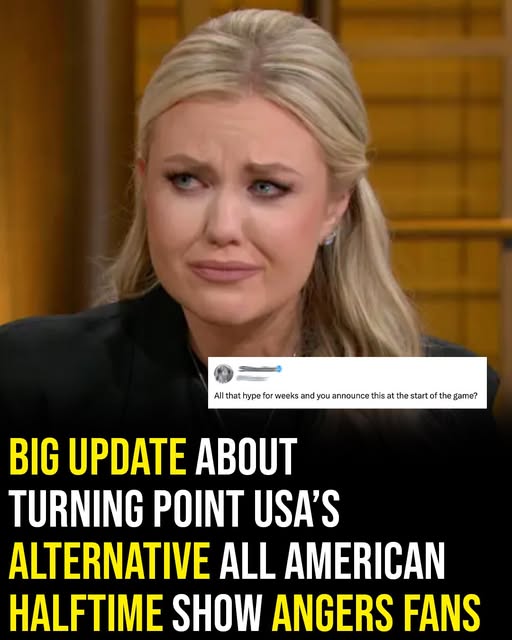
Turning Point USA Adjusts Streaming Plans for Alternative Super Bowl LX Halftime Event
As preparations for the 2026 Super Bowl LX reached their final stages, Turning Point USA moved ahead with plans to stage a competing halftime production designed to air alongside the National Football League’s official show.
The organization promoted the event as a parallel viewing option, positioning it as an alternative to the NFL’s halftime performance headlined by Bad Bunny.
However, only days before kickoff, Turning Point USA released an update that altered how audiences could access the broadcast.
The announcement prompted a shift in viewing plans for supporters and added a new layer of discussion to an already high-profile cultural moment.
Origins of the Alternative Halftime Concept
Turning Point USA unveiled its event under the name “The All-American Halftime Show,” presenting it as a form of cultural counterprogramming.
The organization described the production as a celebration of values it frequently emphasizes, including faith, family, and freedom.
Supporters viewed the effort as an opportunity to showcase performers and themes they felt were underrepresented in mainstream entertainment.
Critics, on the other hand, interpreted the initiative as a political response to the NFL’s choice of Bad Bunny for the official halftime performance.
That selection had already generated discussion and debate, with differing opinions emerging around music style, cultural expression, and the broader symbolism of the Super Bowl stage.
Timing and Format of the Event
The All-American Halftime Show was scheduled to run simultaneously with the NFL’s official halftime performance.
This timing was a deliberate choice, intended to give viewers a real-time alternative rather than a separate pregame or postgame program.
The event was designed as a livestream, allowing audiences to tune in from home without leaving the Super Bowl broadcast environment.
By aligning its schedule with halftime itself, Turning Point USA aimed to directly compete for viewer attention during one of the most-watched moments of the year.
Performers Featured in the Lineup
The alternative halftime show featured a lineup of country and rock artists.
Kid Rock was announced as the headlining performer.
Additional performers included Brantley Gilbert, Lee Brice, and Gabby Barrett.
The selection of artists reflected the tone and audience the organization sought to attract.
The lineup emphasized genres traditionally associated with patriotic themes and broad popular appeal among certain demographics.
Organizers promoted the performers as a contrast to the musical style and presentation of the NFL’s official halftime show.
Leadership Transition at Turning Point USA
The 2026 Super Bowl marked one of the most visible initiatives undertaken by Turning Point USA following a major leadership transition.
The organization was founded in 2012 by conservative activist Charlie Kirk.
Kirk led the group for more than a decade, shaping its identity and expanding its influence in political and cultural spheres.
In September 2025, Charlie Kirk died, leaving a leadership vacancy at the top of the organization.
After his passing, the board appointed his widow, Erika Kirk, as chief executive officer and chair.
Under her leadership, Turning Point USA continued to pursue high-profile initiatives and maintain its presence in national conversations.
Continuing a Public-Facing Strategy
The decision to move forward with a Super Bowl-related event signaled continuity in the organization’s approach.
Turning Point USA has long relied on prominent platforms and major cultural moments to amplify its messaging.
By engaging directly with an event as widely viewed as the Super Bowl, the group reinforced its strategy of pairing political identity with mainstream entertainment.
The alternative halftime show fit into this broader pattern of visibility-focused outreach.
Last-Minute Streaming Announcement
In the days leading up to Super Bowl LX, Turning Point USA issued an update that affected how viewers could watch the event.
The organization posted a statement on X, formerly known as Twitter, explaining that it would not be able to stream the halftime show on that platform.
The message cited licensing restrictions as the reason for the change.
According to the update, The All-American Halftime Show would instead be streamed on the organization’s YouTube channel.
Viewers were informed that the full broadcast would be available around 8PM Eastern Time.
Impact on Viewer Expectations
The announcement required some viewers to adjust their plans at short notice.
Many supporters had anticipated watching the event directly on X, based on earlier messaging and expectations.
The shift to YouTube introduced an extra step for audiences, particularly those who planned to share the stream link or access it quickly during halftime.
The timing of the update, arriving just days before the game, added to the sense of disruption.
Immediate Online Response
The streaming update quickly became a subject of discussion across social media platforms.
Some supporters expressed frustration with the logistics of the change.
A number of users commented that the announcement should have included a direct YouTube link to simplify access.
Others focused on the planning aspect, suggesting that licensing issues should have been resolved earlier in the process.
These reactions reflected concern about execution rather than opposition to the event itself.
Range of Reactions From Supporters
Responses varied in tone, from mild annoyance to more pointed criticism.
Some comments emphasized the importance of making the viewing process as simple as possible, particularly during a time-sensitive broadcast like halftime.
Others questioned whether the organization had adequately prepared for the technical and legal requirements of livestreaming.
Despite these critiques, many supporters indicated that the platform change would not prevent them from watching.
Enthusiasm for the performers and the stated purpose of the event remained evident in numerous comments.
Licensing Constraints and Livestreaming
The mention of licensing restrictions highlighted a recurring challenge for livestreamed entertainment events.
Music performances often involve complex rights agreements, particularly when distributed across different digital platforms.
The inability to stream on X suggested that certain permissions were not in place for that specific service.
By contrast, YouTube offered a viable alternative that aligned with the organization’s distribution capabilities.
The situation underscored the logistical hurdles that can arise when staging large-scale digital broadcasts.
The Broader Context of Halftime Programming
Both the official Super Bowl halftime show and the alternative production existed within a larger cultural landscape.
The Super Bowl halftime slot has long been more than a musical performance.
It functions as a symbol of mainstream culture, attracting scrutiny and commentary beyond entertainment alone.
In recent years, halftime shows have increasingly intersected with discussions about representation, identity, and values.
The presence of a competing event further amplified these dynamics.
Polarization Around Entertainment Choices
The contrast between the NFL’s official show and Turning Point USA’s alternative offering highlighted ongoing cultural divisions.
For supporters of The All-American Halftime Show, the event represented an opportunity to showcase a different aesthetic and message.
For critics, it illustrated how entertainment choices can become focal points for political and ideological disagreement.
Music, language, and symbolism all played roles in shaping perceptions of both events.
The simultaneous broadcasts turned halftime into a moment of choice as well as spectacle.
Managing Visibility During a Major Event
The streaming adjustment added a layer of complexity to Turning Point USA’s effort to capture attention.
While the licensing issue altered the distribution plan, it did not remove the event from the public conversation.
In some respects, the update itself became part of the narrative.
Discussion of the platform change circulated alongside debates about the purpose and message of the alternative show.
The focus extended beyond the performances to include questions of organization and execution.
Continuing Conversation Despite Challenges
Even with the last-minute change, interest in the event remained strong among its target audience.
Supporters continued to promote the lineup and express anticipation for the performances.
The platform shift was viewed by many as an inconvenience rather than a deterrent.
At the same time, critics pointed to the update as evidence of the challenges involved in staging parallel programming at such a large scale.
A Moment That Reflects Larger Trends
The events surrounding Super Bowl LX halftime programming reflected broader trends in media and culture.
Major entertainment moments increasingly serve as stages for competing narratives.
Organizations outside traditional entertainment institutions now attempt to engage audiences during the same windows of attention.
Digital platforms make such efforts possible, but also introduce new logistical considerations.
Looking at the Outcome
The licensing update altered how The All-American Halftime Show reached its audience.
While it required quick adjustments from viewers, it did not fundamentally change the event’s intent.
The alternative halftime show remained positioned as a parallel experience rather than a replacement.
Both the official NFL performance and the rival broadcast contributed to a multifaceted halftime moment.
Conclusion
Turning Point USA’s decision to host an alternative halftime event during Super Bowl LX underscored the evolving relationship between entertainment, politics, and digital media.
The last-minute streaming change highlighted practical challenges but did not erase interest in the event.
As audiences navigated between platforms and performances, the halftime period became a reflection of broader cultural conversations.
In that sense, the update was not just a technical adjustment, but part of a larger moment shaped by visibility, choice, and ongoing debate.