
Online Math Puzzle Sparks Debate as Multiple Methods Produce Different Answers
Many adults feel a sense of relief that the most demanding math assignments and algebra drills are far behind them. For those who did not enjoy working through equations in school, the memory of crowded classrooms, noisy distractions, and time pressure can still be vivid years later.
Even so, math challenges have found a second life outside the classroom. In online spaces, number riddles and pattern-based problems routinely attract attention from people who would not describe themselves as “numbers person” in everyday life.
The appeal often lies in the format. Internet puzzles can be approached without a ticking clock, without the pressure of a teacher calling on students, and without the expectation that there is only one acceptable path to a result.
That relaxed setting has helped build a large community of puzzle enthusiasts who enjoy spotting patterns, testing ideas, and defending their logic. The goal is not only to reach a final number, but also to show a convincing method for how that number is produced.
A Simple Set of Equations That Doesn’t Behave Normally
A recent brain-teaser has circulated widely because it looks straightforward at first glance while behaving differently from ordinary arithmetic. The challenge presents a short sequence of equations that appear to follow a hidden rule.
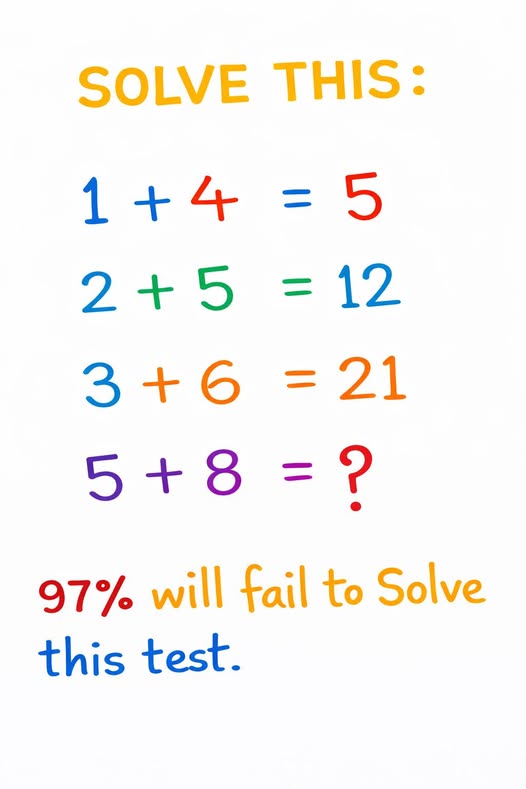
The puzzle begins with three statements that look familiar but do not align with standard addition. The equations are presented as: 1+4=5, 2+5=12, and 3+6=21, followed by a question asking for the value of 5+8.
Written as a set, it appears as: 1+4=5, 2+5=12, 3+6=21, 5+8=? The format invites solvers to assume there is a consistent pattern connecting each left-hand pair to the right-hand result.
The debate emerges because the pattern is not uniquely determined by the information provided. Different rules can be invented that correctly match the three given examples while producing different outcomes for the final expression.
Why the Same Puzzle Can Produce Different Results
The problem has generated divided opinions because it depends on what a solver believes the intended rule should be. With only three example equations, there are multiple ways to build a consistent system that fits them.
This is the heart of the disagreement. People looking for a single definitive answer often assume the puzzle must contain one hidden rule. Others argue that multiple rules can satisfy the same conditions, meaning more than one answer can be logically defended.
In practice, the challenge has been presented alongside five approaches that each produce a result for 5+8. Each approach treats the first three equations as clues, but each interprets those clues differently.
The discussion is less about routine calculation and more about pattern construction. The same starting information can point to more than one plausible structure, and the chosen structure determines the final output.
Strategy One Builds the Result From Multiplication Within the Expression
The first method frames the right-hand value as the left-hand first number plus the product of the first number and the second number. In this structure, the first number is used twice, once as an addend and once as a multiplier.
Under this approach, the first equation remains straightforward: 1 + 4 = 5. For the second, the method becomes explicit as 2 + 5 = 2 + 2(5) = 12, treating the second number as multiplied by the first number and added to the first number.
The third example is interpreted similarly: 3 + 6 = 3 + 3(6) = 21. The same structure is applied consistently, and it fits all three given results.
Using that same mechanism for the final expression produces: 5 + 8 = 5 + 5(8) = 45. The approach is summarized as A + A(B) = C, and it yields an answer of 45.
Strategy Two Uses the Previous Result as an Added Component
The second method treats the sequence as cumulative, with each new result incorporating the previous answer. Instead of relying only on the numbers currently shown, it uses the earlier outcome as an extra value added into the next equation.
In this structure, the first equation is written as 1 + 4 = 1 + 4 + (0) = 5, starting the process with an added value of zero because there is no earlier result.
The second equation becomes 2 + 5 = 2 + 5 + (5) = 12, where the prior answer, 5, is included. The third follows the same pattern: 3 + 6 = 3 + 6 + (12) = 21, adding the previous outcome of 12.
Extending the rule to the final line produces 5 + 8 = 5 + 8 + (21) = 34. The method is summarized as A + B + C’ = C, where C’ is the previous answer, producing 34.
Strategy Three Keeps a Running Base Value While Continuing the Sequence
The third approach introduces a different structure by maintaining a running value that begins at 5 and increases by 2 with each step. In this method, the puzzle’s visible left-hand pairs are not the drivers of the right-hand results.
It begins with 1 + 4 = 5 = 5, establishing a starting value. The next line is expressed as 2 + 5 = (5 + 2) + (5) = 12, combining the increased running value with the previous answer.
The third line continues the same construction: 3 + 6 = (7 + 2) + (12) = 21. The method keeps moving the running value upward by two each time, while also referencing the previous result.
Following that pattern for the final expression produces 5 + 8 = (9 + 2) + (21) = 32. The method is described as a process where X starts at 5, the new result is X plus the previous answer, and X increases by 2 at each step, yielding 32.
Strategy Four Reinterprets Each Sum Using Changing Number Bases
The fourth strategy departs from standard base-10 interpretation and instead represents the sum of the two numbers in a changing base system. The first equation is treated normally as 1 + 4 = 5, then subsequent sums are converted into different bases.
In this approach, 2 + 5 is first computed as 7, then expressed in base 5 as 12. The third equation follows the same concept: 3 + 6 equals 9, then expressed in base 4 as 21.
The final equation, 5 + 8, becomes 13 in base 10, then expressed in base 3 as 111. The structure is presented as a system that begins in one base and then shifts downward, resulting in an answer of 111 for 5 + 8.
This method highlights how a single numeric value can be written in different forms depending on the base used. The changing base becomes the hidden rule, allowing the earlier examples to match while producing a non-decimal representation as the final output.
Strategy Five Extends the Base-Conversion Pattern by Filling a Missing Step
The fifth approach uses a similar base-conversion concept but includes an additional step that is not shown in the original sequence. It assumes the pattern should account for a missing progression before reaching the final question.
Under this structure, 2 + 5 is again treated as 7 written in base 5 as 12, and 3 + 6 is 9 written in base 4 as 21. The method then inserts a line: 4 + 7 equals 11 written in base 3 as 102.
With that added step in place, the final expression is processed as 5 + 8 equals 13 written in base 2, described as binary, producing 1101. This approach therefore reaches an answer of 1101.
This method emphasizes that the perceived pattern may involve a countdown in base values while also maintaining sequential progression through the addends. By inserting the missing equation, it preserves the base shift in a more continuous way and yields a binary-form result.
What the Debate Reveals About Pattern Puzzles
The wide range of outcomes illustrates why this type of puzzle spreads quickly online. It can be presented as a single question, yet it invites lengthy discussion because different logical frameworks can be applied.
Some solvers prioritize a rule that stays closest to the visible numbers on each line, while others focus on the evolving sequence of results or on an external structure like number-base conversion. Each of the five strategies fits the given examples but leads to a different destination.
The disagreement does not come from arithmetic error within the chosen method. It comes from the freedom to choose the method itself, because the problem provides too little information to force one unique rule.
As a result, the puzzle has become an example of how internet challenges can be as much about reasoning style as about calculation. For many participants, the satisfaction lies in identifying a pattern that works, explaining it clearly, and comparing it against other valid approaches.
A Popular Format That Turns Math Into a Shared Challenge
The format also helps explain why people who disliked formal math settings still find these problems engaging. Online puzzles are self-paced, often playful, and built around discovery rather than instruction.
They appeal to those who enjoy structured thinking and to those who prefer creative interpretation, since the same prompt can support multiple frameworks. In this puzzle, the numbers serve as clues, and the solver’s job is to decide what kind of system those clues suggest.
Whether a person arrives at 45, 34, 32, 111, or 1101, the experience remains the same: a short set of equations that sparks curiosity, invites experimentation, and turns a simple question into a broader conversation about patterns and logic.
In the end, the challenge demonstrates why such puzzles continue to circulate. A few lines of numbers can generate multiple coherent solutions, and that flexibility keeps the debate alive long after the question is first posted.