
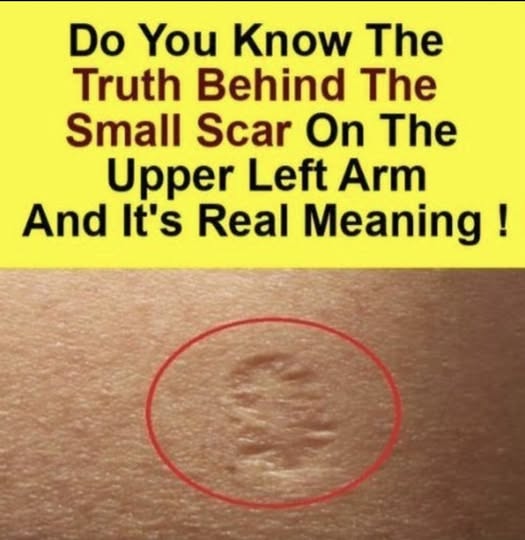
I have a vivid memory from my childhood, one that has remained surprisingly clear over the years. I remember noticing a distinct scar on my mother’s arm—high up, near her shoulder—that drew my attention for reasons I couldn’t explain at the time.
It wasn’t a simple mark. Around a slightly larger central indentation was a ring of tiny, evenly spaced punctures, forming a pattern that seemed deliberate. As a child, I had no understanding of what it meant, but something about its shape and texture captivated me. Perhaps it was the way it contrasted with her otherwise smooth skin, or the unusual formation itself.
Over time, like many childhood curiosities, my fascination faded. Years passed, and I rarely thought about the scar, until one summer moment brought it sharply back into focus. I was helping an elderly woman off a train, guiding her carefully down the steps, when my gaze fell on her arm. There it was—the same type of scar in the same location as my mother’s.
The brief moment of recognition transported me back decades. I couldn’t pause to ask the woman about it, but later that day, I called my mother. She explained, patiently, that I had known this before: the mark was from the smallpox vaccine, a piece of medical history I had long forgotten.
Smallpox: A Deadly Chapter in Human History
Smallpox was one of the most feared diseases in history. The virus caused fever, severe skin rashes, and, in many cases, death. According to the Centers for Disease Control and Prevention (CDC), smallpox killed roughly 30% of those infected during 20th-century outbreaks, leaving survivors permanently scarred.
The disease spread rapidly, devastating entire communities. Hospitals struggled to treat patients, while public health officials imposed quarantines to curb infections. For centuries, there was no cure, and families lived in constant fear. Those who survived often bore visible scars that told of their encounters with this deadly illness.
The Smallpox Vaccine and Its Legacy
The invention of the smallpox vaccine revolutionized human health. Edward Jenner developed the vaccine in the late 18th century using cowpox material to confer immunity to smallpox. Over time, vaccination programs became widespread, eventually eradicating the disease in the United States by 1952. Routine vaccination ended in 1972, and globally, the World Health Organization declared smallpox eradicated in 1980—the first time humanity eliminated a major infectious disease.
Before vaccinations ceased, every child in the United States received the smallpox vaccine. The procedure left a characteristic scar on the upper arm near the shoulder—the very spot I had remembered on my mother. This mark acted as a visible “passport” of immunity, indicating protection against one of the deadliest viruses in history.
Why the Vaccine Left a Scar
The distinct scar was not accidental. The smallpox vaccine was delivered using a bifurcated needle, which deposited the virus into the skin’s dermis through multiple punctures. This method triggered a local immune response: a red bump developed into a fluid-filled vesicle, which eventually scabbed and fell off, leaving a permanent mark.
The pattern of smaller indentations surrounding a central mark reflected the puncturing technique used to ensure effectiveness. Beyond its medical significance, the scar became a visual record of vaccination, easily identifying those who had been protected. In an era before digital records, this simple mark served as a lifelong certificate of immunity.
Reflections on Memory and History
Seeing the same scar on a stranger years later sparked a profound reflection on memory, history, and the way our bodies carry the past. The scar represents more than a medical procedure; it is a living artifact of human ingenuity, public health progress, and the collective fight against one of history’s deadliest diseases.
Each scar tells a story—of survival, scientific achievement, and the generations protected by vaccines. My own memory of the scar, buried for decades, resurfaced with clarity, highlighting how seemingly small details can carry immense personal and historical significance.
Vaccination and Modern Public Health
While smallpox vaccination has ceased in the U.S., the principles it established continue to guide public health. Modern vaccines for diseases like polio, measles, and COVID-19 follow similar immune system strategies, though they are generally less invasive and rarely leave permanent marks.
The smallpox scar stands as a tangible reminder of a time when vaccination represented both personal protection and societal achievement. It reminds us that behind every vaccination campaign are countless individual stories: children receiving their first vaccine, parents hoping to protect their families, and communities striving to prevent outbreaks.
Conclusion
The small scar on my mother’s arm, once a curious childhood detail, has grown into a symbol of medical history, resilience, and the collective fight against disease. It bridges personal memory and public health, connecting one family’s story to the eradication of a deadly virus.
This small mark embodies lessons about curiosity, observation, and the impact of science. What seemed trivial in childhood can reveal profound truths about history, human ingenuity, and the progress humanity can achieve when knowledge and perseverance intersect.
Even a tiny scar can carry the weight of survival, the triumph of medicine, and the story of generations protected from one of humanity’s most formidable diseases.