
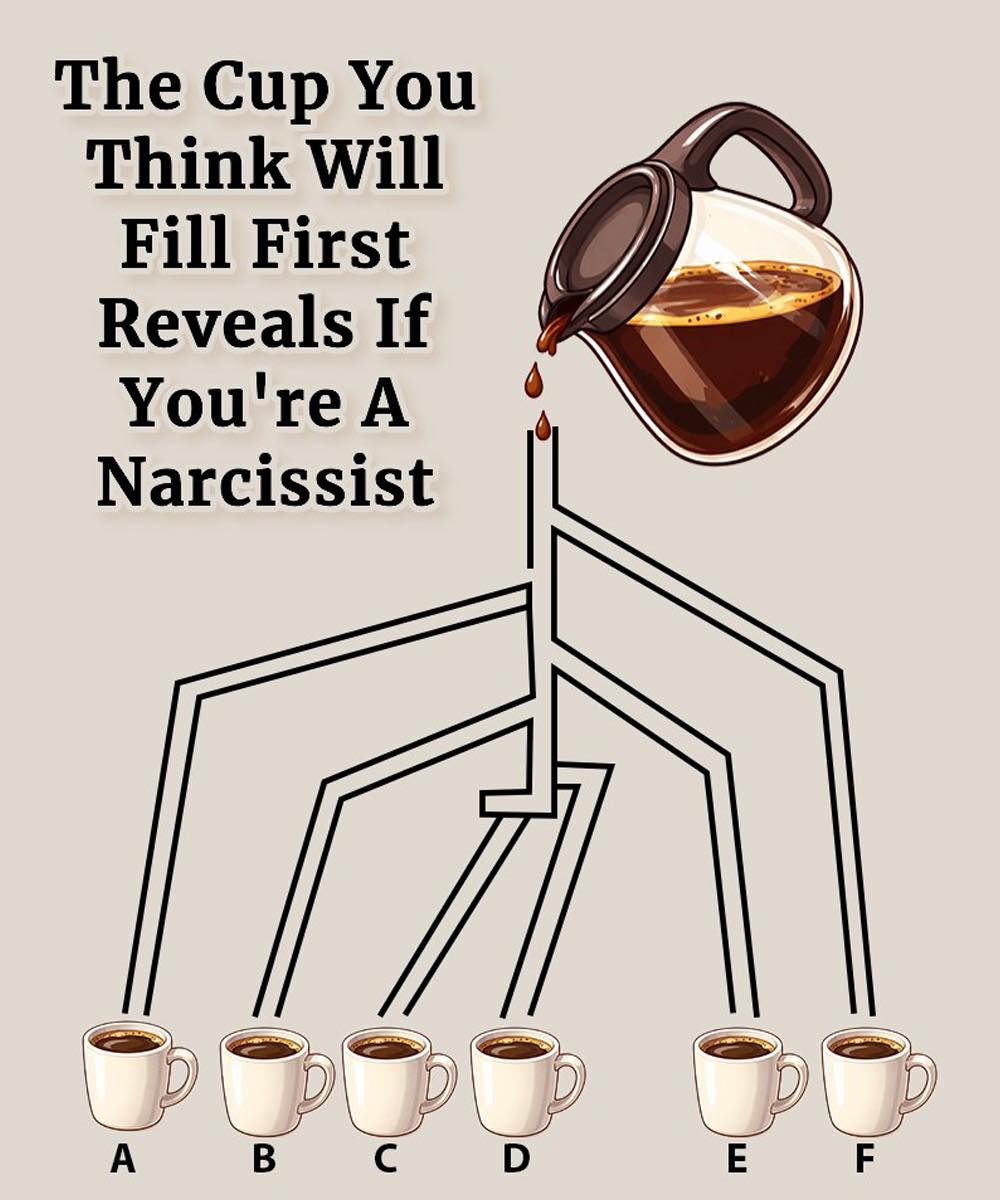
An image circulating widely across social platforms presents a deceptively simple scene. A stream of coffee appears to move through a tangle of pipes toward six cups labeled A through F. The prompt attached to the picture asks viewers to identify which cup will fill first. On the surface, the task looks like a routine logic exercise built around visual tracing and cause-and-effect.
The broader appeal of the graphic, however, does not rest on coffee or plumbing. The image functions as a small case study in how people approach uncertainty, how quickly they commit to a conclusion, and what kind of reasoning they trust most when information is incomplete. The puzzle has become a conversation starter because it highlights differences in confidence, caution, intuition, and analytical rigor rather than because it rewards a single correct answer.
The structure of the image invites a rapid judgment. Pipes appear to branch, loop, and block one another in ways that can mislead the eye. Some routes look open at first glance but turn out to be closed. Others seem improbable but ultimately lead somewhere. The viewer’s choice of cup often says more about the method used to decide than about the diagram itself.
Psychologists and behavioral researchers have long used similar visual problems to observe decision styles. Some people rely on immediate impressions. Others trace every path. Still others blend emotional cues with logic. The coffee puzzle compresses those tendencies into a quick, shareable test. The following sections outline what each common choice tends to signal about a person’s approach to decisions, work, and risk.
Cup A: Confidence Before Process
Selecting Cup A is frequently associated with strong trust in personal judgment. People who settle on this option often move quickly and show comfort with committing to a conclusion without prolonged analysis. The pattern suggests decisiveness and a willingness to rely on experience and instinct rather than extended verification.
In professional settings, this style can translate into assertive leadership. Decisions are made promptly, and momentum is maintained. Teams often appreciate the clarity that comes with a firm call, especially in situations where delays carry a cost. This approach can also signal independence, as the decision-maker does not require extensive external validation before acting.
The trade-off appears when hidden variables are present. Visual puzzles are designed to include traps, and real-world situations frequently contain similar complications. A rapid choice can overlook blocked paths or missing information. When outcomes fall short, the issue is rarely a lack of ability. More often, it reflects speed overtaking scrutiny.
Strength in this pattern lies in confidence and forward motion. The main vulnerability is skipping verification steps that might reveal obstacles.
Cup B: Balance and Reassurance
Those who choose Cup B typically display a preference for stability and measured progress. This group tends to pause, review, and confirm before committing. The underlying motivation is not indecision but a desire for outcomes that feel reliable and emotionally comfortable. The mindset is often summarized by the phrase, “Let me just check one more thing.”
In collaborative environments, this approach can be highly valued. It reduces the likelihood of rash moves and encourages consensus. Colleagues often view these decision-makers as considerate and fair, particularly when choices affect multiple stakeholders.
The limitation emerges under time pressure. When rapid action is required, the same caution that prevents mistakes can slow progress. Opportunities can pass while confirmation is still underway. The pattern favors accuracy and reassurance, sometimes at the expense of speed.
The core advantage is thoughtfulness and emotional balance. The main risk is over-caution in situations that demand swift execution.
Cup C: Method and Detail
Choosing Cup C is commonly linked to a methodical, detail-oriented process. Individuals who prefer this option are more likely to trace each pipe carefully rather than rely on first impressions. Appearances are treated with skepticism, and structure, logic, and proof carry greater weight.
This style aligns closely with analytical roles. In fields that reward precision, such as engineering, finance, or research, the ability to notice what others miss can prevent costly errors. These decision-makers often catch inconsistencies early and bring order to complex systems.
The challenge arises when the search for certainty becomes exhaustive. Rechecking work that is already sound can lead to delays and fatigue. In fast-moving environments, the pursuit of perfect information can result in missed windows of action.
The primary strength is accuracy grounded in logic. The principal blind spot is perfectionism that limits flexibility.
Cup D: Complexity and Control
Cup D tends to attract people who enjoy untangling intricate problems. The appeal lies not only in reaching an answer but in the process of navigating layered systems. This group often believes that deeper analysis reveals better solutions and takes satisfaction in mastering complexity.
Strategic planning and long-term problem-solving benefit from this orientation. Seeing multiple steps ahead and anticipating interactions between variables can produce robust plans. The emphasis on understanding underlying structures makes these decision-makers effective in scenarios where surface-level solutions fail.
At the same time, a preference for complexity can obscure simpler truths. Not every problem requires an elaborate framework, and assuming that the best answer must be the most intricate can lead to unnecessary complications. Efficiency sometimes gives way to intellectual elaboration.
The defining advantage is strategic depth. The main vulnerability is over-intellectualizing situations that could be resolved more directly.
Cup E: Intuition and Emotion
Selecting Cup E is often associated with intuitive reasoning. Rather than following the visible mechanics alone, these decision-makers rely on a sense of how outcomes should unfold. The process blends perception, experience, and emotional awareness into a single judgment.
This approach supports strong interpersonal skills. Empathy, contextual awareness, and sensitivity to consequences are frequently present. In leadership or team settings, such individuals may anticipate reactions and morale more effectively than those focused solely on technical details.
However, intuition does not always align with precision. Visual puzzles, like operational challenges, can hide critical constraints. When emotion leads without sufficient structural analysis, important factors can be missed, resulting in avoidable errors.
The key strength is emotional intelligence and holistic thinking. The main weakness is the tendency to bypass rigorous logical checks.
Cup F: Boldness and Image
Cup F is commonly chosen quickly, reflecting a preference for clear, confident conclusions. People drawn to this option often trust their first impression and resist prolonged second-guessing. There is value placed on decisiveness and on being seen as certain. The role is sometimes summarized as being “the one who knows.”
In organizational life, this confidence can be magnetic. Teams often look to such figures for direction, especially during uncertainty. Charisma and assertiveness can accelerate action and reduce ambiguity about next steps.
The risk appears when confidence replaces curiosity. Over time, unexamined assumptions can accumulate. When certainty becomes the default posture, blind spots expand, and feedback may be overlooked. The style works best when paired with mechanisms that invite periodic review.
The primary advantage is self-assurance and clarity. The principal hazard is ignoring hidden details.
Beyond the Diagram
The enduring popularity of the coffee-and-pipes image stems from what it reveals about certainty rather than from the diagram itself. The exercise highlights differences in how people balance speed and accuracy, instinct and process, confidence and caution. Each choice reflects a trade-off that appears in everyday decisions, from business strategy to personal planning.
In many professional contexts, the most effective teams combine these styles. Quick decision-makers provide momentum. Detail-oriented analysts reduce risk. Strategists map long-term implications. Intuitive thinkers maintain human awareness. Cautious reviewers safeguard stability. The puzzle works as a mirror because it shows how easily one approach can dominate when time is short and information is partial.
The image also underscores a broader point about cognitive habits. Visual problems are designed to exploit assumptions. A blocked pipe that looks open at first glance resembles a market opportunity that seems obvious until constraints are examined. A complex route that actually works mirrors a solution that requires patience to uncover. In both cases, the initial choice reveals how the mind handles uncertainty.
The most durable insight from the exercise is captured in a simple statement: “The smartest minds aren’t the fastest—they’re the most aware of what they might be missing.” This perspective reframes the puzzle from a race to an answer into a reflection on awareness itself. Speed, intuition, and confidence all have their place. So do verification, analysis, and restraint. The challenge is recognizing which tool fits the moment.
As the coffee continues to “flow” across screens worldwide, the image remains a small but telling reminder. Decisions are rarely just about the surface problem. They are about habits of thought, comfort with ambiguity, and the balance between action and reflection. The cup that fills first is less important than the process that led someone to choose it.