
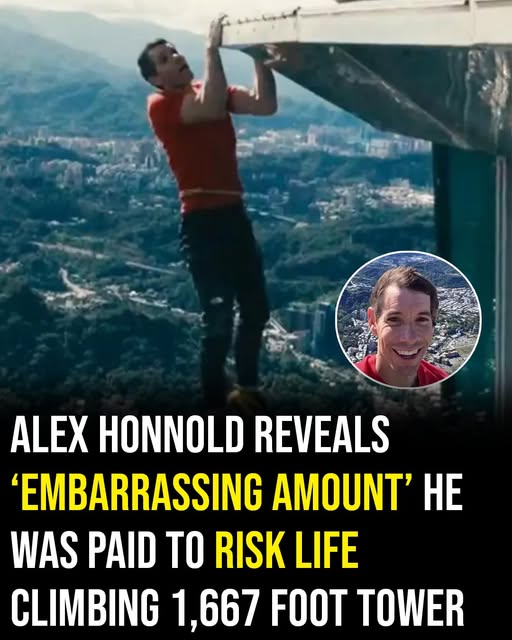
Alex Honnold once again captured global attention this past weekend with an extraordinary feat: scaling Taipei 101, one of the tallest buildings in the world, in Taiwan. The climb, broadcast live on Netflix, showcased the renowned free solo climber’s skill, daring, and fearless approach to high-altitude adventure.
Standing 1,667 feet tall, Taipei 101 is famous not only for its height but also for its unique structural design. Its large tuned mass damper helps stabilize the skyscraper against strong winds, while its futuristic architectural style includes multiple sections that taper outward, creating ledges and overhangs that challenge climbers. To reach the pinnacle, Honnold had to navigate eight overhangs, each one presenting a distinct technical obstacle before arriving at the final, narrow spire at the top.
The live broadcast, part of Netflix’s Skyscraper Live, lasted over an hour and 35 minutes. Viewers around the world followed every tense moment as Honnold moved with precision and calm under extreme conditions. What made the feat even more remarkable was that it was completed entirely without safety equipment or protective measures. Honnold had no harness, no ropes, and, according to him, no life insurance—fully exposing himself to the inherent dangers of free soloing such a massive structure.
Despite the incredible risk, Honnold emphasized that the climb was never about financial gain. In an interview with The New York Times, he described the compensation as “less than my agent aspired to” and declined to disclose the exact figure. He characterized the amount as “embarrassingly small,” especially when compared to the multi-million-dollar contracts seen in mainstream professional sports.
“Actually, if you put it in the context of mainstream sports, it’s an embarrassingly small amount,” Honnold explained. “Major League Baseball players get like $170 million contracts. Like, someone you haven’t even heard of and that nobody cares about. So in that case, yeah, an embarrassingly small amount.”
Sources estimate that Honnold likely earned somewhere in the mid-six-figure range for the climb. However, he was quick to clarify that the monetary aspect was secondary.
“I mean, I would do it for free. If there was no TV program and the building gave me permission to go do the thing, I would do the thing because I know I can, and it’d be amazing,” he said.
Speaking about the experience itself, Honnold described the surreal sensation of reaching the top of Taipei 101.
“Just sitting by yourself on the very top of the spire is insane,” he said. “And so, you know, if there wasn’t the whole spectacle around it, and I just had the opportunity to go do it by myself, I’d be fine with that. I would do that, but in this case, there is a spectacle.”
He further clarified his perspective on compensation: “I’m not getting paid to climb the building. I’m getting paid for the spectacle. I’m climbing the building for free.”
Honnold also discussed why he chose not to obtain life insurance for the endeavor, explaining his skepticism about the industry.
“I think insurance in general is kind of a scam. The whole point is to pay in. There’s a reason insurance companies are financial giants. Because everyone else is getting screwed,” he said.
The climb drew widespread admiration from viewers and fellow athletes, who praised Honnold’s technical skill, composure, and mental focus. Taipei 101’s complex architecture, with its outward-tapering sections and ledges, added layers of difficulty that even seasoned climbers would approach with caution. Yet Honnold moved methodically, demonstrating why he is considered one of the world’s elite free solo climbers.
Beyond the thrill, the climb also highlighted Honnold’s philosophy toward risk and achievement. For him, the money and recognition are secondary to the act itself—the challenge, the personal mastery, and the experience of engaging directly with an extraordinary structure in a way few could even imagine.
The live-streamed climb captivated a global audience, blending extreme sports, urban exploration, and live entertainment. Viewers were able to experience the tension and exhilaration of Honnold’s ascent in real time, appreciating not only his physical prowess but also the strategic thinking and mental preparation required for such a high-stakes climb.
While many questioned the wisdom of climbing without safety measures, Honnold’s calm and deliberate approach demonstrated years of training, experience, and a deep understanding of risk management. He has long been known for pushing boundaries while meticulously assessing his capabilities, and the Taipei 101 climb was no exception.
The event has already sparked conversations about urban climbing, free soloing, and the growing appeal of extreme sports on global streaming platforms. For Honnold, the climb reinforced his long-standing ethos: the act itself, the personal challenge, and the experience of the spectacle hold far more value than any financial reward.
In a world where high-profile stunts are often motivated by fame or money, Honnold’s Taipei 101 ascent reminded viewers that some feats are pursued for passion, skill, and the sheer joy of human potential.
The climb’s combination of architectural complexity, extreme risk, and live broadcast made it a moment that will be remembered in the climbing and entertainment communities alike. For Honnold, it was a demonstration of mastery over both mind and body—a testament to what can be achieved when preparation meets fearlessness.