
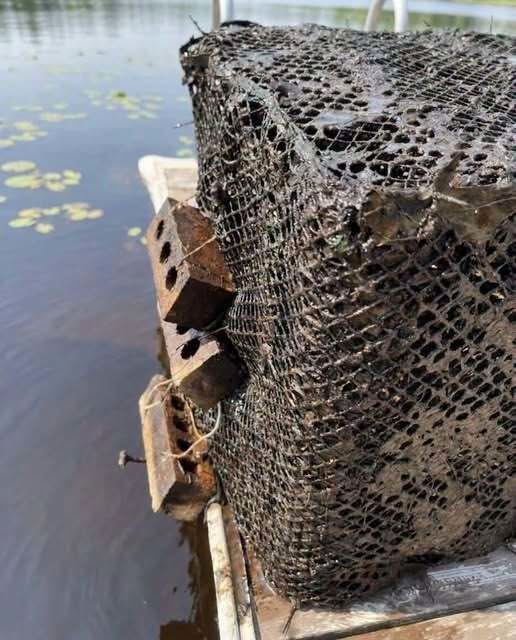
Fish Cribs Transform Empty Lake Bottoms Into Sheltered Habitats for Aquatic Life
A calm lake can appear almost completely still when viewed from the shoreline. The surface reflects the sky, fishing floats move gently with the water, and the only sounds may come from nearby birds or small waves touching a boat.
Beneath that quiet surface, however, fish, insects, plants, and microorganisms are constantly searching for food, shelter, and suitable places to reproduce.
In lakes with flat or mostly empty bottoms, natural hiding places may be limited. Young fish can be especially vulnerable when there are few rocks, branches, plants, or underwater ledges where they can escape larger predators.
Fish cribs were developed as a practical response to that problem. These human-built structures create underwater cover and can gradually become active habitats supporting several levels of aquatic life.
What Is a Fish Crib?
A fish crib is an artificial underwater structure designed to provide shelter, feeding areas, and hiding spaces for fish and other organisms.
Traditional cribs were commonly built from logs, branches, stones, and other durable materials. The pieces were arranged into a rough frame with openings of different sizes.
Some looked like wooden boxes filled with branches. Others resembled piles of timber secured with heavy rocks so they would remain on the lake bottom.
The design often depended on the materials available, the depth of the lake, and the types of fish the builders wanted to support.
Although early fish cribs were strongly associated with improving fishing opportunities, their role eventually became much broader. Once submerged, a simple wooden structure could slowly develop into a small but complex ecosystem.
Anglers Learned That Fish Gathered Around Cover
Long before electronic fish finders, underwater cameras, and digital lake maps became common, anglers studied the water through repeated observation.
They noticed that fish were not distributed evenly throughout a lake. Certain locations consistently held more aquatic life than open areas.
Submerged trees, weed beds, rocky drop-offs, and fallen branches attracted fish because they provided both protection and access to food.
By comparison, a flat lake bottom offered few advantages. Small fish crossing an exposed area could be easily seen and captured by predators.
Anglers eventually realized that placing a structure in an empty section of the lake could imitate the benefits of natural cover.
The principle was straightforward: when shelter was introduced, aquatic life often followed.
Some Cribs Were Built on Frozen Lakes
In cold regions, winter offered a practical opportunity to place heavy structures in selected areas.
A frozen lake created a temporary work surface that allowed volunteers to assemble cribs directly above the intended location.
Builders arranged logs and branches on the ice, then added stones or another approved source of weight.
When spring temperatures melted the ice, the crib dropped into the water and settled onto the lake floor.
This method required careful planning because the structure could not be repositioned easily after it sank.
Smaller cribs were sometimes transported by boat and lowered with ropes. Regardless of the method, the purpose was to add durable cover where natural habitat was limited.
An Empty Structure Gradually Became a Living System
A newly submerged fish crib did not instantly fill with fish. Its transformation occurred slowly as the lake began incorporating the structure into its existing environment.
Algae and microscopic organisms attached themselves to the logs and stones. Aquatic insects then moved into the area to feed, rest, and reproduce.
Small fish arrived to consume those insects and use the open spaces within the structure as shelter.
Larger fish eventually discovered that prey gathered nearby and began patrolling the outer edges.
Over time, the crib could function as a nursery, feeding station, refuge, and hunting area.
What began as an arrangement of wood and rock became a place where different parts of the food chain interacted.
Young Fish Receive Important Protection
Newly hatched and juvenile fish face danger from the moment they enter the water.
Larger fish, birds, turtles, and other predators can consume them before they reach maturity.
A fish crib creates narrow openings that young fish can enter while larger animals remain outside.
Branches, logs, stones, and mesh-like sections provide small pathways where vulnerable fish can hide when threatened.
The structure may also bring food closer to shelter. Young fish can feed on insects and microscopic organisms without traveling far into exposed water.
No crib can guarantee survival, but improved cover may allow more juveniles to grow into adults. Over time, that can support a more stable fish population.
Predatory Fish Also Use the Habitat
Fish cribs do not serve only small species. Larger game fish are also attracted to them because the structures concentrate potential prey.
Predators commonly remain near the outer edges rather than entering the tight interior spaces.
They wait for smaller fish to leave the protection of the crib or move between nearby feeding areas.
This creates a layered habitat. Small fish occupy the protected center, while larger fish use the surrounding open water.
The crib does not eliminate the natural relationship between predator and prey. Instead, it introduces enough complexity to give smaller fish a better opportunity to avoid immediate capture.
Fish Cribs Became Valuable Fishing Locations
Once anglers recognized that fish gathered around submerged cribs, the locations became highly valued fishing spots.
Before precise electronic mapping, families often remembered crib locations by using landmarks along the shore.
An angler might align a large tree with a barn, rock formation, dock, or distant hill to position a boat over the hidden structure.
Knowledge of these locations was sometimes passed quietly between relatives and close friends.
Different cribs could be productive at different times. One might attract fish during cooler mornings, while another became active near sunset.
Finding the crib did not guarantee a successful trip. Depth, weather, water temperature, seasonal movement, and fish behavior still influenced whether anything would bite.
Even so, the structure increased the likelihood that fish would be present in that part of the lake.
A Fishing Technique Developed Into Conservation
Early builders may have created cribs mainly to improve their chances of catching fish.
Over time, people began recognizing that the structures also replaced habitat lost through human activity.
Shoreline development, erosion, vegetation removal, and the clearing of fallen trees can leave a lake with fewer places for fish to hide.
Property owners sometimes remove branches and submerged wood because they want a cleaner-looking shoreline.
While the area may appear more orderly, removing those materials can eliminate valuable habitat.
Artificial cribs became one method of restoring some of the complexity that had disappeared.
The purpose expanded from attracting fish for anglers to helping rebuild the underwater environment that fish needed for survival.
Communities Worked Together to Build Habitat
Large fish crib projects often required cooperation among anglers, conservation groups, landowners, and local volunteers.
One participant might provide logs, while another contributed rope, stones, transportation, or access to equipment.
Volunteers gathered to assemble the structures and discuss suitable placement locations.
This changed the activity from an individual fishing strategy into a community conservation project.
Participants understood that the crib might take years to mature fully. They were investing effort into a habitat that future anglers and residents would also use.
That long-term perspective helped encourage a more responsible relationship with the lake.
Families Passed the Knowledge Forward
For many families, fish cribs became part of a tradition extending beyond the act of catching fish.
Parents and grandparents taught younger relatives where the structures were located and why fish gathered around them.
Fishing trips became opportunities to explain predator behavior, food chains, spawning areas, and the importance of underwater shelter.
Children learned that maintaining a healthy lake involved more than removing fish from the water.
Protecting the places where fish fed, reproduced, and matured was equally important.
Some families returned to the same sections of a lake for generations, following routes established long before modern mapping technology existed.
The Structures Also Preserved Family Stories
A fishing location used for many years naturally becomes connected to personal memories.
Families remember the largest fish caught there, the one that escaped beside the boat, or the morning when nobody caught anything but remained on the water anyway.
A grandparent might remember helping construct a crib as a teenager.
Decades later, that same person could bring a grandchild to fish above it.
The structure remained unseen beneath the surface, but its location became part of the family’s shared history.
Even when the wood weakened or changed underwater, the stories associated with the crib remained strong.
Modern Cribs May Use New Materials
Contemporary fish habitat structures do not always resemble the original log-and-stone designs.
Some are made from PVC pipes, synthetic panels, mesh, or specially manufactured plastic components.
These materials may last longer underwater and can be arranged to create openings suitable for fish of different sizes.
Modern structures may resemble underwater bushes, cages, trees, or open frameworks.
Some are designed to reduce the risk of snagging fishing lines. Others prioritize dense shelter for young fish.
The appearance has changed, but the underlying principle remains the same. Adding structure to an empty area gives aquatic organisms more surfaces and spaces to use.
Placement Is Essential to Success
A fish crib cannot simply be dropped into a random part of a lake and expected to become effective habitat.
Water depth, bottom material, oxygen levels, temperature changes, existing vegetation, and seasonal conditions all influence the result.
A structure placed too deeply may receive limited oxygen during certain periods.
One positioned too close to the surface may interfere with boats, swimmers, or changing water levels.
Soft sediment can absorb heavy structures, burying the openings that fish need.
Placement near travel routes, spawning areas, drop-offs, or existing habitat may improve the crib’s usefulness.
Successful projects often involve lake managers or fisheries specialists who understand local water conditions.
Poorly Planned Structures Can Cause Harm
Not every object placed underwater becomes suitable fish habitat.
Treated lumber, unstable metal, loose wire, and discarded household items can release harmful substances or create dangerous conditions.
Improper structures may trap wildlife, snag fishing equipment, damage boats, or create hazards for swimmers.
Unrecorded placement can also interfere with navigation.
For these reasons, fish cribs should not be installed without authorization and careful planning.
Many lakes have rules governing the types of materials that may be used, the allowed locations, and the required permits.
Responsible projects document the position of every structure and use materials approved for long-term underwater exposure.
Fish Cribs Cannot Solve Every Environmental Problem
Artificial shelter can improve habitat, but it cannot repair every form of lake damage.
A body of water affected by pollution, invasive species, severe oxygen loss, or destructive shoreline activity requires broader restoration measures.
Adding cribs cannot replace clean water, healthy vegetation, stable banks, or responsible fishing limits.
The structures work best as one part of a larger conservation strategy.
A healthy fish population depends on suitable spawning conditions, sufficient food, good water quality, stable oxygen, shelter, and sustainable harvesting.
Cribs can supplement those conditions, but they cannot substitute for them.
The Lake Floor Is More Important Than It Appears
People commonly judge the condition of a lake by looking at its surface.
Clear water and a peaceful shoreline may create the impression of a complete and healthy ecosystem.
To a fish, however, a flat lake bottom can resemble an open field without trees, buildings, or places to hide.
A crib changes that landscape by adding height, edges, shade, surfaces, openings, and pathways.
Those physical details influence where fish rest, feed, and seek protection.
A relatively small structure can therefore affect how aquatic life uses a much larger surrounding area.
Shared Stewardship Became Part of the Tradition
Fishing is often associated with personal skill, private knowledge, and carefully guarded locations.
Community crib projects introduced a more cooperative approach.
Volunteers worked together to improve habitat that could benefit everyone using the lake.
The results extended beyond those who built the structures.
Future anglers, children, property owners, wildlife watchers, and nearby communities could all benefit from a healthier aquatic environment.
This shared responsibility helped conservation become a local practice rather than a distant idea.
People protected the water because it was part of their own lives and family histories.
An Invisible Structure Can Influence a Lake for Years
Most visitors will never directly see a submerged fish crib.
It remains beneath the surface as algae and other growth gradually cover the original material.
Insects attach to it, small fish move through its openings, and predators circle nearby.
Above the crib, boats pass and fishing lines descend through the water.
Families may wait quietly without realizing how much activity is occurring below them.
The crib does not need to be visually impressive. Its importance is measured by the life that gathers around it.
The Basic Promise Remains Unchanged
Fish cribs began with a simple observation: fish need shelter, and an empty lake bottom offers limited protection.
By placing structure underwater, early anglers created locations where algae, insects, young fish, and predators could interact.
The practice later developed into a form of habitat restoration, community cooperation, and family tradition.
Modern materials may be more durable, and electronic technology may make the structures easier to locate.
The central purpose, however, has remained consistent.
Where responsible shelter is created, aquatic life has more opportunities to gather, feed, hide, and mature.
A fishing line may receive its next pull near a crib built many years earlier by volunteers who understood that a lake needs more than water to remain productive.
It needs healthy habitat, careful planning, patient stewardship, and people willing to protect the unseen world beneath its surface.