
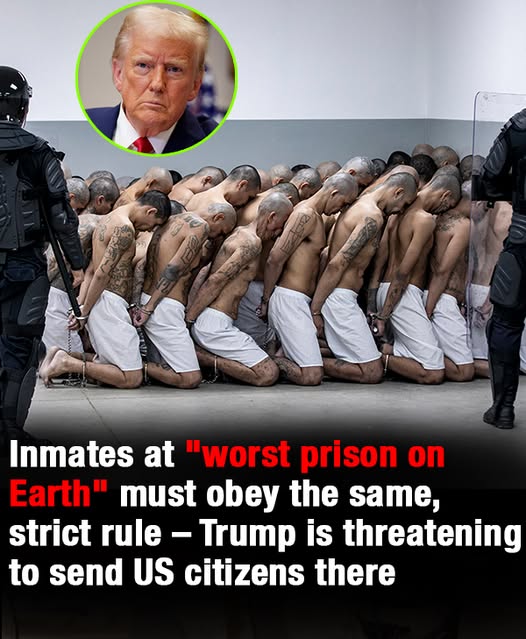
Trump Immigration Policy Draws Attention to El Salvador’s Controversial CECOT Prison
A Prison at the Center of an International Debate
Donald Trump’s immigration position has drawn global attention to one of the most controversial detention facilities in the world. The prison, known as CECOT, has become a focus of debate because of its size, purpose, conditions, and the possibility that deported people could be sent there without a proven conviction.
CECOT is short for the Centre for the Confinement of Terrorism. The facility is located about 70 kilometers east of San Salvador and covers a 23-hectare site.
The prison was built in February 2023 as the centerpiece of President Nayib Bukele’s sweeping campaign against gangs in El Salvador. Designed to hold up to 40,000 inmates, it is the largest prison complex in the Americas.
The project cost $115 million and is a central part of Bukele’s security strategy. The 44-year-old president has promoted aggressive measures against gangs, and those policies have been linked to a sharp drop in homicide rates across the country.
That decline has made Bukele’s approach popular among many supporters who see the crackdown as a major improvement in public safety. At the same time, the strategy has drawn serious concern from critics who warn that mass arrests and detentions may capture people without sufficient evidence.
Bukele’s Security Strategy Brings Praise and Alarm
Bukele’s policies have created a deep divide between those who focus on public safety gains and those who focus on civil liberties and human rights. Supporters argue that his strategy has reduced violence and restored a sense of security in communities affected by gangs.
Critics, however, warn that such a broad crackdown can come at a severe cost. When authorities detain people in large numbers, the risk grows that individuals may be imprisoned without strong evidence or meaningful due process.
CECOT sits at the center of that debate. It is not merely a prison with a large capacity. It represents a model of incarceration built around isolation, control, and punishment.
Analysts from the SAIS Review of International Affairs have described the facility as prioritizing “security and isolation over rehabilitation, reflecting a punitive approach to incarceration.”
That description has become one of the key concerns surrounding the prison. Rather than focusing on preparing inmates for reintegration into society, the facility has been described as a place where security and separation dominate every part of daily life.
A Facility Described as a “Concrete and Steel Pit”
The prison’s design and purpose have led to strong criticism from international observers. Miguel Sarre, a former member of the United Nations Subcommittee for the Prevention of Torture, described the mega prison as a “concrete and steel pit,” a phrase that reflects concerns about the conditions and philosophy behind the facility.
The description points to the physical and symbolic nature of CECOT. It is presented not as a place centered on rehabilitation, but as a massive structure built to contain large numbers of people under extremely strict control.
Because of its scale, CECOT has become one of the most visible symbols of El Salvador’s security policy. Images and descriptions of the facility have circulated widely, reinforcing its reputation as one of the harshest detention environments in the world.
For supporters of Bukele’s approach, that harshness is part of the point. They see the prison as a strong response to violent criminal organizations and a warning to those accused of threatening public safety.
For critics, the same harshness raises serious questions about human rights, legal protections, and whether incarceration can become a method of permanently removing people from society without adequate legal safeguards.
Trump Deportation Plan Intensifies the Controversy
The debate around CECOT expanded beyond El Salvador when Bukele offered the Trump administration an arrangement to house “dangerous criminals” deported from the United States in the “notorious” prison.
That invitation became part of a broader immigration controversy involving Trump’s use of a little-known 18th-century wartime law. The law was used to justify deporting foreign nationals accused of crimes in the United States.
The administration argued that the United States was facing an “invasion” by violent organizations. That claim became the basis for the deportation effort, even as legal challenges and human rights concerns intensified.
The White House paid roughly $6 million to imprison about 300 alleged violent criminals in El Salvador for one year. The arrangement tied U.S. immigration enforcement directly to the prison system built under Bukele’s gang crackdown.
The move created a major dispute over whether people accused of crimes should be sent to a foreign prison known for extreme conditions, especially before a proven conviction has been established.
Warning From Homeland Security
The policy was promoted with a direct warning to undocumented immigrants accused of criminal activity. Kristi Noem, the former Secretary of Homeland Security, posted a message in March 2025 that highlighted the administration’s position.
“President Trump and I have a clear message to criminal illegal aliens: LEAVE NOW,” Kristi Noem, the former Secretary of Homeland Security, warned in a March 2025 social media post.
“If you do not leave, we will hunt you down, arrest you, and you could end up in this El Salvadorian prison.”
The message made clear that CECOT was being used not only as a detention site, but also as a threat intended to deter people from remaining in the United States illegally if they were accused of criminal conduct.
That approach intensified public attention on the prison. It also raised questions about how far immigration enforcement should go and whether deportation to such a facility could be used before a person’s guilt is fully proven through the legal system.
The warning was direct, forceful, and politically charged. It presented the El Salvador prison as a possible consequence of remaining in the United States while facing accusations of violent criminal activity.
Legal Challenge and Flights Already in the Air
A federal judge attempted to block the deportations. However, the ruling came after flights carrying deportees were already in international airspace.
The administration has maintained that its actions were lawful. The timing of the judge’s order and the already-departed flights became part of the controversy, with critics questioning whether the deportations moved too quickly for legal review to be effective.
The situation created a difficult legal and ethical dispute. On one side, the administration argued that it had the authority to remove dangerous individuals and send them to El Salvador. On the other side, opponents raised concerns about due process, prison conditions, and the rights of those being deported.
The use of a wartime law added another layer of debate. Critics questioned whether such a law should be applied to immigration enforcement in this context, while supporters of the policy emphasized the administration’s claim that violent organizations posed an extraordinary threat.
As the legal fight continued, CECOT remained central to the issue. The prison was no longer only a symbol of El Salvador’s domestic security policy. It had become part of a cross-border immigration and human rights conflict.
Human Rights Concerns Grow
Human rights groups and international observers have strongly criticized the arrangement. Reports have described CECOT as a “black hole of human rights,” warning that international standards for prisoner treatment are not followed inside the facility.
The phrase reflects the fear that people sent into CECOT may lose access to basic protections, oversight, and legal recourse. For critics, the concern is not only the strict environment, but the possibility that detainees could disappear into a system designed to keep them isolated indefinitely.
Sarre also warned that the prison appears to function as a system “to dispose of people without formally applying the death penalty,” a statement that captures one of the most serious criticisms of the facility.
That warning suggests that imprisonment in CECOT may be viewed by some observers as a form of permanent removal from public life. Instead of execution, critics fear that the system uses extreme confinement and isolation to achieve a similar social effect.
The criticism is especially intense when applied to deportees who have not received a proven conviction. Sending people into such a facility while their legal status or guilt remains disputed raises concerns about justice, punishment, and the limits of state power.
Life Inside the Facility
Descriptions of daily life inside CECOT present a world of strict control and enforced uniformity. Inmates are required to wear white shirts and shorts, and their heads are shaved every five days to maintain a standardized appearance.
This visual uniformity reflects the prison’s broader system of discipline. Individual identity appears to be minimized, while order, surveillance, and obedience are emphasized at every level.
Prisoners are housed in crowded conditions. Rows of inmates with shaved heads have been described as packed tightly together, reinforcing the prison’s reputation as one of the most extreme detention facilities in the world.
The cells are windowless and contain bare metal bunks without mattresses. The design leaves little room for comfort, privacy, or ordinary daily activity.
When asked about maximum capacity in each cell, the prison director gave an answer that captured the facility’s approach to overcrowding.
“What is the maximum capacity of each cell?” she asked the prison director, who chose not to be named.
“Where you can fit 10 people, you can fit 20,” he replied of the windowless cells, with bare metal bunks and no mattresses.
Constant Monitoring and Limited Movement
Surveillance inside CECOT is constant. Cameras and guards monitor inmate movement, ensuring that prisoners remain under observation throughout the day.
Inmates spend 23.5 hours a day confined to their cells. They are allowed only 30 minutes of exercise, which takes place in a windowless corridor.
The lack of open space, privacy, and movement is one of the most defining features of life inside the prison. The environment is designed for containment rather than rehabilitation or ordinary prison programming.
There is also very little available to occupy inmates’ time. Each crowded cell reportedly contains only two Bibles, leaving prisoners with almost no personal activities, educational resources, or recreational options.
Meals are described as minimal. Prisoners receive food such as rice, beans, hard-boiled eggs, or pasta, and they eat by hand without utensils.
The prison director explained the absence of utensils by linking it to security concerns.
“Any utensil can be [fashioned into] a deadly weapon,” said the director.
Accounts of Abuse From Deportees
Some deportees sent to CECOT have described the prison in deeply disturbing terms. One deportee told 60 Minutes that arrival at the facility immediately made clear the severity of the environment.
“When you get there, you already know you’re in hell. You don’t need anyone to tell you,” one deportee told 60 Minutes, explaining he was beaten so badly by the guards when he arrived at CECOT that one of his teeth was knocked out.
The deportee was a college student speaking in a leaked segment of a controversial CBS report that was abruptly pulled from the air at the last minute.
The report featured interviews with migrants sent to El Salvador’s Terrorism Confinement Center under Trump’s aggressive immigration crackdown. Their accounts added new allegations about what happens to people placed inside the prison.
Two deportees reported torture, beatings, and abuse. A Venezuelan man said he was subjected to sexual abuse and placed in solitary confinement as punishment.
Those allegations have intensified criticism of the deportation arrangement. If prisoners are being sent to a facility where abuse and torture are reported, the legal and moral questions surrounding the policy become even more serious.
A Prison Built Around Isolation
CECOT’s structure reflects a model of incarceration that emphasizes isolation above all else. The large-scale prison complex is designed to hold tens of thousands of people while maintaining strict control over movement, appearance, communication, and daily routine.
The combination of shaved heads, matching clothing, crowded cells, constant surveillance, minimal exercise, limited possessions, and restricted activity creates a severe environment. The prison is intended to separate inmates from society and from almost every normal form of personal autonomy.
Supporters see that severity as necessary in the fight against violent gangs. They argue that strong security measures are required to restore public safety and prevent criminal organizations from continuing their operations.
Opponents see the same system as dangerous and dehumanizing. They warn that the lack of rehabilitation, the reported abuses, and the absence of meaningful protections could turn the facility into a place where people are effectively erased from public concern.
The phrase “security and isolation over rehabilitation” captures the core of this criticism. It suggests that CECOT is not designed to change inmates, prepare them for release, or evaluate individual cases with care. It is designed to contain.
The Question of Conviction and Due Process
The most serious concern in the Trump-related deportation controversy is whether people can be sent to a prison like CECOT without a proven conviction. The issue is not only where deportees are being held, but what legal process takes place before they are sent there.
The arrangement involved alleged violent criminals, but critics have stressed the difference between accusation and conviction. A person accused of a crime has not necessarily been proven guilty in court.
When a person is sent to a foreign prison with extreme conditions, limited oversight, and serious allegations of abuse, the consequences can be severe and potentially irreversible. That makes the legal standard before deportation especially important.
The federal judge’s attempt to block the deportations showed that the policy faced serious legal scrutiny. The fact that flights were already in international airspace when the ruling came made the situation even more controversial.
The administration’s position is that the actions were lawful. Critics argue that legality alone does not resolve the deeper concerns about human rights, due process, and the use of a foreign prison as part of domestic immigration policy.
A Facility With Global Consequences
CECOT began as part of El Salvador’s campaign against gangs, but it has now become part of a wider international debate. Its role in Trump’s immigration enforcement approach has connected the prison to questions about deportation, punishment, sovereignty, and human rights.
The facility’s scale alone makes it extraordinary. With capacity for up to 40,000 inmates, it is the largest prison complex in the Americas and one of the most visible symbols of mass incarceration in the region.
Its reputation has been shaped by images of tightly packed prisoners, accounts of strict rules, descriptions of bare cells, and warnings from human rights observers. These details have made the prison a powerful political symbol for both supporters and critics of tough-on-crime policies.
For Bukele, the prison represents strength against gangs and a security model that has been credited with lowering homicide rates. For critics, it represents the dangers of using mass detention as a substitute for careful legal process and rehabilitation.
For Trump’s immigration policy, CECOT became a warning and a destination. The idea that deportees could be sent there gave the prison a new role in American political debate.
A Continuing Debate Over Punishment and Rights
The controversy surrounding CECOT raises questions that go beyond one country or one administration. It asks how far governments should go in the name of public safety and what protections must remain in place even for people accused of serious crimes.
Supporters of aggressive security policies often point to victims, gangs, violence, and the need for decisive action. They argue that ordinary public safety cannot exist unless violent organizations are confronted with force.
Critics respond that public safety cannot be built by abandoning due process or placing people into facilities where abuse, overcrowding, and indefinite isolation are feared. They argue that a prison system without strong protections can punish the guilty and innocent alike.
CECOT has become a symbol of that tension. Its supporters view it as proof that a government can impose order. Its critics view it as a warning about what happens when punishment becomes more important than justice.
The deportation arrangement involving the United States has made those concerns more urgent. People sent to the facility may be far from the legal systems, families, and public oversight that could otherwise help protect them.
The Human Cost Behind the Policy
Behind the political debate are the people held inside the prison. They live under strict rules, constant monitoring, limited movement, and crowded conditions.
Some have described abuse, beatings, torture, sexual abuse, and solitary confinement. These claims have strengthened the argument that CECOT should not be used as a destination for deportees without careful legal safeguards.
The question is especially serious when the people involved have been accused but not proven guilty. Sending someone into a prison described as a “black hole of human rights” raises profound concerns about whether justice is being served or bypassed.
CECOT’s defenders may argue that the facility is necessary because of the threat posed by violent criminal organizations. But its critics warn that a prison designed around extreme isolation can become a place where legal protections disappear.
The debate now involves El Salvador’s security policy, Trump’s immigration enforcement, human rights standards, and the broader meaning of punishment. It asks whether public safety can be achieved without sacrificing fundamental protections.
An Unresolved International Controversy
The Centre for the Confinement of Terrorism remains one of the most controversial prisons in the world. Built as part of Nayib Bukele’s gang crackdown, it has become both a symbol of reduced violence and a focus of human rights concern.
Trump’s decision to send alleged violent criminals there placed the prison at the center of a new international dispute. The use of a wartime law, the payment to imprison deportees, and the judge’s attempted intervention all added to the controversy.
The conditions inside CECOT have been described as severe, with inmates packed into windowless cells, monitored constantly, allowed only brief exercise, and given little to occupy their time. Reports of abuse from deportees have made the issue even more alarming.
The central question remains whether people should ever be sent to a prison like this without a proven conviction. For critics, the answer is tied to due process, human dignity, and the danger of using incarceration as a way to erase people from society.
For supporters of harsh security measures, the prison represents a forceful response to violence and criminal organizations. For opponents, it represents a system built on fear, isolation, and punishment without adequate safeguards.
The debate around CECOT is unlikely to fade quickly. As long as the prison remains connected to deportation, mass detention, and allegations of abuse, it will continue to stand at the center of a global argument over security, justice, and human rights.