
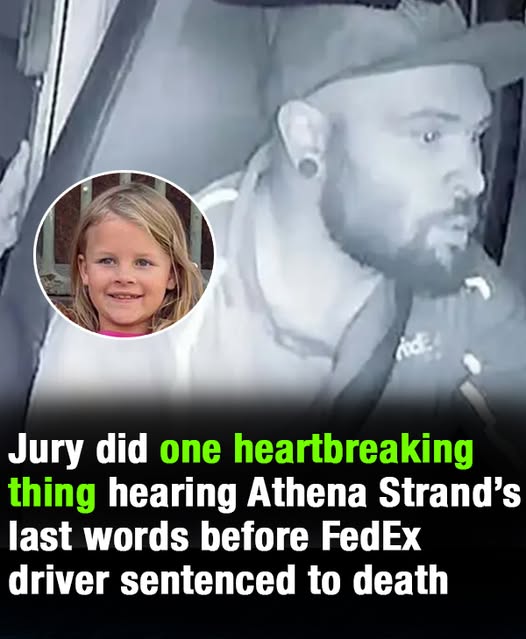
Tanner Horner Sentenced to Death for Kidnapping and Murder of 7-Year-Old Athena Strand
Jurors Hear Devastating Evidence Before Death Sentence
Jurors were left visibly shaken and sobbing in a Texas courtroom after hearing audio that captured the final moments of 7-year-old Athena Strand before her killer received a death sentence.
On May 5, Tanner Horner, a former FedEx driver, was sentenced to death for kidnapping and murdering Athena in 2022. The sentencing followed a weeks-long trial that required jurors to review deeply disturbing evidence about the child’s final hours.
Athena disappeared from her home near Paradise, Texas, on Nov. 30, 2022. Horner had reportedly stopped at the property while delivering a Christmas package during his FedEx route.
Two days after Athena vanished, her body was found not far from her family’s home. The discovery ended the search for the missing child and began a legal process centered on one of the most painful cases presented in the courtroom.
Horner later pleaded guilty to aggravated kidnapping and capital murder. Even after those guilty pleas, the trial continued so jurors could decide whether he should be sentenced to death.
The trial’s most emotional evidence included a recording from inside Horner’s delivery truck. That audio and video showed the moments after Athena was forced into the vehicle and taken away from her home.
Judge Issues Warning Before Recording Is Played
Before the recording was played in court, Judge George Gallagher warned those present that the evidence was extremely disturbing. He gave people inside the courtroom the chance to leave before hearing it.
“If you think you cannot watch it or listen to it, leave now. Now’s your time to get out,” the judge said.
Jurors remained in the courtroom. Athena’s parents chose to leave before the recording began, avoiding the painful experience of hearing what happened inside the truck.
The warning reflected the gravity of the evidence. The recording was not simply a technical exhibit or a timeline detail. It captured the child’s words, confusion, fear, and suffering during the final period of her life.
The atmosphere in the courtroom changed as the evidence was prepared. Those who stayed knew they were about to hear details that would be central to the final decision over Horner’s punishment.
The recording became one of the most powerful pieces of evidence presented during the sentencing phase. It showed not only how Athena was taken, but also how Horner behaved after bringing her into the delivery truck.
Video Shows Athena Near the Delivery Truck
The video showed Horner arriving at Athena’s home. He stepped out of the truck and looked around the property during the delivery stop.
A short time later, Athena appeared behind him while he walked back toward the vehicle. She was later seen near the truck, looking inside.
Horner then lifted the child into the van and closed the door behind her. From that point, the recording captured a terrifying shift from what had appeared to be a routine delivery stop to the beginning of a kidnapping.
Inside the vehicle, Athena began asking questions. She appeared confused by what was happening, though she was not described as immediately frightened in the first moments.
Her question to Horner became one of the most haunting moments heard in the courtroom.
“What are you doing? Are you a kidnapper?” Athena asked Horner.
The question exposed the child’s uncertainty as she tried to understand why she had been placed inside the truck. It also showed that she recognized something was wrong before the situation grew more terrifying.
Athena Asks Where She Is Being Taken
As Horner drove away from Athena’s home, she stood up inside the truck and asked where they were going.
“Where are we going?”
Horner’s answer was brief and cold.
“It doesn’t matter,” Horner replied.
After that exchange, Horner covered the lens of the camera inside the truck’s cabin. The video feed was blocked, but the audio continued recording.
The absence of video did not stop the courtroom from hearing what unfolded. The recording continued to capture Horner’s voice, Athena’s questions, and the sounds that followed.
At one point, Horner spoke to the child in a way that added to the horror of the evidence.
“You’re really pretty. You know that?” Horner told the girl.
The recording then captured Horner questioning Athena about her age, her school, and her teacher. The exchange showed the child being drawn into conversation while trapped inside the vehicle.
After Athena mentioned her teacher’s name, Horner asked another question.
“Is she nice?” he asked after Athena mentioned her teacher’s name.
The audio later captured Athena asking Horner where he lived. He answered with another unsettling response.
“far away.”
The Recording Captures Fear and Escalation
When the truck appeared to stop, Athena asked what they were doing. Her questions reflected growing uncertainty as she remained inside the vehicle with Horner.
“We’re going to hang out for a minute,” Horner told her.
The recording then grew more disturbing. Horner ordered the child to remove her shirt, but Athena refused. She continued crying and asked to go home.
The audio captured sounds of choking, screaming, and crying. Those sounds indicated that Horner was harming Athena inside the truck.
As the truck began moving again, Athena could be heard screaming in the background while “Jingle Bell Rock” played loudly on the radio.
Horner responded to her cries by yelling at her to shut up. He also threatened to hurt her further as she screamed.
Jurors who heard the recording were left sobbing and visibly shaken. The courtroom was forced to confront the final moments of a child who had been taken from her home and killed by the man who had arrived there during a delivery route.
The evidence was central to showing the brutality of Athena’s final hours. It also gave jurors a direct understanding of what Horner did after abducting her.
Prosecutors Describe Athena’s Final Fight
Prosecutors revealed that Athena fought back while Horner made repeated attempts to kill her inside the truck. The evidence showed that she resisted during the attack.
Before Horner dumped her body in water near the Trinity River, Athena had died from blunt force trauma, strangulation, and smothering.
The details of her death added to the emotional weight of the trial. Jurors had already heard her voice on the recording, and then had to consider the physical evidence showing how she died.
The prosecution’s case focused on the sequence of events beginning with the delivery stop, continuing through the kidnapping, and ending with the disposal of Athena’s body.
Horner’s actions after Athena’s death were also described in court. The recording captured him coughing heavily, possibly vomiting, before he later uncovered the camera lens.
He then continued driving while smoking a cigarette. Afterward, he stopped at a store, where he picked up paper towels and a spray bottle of cleaning solution.
Those items were used to scrub the cab of the FedEx truck. The cleaning effort became part of the evidence showing what Horner did after the killing.
Horner Calls His Boss After Cleaning the Truck
After the attack and the attempted cleanup, Horner called his boss. During that call, he asked to use the same truck for deliveries the next day.
His explanation for the condition of the truck was captured in his own words.
“It kind of smells like barf in here,” he says. “I guess I just ate something bad earlier.”
The comment became another chilling detail in the case. It came after investigators said Horner had killed Athena, disposed of her body, and tried to clean the truck’s cab.
The request to keep using the same vehicle showed how Horner attempted to continue as though nothing had happened. The contrast between his ordinary delivery work and the crime committed inside the truck became a major part of the evidence presented during the trial.
For jurors, the recording and the aftermath offered a complete and painful picture of Horner’s conduct. It captured his words to Athena, the sounds of the attack, his behavior afterward, and his effort to explain away the condition of the truck.
Guilty Pleas Still Required a Sentencing Decision
Horner had already pleaded guilty to aggravated kidnapping and capital murder. Those pleas established his responsibility for the crimes, but they did not automatically determine the sentence.
The trial continued because a jury had to decide whether the death penalty should be imposed. That decision required jurors to hear the evidence and determine the appropriate punishment.
The weeks-long proceedings placed jurors in the position of hearing testimony, reviewing recordings, and considering the circumstances of Athena’s death. The emotional burden of the case was clear during the presentation of the final recording.
Capital murder cases often involve detailed sentencing evidence, especially when the death penalty is being considered. In this case, the recording from the truck became one of the most important pieces of evidence because it documented the child’s final moments.
The jury ultimately needed less than three hours to reach a final decision after reviewing the evidence and arguments presented in court.
Death Sentence Announced
After deliberating for less than three hours, the jury reached its decision. Horner was sentenced to death by lethal injection.
The sentence concluded a trial that had forced the courtroom to confront the kidnapping and murder of a 7-year-old girl whose final moments had been recorded inside a delivery vehicle.
The death sentence brought one phase of the legal process to an end. For Athena’s family, however, the verdict did not undo the loss or remove the pain of what had happened.
The courtroom then heard from members of Athena’s family, who spoke about the devastation left behind by her murder. Their words reflected grief, anger, and the lasting impact of losing a child in such a violent and senseless way.
The sentencing marked accountability for Horner, but it also underscored the permanence of Athena’s absence. Her family was left to continue living with the consequences of a crime that took her life and changed theirs forever.
Athena’s Uncle Addresses the Court
After the sentence was announced, Athena’s uncle, Elijah, stood before the court and spoke about the damage caused by Horner’s actions.
“There are no words that truly capture the devastation that Tanner Horner caused us and in our family. What he took from this world was not just a child. He took a life, a future, and a piece of every single person who loved her…And we are left trying to honor the beautiful little girl whose life was taken in the most senseless and horrific way,” Elijah said.
His statement described the depth of the family’s grief. Athena’s death was not only the loss of a child, but the loss of everything her life could have become.
Elijah then addressed Horner directly in the courtroom.
“You will face the wrath of God. I want you to know that you are nothing. You are a footnote in Athena’s story. Her name will forever be remembered. Her name will forever be celebrated, and everyone will forget you. No one’s going to remember you after this.”
The statement made clear that Athena’s family wanted her memory to stand above the name of the man who killed her. Elijah’s words emphasized that the focus would remain on Athena, not on Horner.
A Child Remembered After a Horrific Crime
Athena Strand was 7 years old when she disappeared from her home near Paradise, Texas. She had been at the family property when Horner arrived to deliver a Christmas package during his route for FedEx.
The sequence of events that followed turned an ordinary delivery stop into a kidnapping and murder. Athena was placed inside the delivery truck, driven away from her home, and killed before her body was later found near the family’s home.
The evidence presented during the trial revealed the fear and confusion she experienced after being taken. Her questions inside the truck showed a child trying to understand why she was there and where she was being taken.
Her voice became one of the most painful parts of the proceedings. Jurors heard her ask whether Horner was a kidnapper, ask where they were going, refuse his commands, cry, and ask to go home.
Those final recorded moments gave the courtroom a devastating connection to what Athena endured. They also became a central reason the jury was asked to consider the harshest punishment available.
The Impact on the Courtroom
The courtroom reaction showed how deeply the evidence affected those who heard it. Jurors remained through the recording after the judge’s warning, but many were left sobbing and visibly shaken.
The emotional response was not limited to the evidence itself. It came from hearing a child’s final moments and understanding that she had been taken by someone who had arrived at her home in a delivery truck.
Athena’s parents chose not to remain inside the courtroom while the recording was played. Their decision reflected the unimaginable pain of hearing the final moments of their child’s life.
The judge’s warning before the audio was played acknowledged that the evidence would be difficult for anyone to hear. The fact that it became central to the sentencing showed how significant it was in establishing the full horror of the crime.
For the jury, the recording was not an abstract description. It was direct evidence of Athena’s fear, Horner’s conduct, and the violence that followed.
A Case That Ended With the Death Penalty
The sentencing of Tanner Horner brought a legal conclusion to the trial that followed Athena Strand’s kidnapping and murder. Horner pleaded guilty to aggravated kidnapping and capital murder, and the jury sentenced him to death by lethal injection.
The case forced jurors to confront evidence showing how Athena was taken from her home, what happened inside the truck, and how Horner acted afterward.
The death sentence was reached after less than three hours of jury deliberation. The decision came after days of testimony and evidence that made clear the violence and cruelty involved in the crime.
For Athena’s family, the sentence cannot replace what was taken. Her uncle’s statement in court made clear that the family will continue trying to honor her life and memory.
Athena’s name remains at the center of the case. She is remembered as a child whose life, future, and place in her family were stolen in a horrific act of violence.
Family Left With Unimaginable Loss
The murder of Athena Strand left her family with a loss that cannot be measured only through the court process. The sentencing delivered punishment for Horner, but it did not restore the life that was taken.
Her family must continue living with the grief of losing a 7-year-old child who vanished from her home and was later found dead. The details heard during the trial added another layer of pain to that loss.
The courtroom statements made clear that Athena’s loved ones want her to be remembered for who she was, not only for what happened to her. Her uncle’s words emphasized that her name would continue to be honored and celebrated.
The trial revealed the final moments of her life in devastating detail, but it also showed the determination of her family to keep her memory alive. Their grief was present throughout the proceedings and remained after the sentence was announced.
Horner’s conviction and death sentence now stand as the legal outcome of the case. Athena’s family is left with the emotional reality of a life cut short and a future that was taken before it could unfold.
The case will be remembered for the painful evidence that brought jurors to tears, the death sentence handed down after brief deliberation, and the family’s words insisting that Athena’s life and name remain the true focus.