
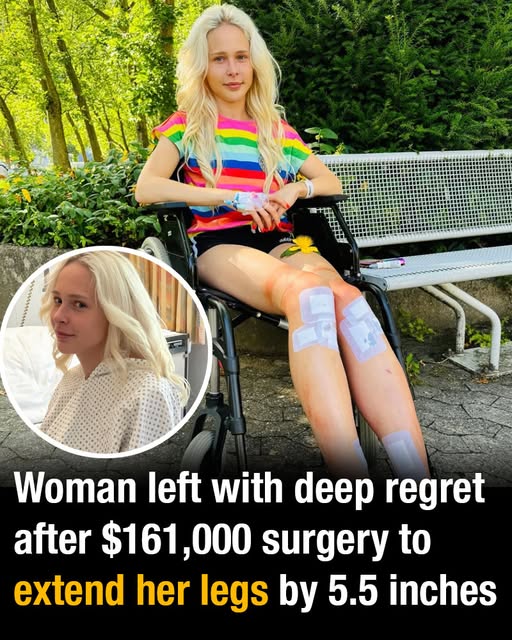
Theresia Fischer Says She Regrets Leg-Lengthening Surgery After Years of Pain
A Major Procedure Followed by Lasting Regret
Theresia Fischer underwent an extreme body-altering procedure in an effort to become taller. Years later, she has spoken about the physical and emotional pain that followed and has said she now feels deep regret over the decision.
Fischer, who was originally five feet six inches tall, chose to have surgery designed to lengthen her legs. The operation reportedly cost $161,000 and was intended to add 5.5 inches to her height by artificially extending the bones in her legs.
At the time of the procedure, Fischer was 24 years old. The former German Celebrity Big Brother contestant had hoped the surgery would help her achieve the taller appearance she wanted, but the years after the operation proved far more difficult than she expected.
Her experience has since become an example of how far some people may go in pursuit of a desired appearance. It also shows how major cosmetic or body-modifying procedures can carry consequences that continue long after the initial decision has been made.
The Pressure to Change Appearance
Many people care about the way they look. Across cultures and generations, appearance has influenced personal confidence, social expectations, and ideas about beauty.
Beauty trends have changed repeatedly throughout history. Some people make small changes to their appearance, while others choose more permanent methods in an effort to feel closer to an ideal image.
Common forms of personal enhancement include makeup, hair dye, nail polish, and anti-aging skincare products. These choices are usually part of everyday routines and can be changed or stopped without lasting physical consequences.
In recent years, more intensive procedures have become increasingly common. Fillers, Botox, laser treatments, and plastic surgery have become familiar parts of modern beauty culture for many people.
Some procedures remain relatively minor, while others involve major medical intervention. Fischer’s leg-lengthening surgery was far beyond a simple cosmetic treatment. It involved altering the bones in her legs to increase her height.
For Fischer, the choice to undergo such a procedure became tied not only to appearance, but also to outside influence. She later said that pressure from a former partner played a major role in her decision.
The Cost of Becoming Taller
Fischer reportedly spent $161,000 on the surgery to lengthen her legs. The procedure was intended to give her an additional 5.5 inches in height, changing her body in a significant and permanent way.
Leg-lengthening surgery involves artificially elongating bones. It is a complex process that affects not only the bones themselves, but also the surrounding muscles, nerves, blood vessels, and skin.
Although Fischer wanted to become taller, the operation came with a long recovery and serious consequences. She later admitted that it may not have been the best decision for her.
The goal of the surgery was clear: to increase her height. But the outcome became much more complicated, involving pain, medical issues, movement limitations, and emotional distress.
For someone in the public eye, the effects were not limited to private discomfort. Fischer’s work in reality television was also affected, as filming became more difficult after the operation.
Physical Problems After the Operation
After the surgery, Fischer reportedly suffered from periosteum inflammation. That condition added to the physical challenges she faced while recovering from the leg-lengthening procedure.
She also said that running became difficult. The presence of metal in her legs changed the way movement felt and made ordinary physical activity more complicated.
In one interview, Fischer described how strange it felt to move quickly after the operation. She said: “When I had to run a little or be faster – it’s just strange to run with metal in your legs,”
Her statement reflected the practical reality of living with the results of the surgery. It was not only about height or appearance. It affected how her body felt when she tried to perform basic movements.
Filming reality television also became harder. Work that required movement, speed, or physical endurance was no longer as simple as it might have been before the procedure.
The challenges continued for years. Fischer later described the pain she experienced as both physical and mental, making clear that the procedure affected far more than her legs.
Years of Pain and a Complicated Recovery
One of the fibula bones in Fischer’s legs reportedly did not grow as expected. That complication added to the long and painful aftermath of the operation.
Eventually, Fischer had the metal rods removed. For her, the removal represented more than another medical procedure. It became a symbolic step away from a painful chapter in her life.
She wrote about the experience on Instagram, describing the depth of what she had endured over many years.
“Pain that I endured for over 8 years was so enormous (physical as well as mental) that I can’t even put into words.Today is THE DAY I finally get my last 2% of my past removed from my body. The two extension rods with screws have finally been removed from my lower thighs,”
The words showed how strongly Fischer connected the rods with the pain of her past. Their removal was not simply a medical event. It represented the final stage of something she had carried physically and emotionally for more than eight years.
Her description also made clear that the suffering was not limited to physical discomfort. She referred directly to mental pain as well, suggesting that the procedure affected her identity, confidence, and emotional well-being.
The Medical Risks of Leg-Lengthening Surgery
Professor Hamish Simpson of the British Orthopaedic Association explained that the procedure carries serious risks, as with any major surgery. Although methods have improved, the operation remains highly complex.
He said: “The techniques and technology have improved substantially over the past couple of decades, making it a safer procedure,”
He also warned that the surgery requires far more than bone growth alone. The body must adapt in several ways during the process, making the operation difficult and risky.
He added: “However, as well as growing more bone – more muscle, nerve, blood vessels, and skin have to be grown and the procedure remains an extremely complex process, with a high complication rate.”
That explanation helps show why Fischer’s experience was so difficult. Lengthening the bones in the legs affects the entire structure of the lower body and places demands on many connected systems.
The need for muscle, nerve, blood vessel, and skin adaptation means the surgery is not a simple height adjustment. It is a major medical process that can involve pain, limited movement, complications, and a long recovery.
Influence From a Former Partner
In 2023, Fischer said that pressure from her ex-boyfriend influenced her decision to have the surgery. She spoke about the relationship during an interview with German radio network MDR Jump.
Fischer said her former partner expressed a preference for taller women and encouraged her to change her body. She said he told her: “‘Theresia, you know I like big ladies. So I would really like this. You could get up to 14 centimeters more.’”
Her comments described a relationship dynamic in which she felt dependent on him and increasingly influenced by repeated statements about what she should do.
She said: “[He would say] ‘You can’t do anything without me. You need me.’ And if you are told that 20, 30, 60, 70 times – then you believe that you are nothing without him.”
Those words show how emotional pressure can affect major personal decisions. Fischer later connected the surgery not only to her own desire for change, but also to the influence of someone who repeatedly made her feel she needed him.
The decision to undergo the operation became more painful in hindsight because she felt it was tied to pleasing another person. The procedure was not a small adjustment. It was a major surgery that changed her body and led to years of pain.
Shame Over a Decision She Now Questions
Fischer has since said that she feels ashamed for agreeing to the procedure. Her regret is rooted in the belief that she consented to an operation she should not have had.
She said: “I am ashamed because I consented to an operation that (I) shouldn’t have had,”
The statement reflects how her view of the surgery changed over time. What may have once seemed like a way to gain height or approval later became a source of regret.
For Fischer, the shame appears connected not only to the physical outcome, but also to the reasons behind the decision. She has described pressure from her ex-boyfriend and the emotional control she felt within that relationship.
Her comments suggest that the operation became a visible reminder of a time when she did not feel fully free or confident in her own choices. The removal of the metal rods marked an attempt to separate herself from that period.
The Emotional Weight of Body Modification
Fischer’s story highlights how cosmetic or body-altering procedures can carry emotional consequences. While many people pursue appearance changes for personal reasons, a major surgery can become deeply painful if it is connected to pressure, insecurity, or someone else’s expectations.
For years, Fischer lived with the physical effects of her leg-lengthening surgery. She described pain that lasted more than eight years and said the experience was both physical and mental.
The procedure changed not only her height, but also how she moved, how she worked, and how she related to her own past. Running became strange and difficult, filming reality shows became harder, and one of her fibula bones reportedly did not grow as expected.
Her public reflections show that the results of a major operation cannot be measured only in inches gained. The cost can include recovery, complications, discomfort, regret, and emotional distress.
The fact that she eventually had the rods removed shows how strongly she wanted to close that chapter. In her own words, removing the final pieces meant taking the last part of her past out of her body.
A Story of Beauty Standards and Personal Autonomy
Fischer’s experience also raises questions about beauty standards and personal autonomy. The desire to look a certain way can be powerful, especially when reinforced by relationships, public attention, or cultural expectations.
Many beauty choices are temporary or reversible, such as makeup, nail polish, hair dye, or skincare routines. More intensive procedures, however, can involve serious medical risks and lasting consequences.
Leg-lengthening surgery sits at the far end of that spectrum. It is not a quick enhancement or a minor cosmetic change. It is a complex medical process that requires the body to grow and adapt across bones, muscles, nerves, blood vessels, and skin.
Fischer’s regret shows how important the reasons behind such a decision can become. A procedure chosen under pressure may later feel very different from one chosen freely and confidently.
Her story is not only about height. It is about the personal cost of changing the body in a major way and later realizing that the decision was tied to someone else’s expectations.
Life After the Rods Were Removed
The removal of the rods from Fischer’s lower thighs was an important moment for her. After years of pain, she described the procedure as removing the final part of a painful past from her body.
Her words showed relief, but also the seriousness of what she had endured. The operation to become taller had remained with her physically for years through the metal rods and screws in her legs.
By having them removed, Fischer took a step toward reclaiming her body after a long and difficult experience. It marked the end of one phase, though it did not erase the pain she said she had carried.
The emotional meaning of that removal was clear in the way she described it. She did not refer to the rods only as medical hardware. She described them as the last part of her past still inside her body.
That language reflected the depth of regret surrounding the surgery. The procedure had become tied to memory, pain, shame, and a former relationship she now views differently.
A Public Figure Reflects on a Painful Choice
As a former German Celebrity Big Brother contestant, Fischer’s experience drew public attention. Her decision to speak openly about the surgery allowed others to understand the difficult reality behind a dramatic physical transformation.
Her story includes the initial desire to become taller, the large financial cost, the physical complications, the mental burden, and the later regret. It also includes her claim that pressure from a former partner influenced the decision.
By discussing what happened, Fischer has presented a more complicated picture of cosmetic change. The outside result may be visible, but the internal consequences can remain hidden for years.
Her account shows that a procedure intended to improve appearance or confidence can become a source of distress when it is connected to pain and regret. In Fischer’s case, the height increase came with years of suffering she says she cannot fully put into words.
Her reflections also point to the importance of personal agency. A decision involving major surgery can have lasting effects, and Fischer now says she is ashamed that she agreed to an operation she believes she should not have had.
Regret After an Extreme Transformation
Theresia Fischer’s decision to undergo leg-lengthening surgery changed her life in ways that went far beyond her height. What began as an effort to become taller led to complications, movement difficulties, years of pain, and a deep sense of regret.
She reportedly spent $161,000 to gain 5.5 inches, but the physical and emotional cost became much greater over time. Her experience included periosteum inflammation, difficulty running, problems during reality television filming, and a fibula bone that reportedly did not grow as expected.
After more than eight years of pain, Fischer had the metal rods removed from her lower thighs. The removal marked a significant moment in her recovery and in her effort to leave that chapter behind.
Today, Fischer says she regrets the operation and feels ashamed that she consented to it. Her comments about pressure from her ex-boyfriend add another painful layer to the story, showing how outside influence can shape choices that affect the body for years.
Her story remains a striking example of the risks involved in major body-modifying surgery and the emotional consequences that can follow. For Fischer, becoming taller came at a price she now believes was far too high.