
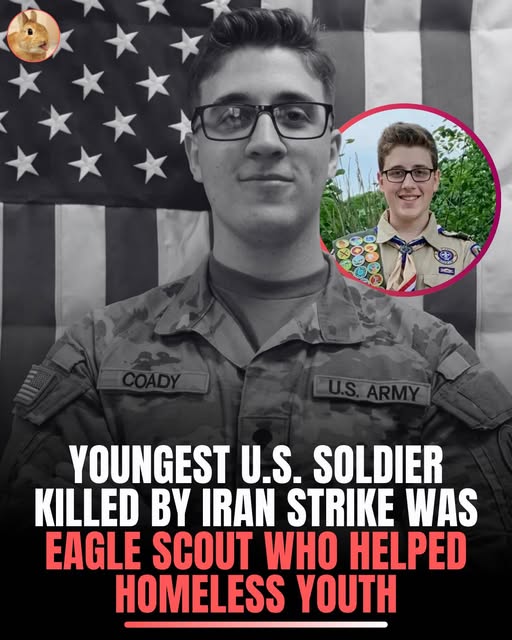
Remembering Sgt. Declan Coady: The Young Army Reservist Whose Life and Service Touched a Community
A Young Life Lost in a Widening Conflict
War is often described through maps, military movements, and strategic calculations. Yet the true cost of conflict is most clearly understood through the lives of the people caught in it.
For many Americans, that reality came into focus with the death of Sgt. Declan Coady, a 20-year-old Army reservist killed during a drone strike in Kuwait.
Coady was one of six U.S. soldiers who died on March 1, 2026, when an Iranian drone hit a military operations center at the Port of Shuaiba. The port served as an important logistics hub supporting U.S. military activity in the region.
The strike took place during the opening phase of a broader conflict involving Iran and U.S. forces. As tensions intensified, the attack became part of a larger story of retaliation, regional instability, and military escalation.
But beyond the headlines, Coady’s life told a more personal story.
Before he was a soldier deployed overseas, he was a student, a volunteer, an Eagle Scout, and a young man widely remembered for helping others. In only 20 years, he built a reputation for service that left a lasting mark on the people around him.
The Attack at Port Shuaiba
The strike that killed Coady happened during a period of heightened military activity across the Middle East.
In late February 2026, Iran launched a series of retaliatory drone and missile attacks against American and allied positions in the region. The conflict, already volatile, entered a more dangerous phase as military exchanges expanded.
One of those attacks targeted a small U.S. tactical operations center at Port Shuaiba in Kuwait.
The site had recently been repurposed as a backup command hub for logistics and communications. Its role was essential, supporting the systems and supply networks that help military operations function.
At around 9 a.m. local time on March 1, an unmanned drone struck the facility.
The impact killed six American service members and injured dozens more.
All six soldiers belonged to the 103rd Sustainment Command, an Army Reserve unit based in Des Moines, Iowa.
The unit’s work centered on the logistical foundation behind military operations. That included managing equipment movement, maintaining communications, and coordinating the flow of supplies.
Among those killed were several experienced soldiers. The youngest was Sgt. Declan Coady.
He had only recently begun shaping his future as both a college student and a member of the military.
National Tributes and Private Grief
News of the attack spread quickly across the United States.
Public tributes followed from elected officials, military leaders, and people who had never met Coady but were moved by his story. Iowa Governor Kim Reynolds described him as a young man who answered his country’s call to duty and paid the ultimate sacrifice.
Those words reflected the public recognition given to fallen service members.
At the same time, Coady’s family was facing the shock of an unbearable loss.
For them, the story was not about military strategy or official statements. It was about the sudden silence left behind when a son, brother, and loved one never came home.
The Final Messages He Sent Home
In the hours before the drone strike, Declan Coady was doing something deeply personal and familiar. He was checking in with his family.
According to his father, Andrew Coady, Declan regularly sent updates while deployed. Every hour or two, he would send short messages to reassure them that he was safe.
The messages were simple.
“I’m good. Everything’s okay.”
For families with loved ones overseas, those brief updates carry enormous emotional weight. During periods of uncertainty, even a few words can provide comfort.
Declan appeared to understand that well. He seemed to know how much those messages mattered, and he sent them often.
At one point that same morning, he also called his brother, who was stationed in Italy.
Because of the time difference, it was an early call for the family back in Iowa. It was an ordinary conversation, the kind that seems routine in the moment.
Later, it would take on heartbreaking significance.
That call became the final time his family heard his voice.
Based on the timeline later shared with the family, the drone likely hit the command center shortly after the call ended.
Then the messages stopped.
The steady stream of reassurance that had become part of daily life suddenly disappeared.
For his family, that silence became the first sign that something might be wrong.
The confirmation that followed was devastating.
A Pattern of Service That Started Early
People in Coady’s hometown say his identity as someone who served others began long before he joined the Army Reserve.
As a teenager in West Des Moines, Iowa, he had already earned a reputation for stepping forward when help was needed.
One of the clearest examples came through his work in scouting.
Coady achieved the rank of Eagle Scout, the highest distinction in the Scouting America program. Reaching that level requires years of commitment, leadership, and meaningful service to the community.
Only about four percent of scouts earn that honor.
For his Eagle Scout project, Coady chose to support vulnerable young people in his own community.
He organized volunteers and led the construction of twelve Adirondack chairs for the Iowa Homeless Youth Centers.
The chairs were intended to offer comfort to teenagers and young adults facing difficult circumstances. Some were placed in programs designed to help youth transition out of homelessness.
It was a practical project, but it also reflected something deeper about the way he approached service.
He wanted his work to make life a little easier for others.
Helping Beyond What Was Required
For many scouts, an Eagle Scout project marks the completion of a long process. For Coady, it was not the end of his involvement.
After the required work had been completed, he returned to the youth center with his brother to keep helping.
Together, they built storage shelves in the basement of the building.
That extra effort left a strong impression on people who worked there. It showed that his commitment had not been about checking a box or reaching a milestone.
He came back because he genuinely wanted to continue contributing.
People who knew him through scouting remembered him as someone dependable and generous.
Friends from his troop described him as a person who naturally stepped in when someone needed support, guidance, or extra hands.
That pattern of action followed him throughout his short life.
A Student With Purpose and Ambition
By the time he graduated from West Des Moines Valley High School in 2023, Coady had already completed more than 100 hours of community service.
That effort earned him a silver cord at graduation, a recognition reserved for students whose service extends well beyond the ordinary.
After high school, he enrolled at Drake University.
There, he pursued studies in information systems, cybersecurity, and computer science.
His academic path reflected a clear interest in technology, systems, and problem-solving. These were not casual interests but part of a larger vision for his future.
He saw a way to use technical knowledge in meaningful public service.
Around the same period, he enlisted in the Army Reserve and trained as an information technology specialist.
The role focused on supporting the communication systems and digital infrastructure necessary for military operations. It was a position that suited both his academic interests and his sense of responsibility.
Balancing college classes with military training demanded discipline and focus.
People who knew him said he handled that challenge with energy and commitment.
According to Drake University, he was regarded as a dedicated student who was well liked and had a promising future ahead of him.
A Future He Was Still Building
Coady’s goals extended beyond his current service and studies.
Through the Reserve Officers’ Training Corps program, he hoped to become a commissioned officer after completing his college degree.
That ambition suggested a long-term commitment to military leadership and service.
He was not simply passing through one stage of life on the way to another. He was actively building a future that connected education, technical skill, and duty.
At just 20 years old, he had already begun laying the groundwork for that future with seriousness and determination.
Those around him saw someone who was moving with purpose.
The deployment that ultimately took him overseas became part of that journey.
His Decision to Deploy
When the time came for his unit to deploy, Coady made his choice without hesitation.
His father later recalled a conversation they had before he left.
Declan explained that he had experienced civilian jobs before, but the military gave him a stronger sense of purpose. Even with demanding schedules and long workdays, he felt fulfillment in what he was doing.
He spoke positively about the work, even when it required sacrifice.
According to his father, he genuinely loved it.
He could have remained closer to home and concentrated more heavily on his studies. Instead, he made it clear that he wanted to go where his unit went.
For him, deployment was not simply about assignment or obligation.
It was about loyalty.
The people he trained with were not distant coworkers. They were the people he served beside, depended on, and trusted.
He wanted to be with them.
That decision placed him at Port Shuaiba on March 1, when the drone struck the command center.
A Lasting Legacy in a Short Life
Sgt. Declan Coady’s life was brief, but the impression he left was not.
He was remembered not only as a soldier killed in a conflict far from home, but also as a young man whose values were already visible long before his deployment.
He served in his community as a volunteer. He served through scouting leadership. He served as a student pursuing skills he hoped to use for something larger than himself.
And in the military, he chose to stand with his unit when the moment came.
His story carries the human weight that often gets lost in larger discussions of war.
Behind every casualty count is a person with plans, habits, relationships, and a future that once seemed open.
In Declan Coady’s case, that future included study, service, leadership, and a life still just beginning.
What remains now is the memory of the way he lived those 20 years: with loyalty, with purpose, and with a steady instinct to help others.
For his family, his friends, and the community that watched him grow, that memory is inseparable from the pain of losing him.
But it is also what ensures that his life will be remembered for more than the circumstances of his death.
He was a son and a brother. He was a student and a scout. He was a soldier. And to the people who knew him, he was someone who made a difference wherever he went.