
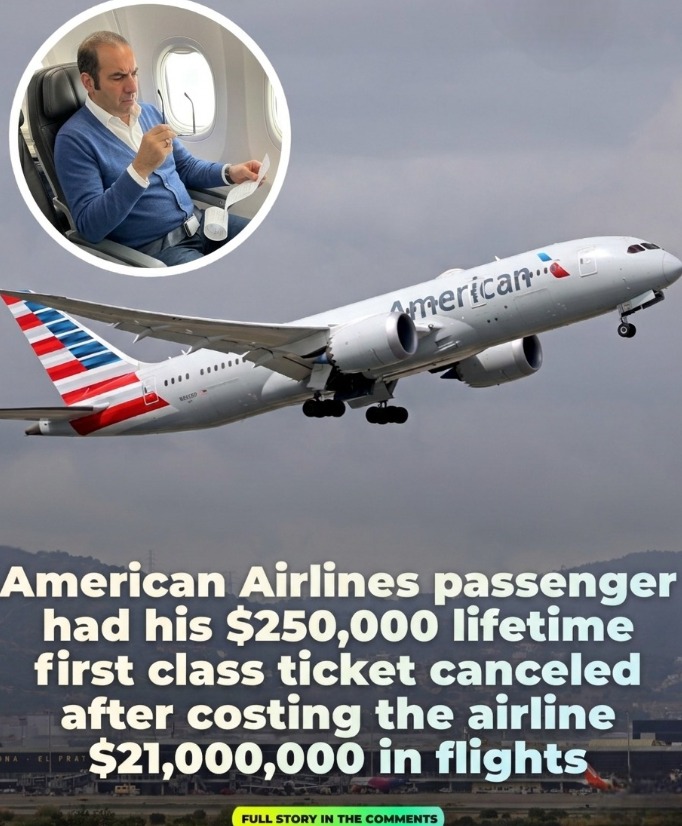
How American Airlines’ Lifetime First-Class Pass Became a Costly Lesson in “Unlimited” Travel
A Bold Idea Takes Flight
In 1981, American Airlines introduced an ambitious offering that captured the imagination of frequent travelers: the AAirPass.
The program promised lifetime first-class travel for a single upfront payment.
Holders would be entitled to unlimited flights with no blackout dates and no mileage restrictions.
At a time of significant change in the aviation industry, the offer stood out as both innovative and daring.
Launched in an Era of Deregulation
The airline introduced the pass during a period marked by deregulation and intensifying competition.
Air carriers were seeking new strategies to stabilize revenue streams and secure customer loyalty.
The AAirPass was designed to bring in substantial upfront cash while building long-term relationships with affluent travelers.
Executives believed the large initial payment would more than offset the cost of future travel.
The Price of Lifetime Luxury
Early versions of the pass were priced at approximately $250,000.
As demand and perceived value increased, the cost rose significantly.
Later passes were sold for more than $1 million.
Buyers were also offered an optional companion benefit for an additional $150,000, allowing a designated guest to travel alongside them.
The structure appeared to balance exclusivity with financial prudence.
Assumptions Behind the Offer
Airline leadership operated under the assumption that even wealthy customers would use the pass within reasonable limits.
While “unlimited” was the headline feature, planners expected usage patterns to mirror typical business or leisure travel habits.
They did not anticipate a scenario in which a pass holder would maximize the benefit to its absolute limit.
The concept of lifetime first-class access seemed extravagant but manageable.
A Buyer Who Redefined Unlimited
Among the program’s customers was Steven Rothstein, who purchased his AAirPass in the late 1980s at the age of 37.
He also added the $150,000 companion option.
At the time, the purchase appeared to be a lavish but personal investment in convenience and flexibility.
Over the following years, however, it became something far more significant.
Millions of Miles Accumulated
Rothstein used his pass extensively, transforming the promise of unlimited travel into a practical reality.
Over roughly two decades, he logged approximately 30 million miles.
His journeys totaled around 10,000 flights.
The estimated retail value of those trips reached as high as $21 million.
The scale of usage far exceeded the cost of the original purchase.
Travel Without Limits
For Rothstein, the AAirPass represented freedom.
He booked flights frequently, sometimes arranging trips on short notice or reserving seats speculatively.
His travels took him across continents for business engagements, personal visits, and spontaneous journeys.
The pass eliminated concerns about ticket prices or availability in the first-class cabin.
It allowed him to move across the globe with remarkable flexibility.
A Growing Financial Burden
While the pass delivered unparalleled convenience to its holder, it increasingly weighed on the airline’s balance sheet.
Each first-class seat occupied by a pass holder represented revenue that could not be recovered.
As Rothstein’s mileage accumulated, the financial gap between his initial payment and the value of his flights widened dramatically.
The program that once promised predictable revenue began to look like a mounting liability.
Scrutiny and Termination
In 2008, after years of heavy use, American Airlines terminated Rothstein’s pass.
The airline alleged that certain bookings and the use of companion privileges violated program rules.
Rothstein maintained that he operated within the terms as he understood them.
The disagreement escalated into a legal dispute.
Ultimately, the matter was settled out of court.
The End of an Era
The controversy surrounding Rothstein’s pass marked a turning point for the AAirPass program.
By that time, the airline had already begun reassessing the long-term viability of lifetime unlimited travel.
The program was eventually discontinued.
No new lifetime passes were offered after the disputes highlighted the risks inherent in the concept.
The experiment with boundless access had run its course.
A Lesson in Risk and Reward
The AAirPass remains one of the most striking marketing initiatives in airline history.
It demonstrated how bold incentives can capture attention and generate immediate capital.
At the same time, it revealed how difficult it can be to forecast long-term consumer behavior.
The gap between projected usage and actual usage proved substantial.
Unlimited access, when fully embraced, can exceed even optimistic financial modeling.
The Appeal of “Unlimited”
The promise of unlimited benefits carries powerful appeal.
For customers, it suggests liberation from constraints and predictability in cost.
For businesses, it can signal confidence and exclusivity.
Yet the term also contains inherent uncertainty.
When a customer maximizes such an offer, the financial implications can escalate quickly.
Strategic Miscalculation
In retrospect, the airline’s strategy relied heavily on assumptions about average behavior.
Executives did not foresee a scenario in which a single customer would approach the theoretical maximum of usage.
The AAirPass was built on statistical expectations rather than extreme possibilities.
Rothstein’s travel patterns exposed the vulnerability of that approach.
The difference between ordinary and extraordinary use became financially significant.
Balancing Innovation and Sustainability
The story underscores the challenge of balancing innovation with sustainable economics.
Programs designed to stand out in competitive markets must also account for long-term costs.
In the case of the AAirPass, the initial influx of cash did not fully anticipate decades of premium travel.
The gap between marketing ambition and operational reality became increasingly visible.
Eventually, corrective action followed.
A Marketing Legend
Decades later, the AAirPass continues to be cited as a remarkable example of bold corporate strategy.
It combined exclusivity, simplicity, and an extraordinary promise.
The idea of paying once for unlimited first-class access captured the imagination of travelers and industry observers alike.
At the same time, it serves as a reminder of how generous commitments can evolve into financial strain.
The legacy of the program rests on both its ingenuity and its unintended consequences.
Enduring Significance
Steven Rothstein’s experience illustrates the tension between contractual rights and corporate sustainability.
From his perspective, he exercised the privileges he had purchased.
From the airline’s standpoint, the cost of fulfilling those privileges grew beyond expectation.
The settlement closed the chapter without a public courtroom conclusion.
However, the broader narrative continues to resonate.
A Cautionary Tale for Future Offers
The AAirPass stands as a case study in how “unlimited” can transform from a marketing slogan into a financial challenge.
It highlights the importance of anticipating not only average behavior but also exceptional use.
For airlines and other industries, the program remains a vivid illustration of the risks embedded in lifetime guarantees.
What began as a strategy to strengthen competitive positioning ultimately became a lesson in the limits of limitless promises.
The story endures as both a bold experiment and a cautionary example of how fully embracing an offer can redefine its impact.