
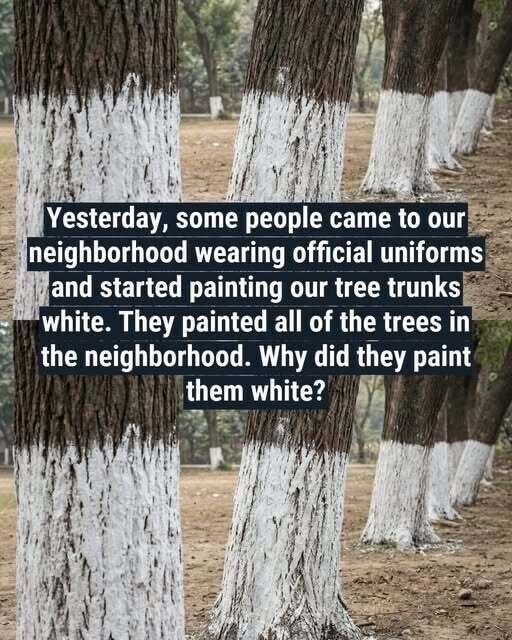
Why Tree Trunks Are Painted White: The Science Behind a Simple but Powerful Protective Practice
A Common Sight with a Serious Purpose
In late autumn orchards and carefully maintained public parks, it is common to see tree trunks coated in a bright white layer near their base. To many observers, the uniform color may appear decorative, as though part of a landscaping aesthetic.
In truth, this practice serves a practical and protective function. The white coating is a time-tested method used by arborists, farmers, and land managers to shield trees from environmental stress that could otherwise cause lasting damage.
Far from cosmetic, the paint represents a proactive strategy rooted in biology and physics. Its purpose is to help trees withstand extreme temperature fluctuations and preserve their long-term structural health.
Why Trees Require Thermal Protection
Trees are stationary organisms. Unlike animals, they cannot relocate when faced with harsh weather or sudden environmental shifts.
Throughout the year, they endure freezing winter nights, intense summer heat, and rapid swings in temperature. These changes affect not only their outer bark but also the delicate tissues beneath the surface.
Even subtle variations in temperature can disrupt a tree’s internal systems. The white coating on trunks is directly linked to managing these stresses, particularly during the colder months.
The Hidden Threat of Winter Sunscald
The primary reason trunks are painted white is to prevent a condition known as sunscald. This issue most often occurs in climates where bright winter days are followed by sharply dropping nighttime temperatures.
During a sunny winter afternoon, dark bark absorbs solar radiation. Because darker surfaces retain heat, the temperature of the bark can rise 20 to 30 degrees above the surrounding air.
This sudden warmth can stimulate the cambium, the thin living layer beneath the bark responsible for transporting water and nutrients. The cambium may begin to expand and activate, responding as though warmer conditions have arrived.
As evening falls and temperatures rapidly decline, the bark cools quickly. The swift contraction that follows can cause splitting, cracking, or peeling.
These wounds typically appear on the south or southwest side of a tree, where sun exposure is strongest. Repeated cycles of heating and cooling intensify the damage over time.
Once the bark is compromised, the tree becomes vulnerable to insects, fungal infections, and bacterial disease. Severe or repeated injury can girdle the trunk, disrupt nutrient flow, and ultimately lead to decline or death.
How White Paint Protects the Trunk
The protective power of white paint lies in its reflective qualities. Light-colored surfaces reflect more sunlight, while darker surfaces absorb it.
By coating the trunk in white, caretakers increase its albedo, or reflectivity. This reduces the amount of solar energy absorbed during daylight hours.
With less heat absorbed, the bark maintains a more stable temperature. The gap between daytime warmth and nighttime cold narrows, decreasing the likelihood of expansion and contraction stress.
This stabilization keeps the cambium dormant during winter, preventing premature activation and reducing the risk of structural cracking.
Choosing the Right Paint Matters
Not all paint is suitable for this purpose. Professionals recommend using water-based white latex paint diluted in equal parts with water.
Latex paint is breathable, allowing necessary gas exchange between the tree and the surrounding air. This permeability is essential for maintaining healthy bark.
Once dry, high-quality latex is non-toxic to living tissues. In contrast, oil-based paints form an impermeable barrier that can trap moisture and interfere with natural respiration.
Using oil-based products may suffocate the bark, promote rot, and create more harm than protection. Proper material selection is therefore critical.
The paint is generally applied from the soil line up to the first major scaffold branches, covering the area most exposed to direct sunlight and reflected heat from snow or pavement.
Which Trees Benefit the Most
While many trees can benefit from this treatment in cold climates, certain categories are particularly vulnerable.
Young and newly planted trees have thin, smooth bark that offers minimal insulation. Their cambium layer lies closer to the surface, making them especially susceptible to temperature stress.
Fruit trees, including apple, peach, cherry, and citrus varieties, are known for their sensitivity to bark splitting. Orchard managers frequently apply white paint as a preventive measure.
Urban trees also face elevated risk. In city environments, trunks receive heat not only from direct sunlight but also from reflected radiation off pavement, glass, and concrete surfaces.
Trees that have recently been transplanted are another high-risk group. After relocation, they often experience transplant shock and may struggle to adapt to new exposure conditions.
Understanding Forestry Color Codes
White paint used for protection should not be confused with other tree markings that serve entirely different purposes.
Orange or blue markings are commonly used by municipal crews to designate trees for removal, pruning, or utility work. These colors signal maintenance or clearance operations.
Purple paint, in many regions of the United States, indicates private property boundaries and functions as a legal “No Trespassing” notice.
White, by contrast, is associated with preservation. It signifies that the tree is being actively protected rather than prepared for removal.
Additional Protective Advantages
Beyond thermal regulation, white-painted trunks offer secondary benefits. The lighter surface may deter certain wood-boring insects that prefer darker, warmer bark for laying eggs.
The coating can also discourage small mammals such as rabbits and voles from gnawing on bark during winter months. Bark chewing can girdle a young tree and disrupt nutrient transport.
In agricultural settings, uniform white trunks make it easier to identify trees that are struggling despite protective measures. This visibility allows for targeted care and monitoring across large orchards.
A Simple Technique with Long-Term Impact
The practice of painting tree trunks white demonstrates how straightforward interventions can produce meaningful ecological benefits.
By applying a reflective coating, caretakers reduce stress, prevent avoidable injury, and extend the lifespan of valuable trees.
Whether in a rural orchard or an urban park, this visible layer of protection reflects careful planning and environmental responsibility.
Each painted trunk represents an investment in longevity. It signals that the tree is expected to thrive for decades, contributing shade, beauty, and ecological value.
What may appear to be a cosmetic detail is, in reality, a calculated and effective safeguard. Through a combination of biological understanding and basic physical principles, this practice helps ensure that rooted giants remain resilient against the elements.
The next time you encounter a tree with a white-painted base, you are witnessing a deliberate act of stewardship designed to protect life from the silent stress of seasonal extremes.
seo partner program [url=https://prodvizhenie-sajtov-v-moskve15.ru/]prodvizhenie-sajtov-v-moskve15.ru[/url] .
продвижение в google [url=https://tyumen-news.net/other/2025/07/15/509294.html]продвижение в google[/url] .