
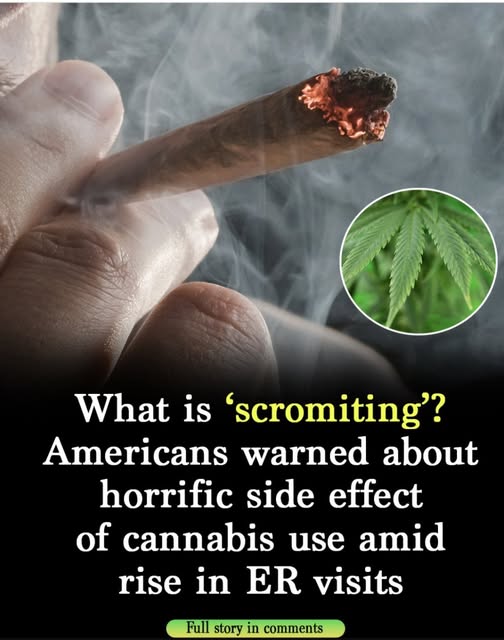
Doctors Warn of Rising Emergency Room Cases Linked to Severe Cannabis-Related Condition Known as “Scromiting”
A Disturbing Trend Emerging in Hospitals
Medical professionals are increasingly raising concerns about a serious condition connected to cannabis use that has led to a surge in emergency room visits. The condition, commonly referred to as “scromiting,” involves extreme nausea, persistent vomiting, and severe abdominal pain.
While the term may sound unusual, healthcare experts emphasize that the symptoms and consequences are far from trivial. Over the past decade, hospitals have reported a growing number of patients arriving with intense gastrointestinal distress linked to cannabis consumption.
Many of these individuals experience symptoms so severe that they return to emergency departments multiple times each year seeking relief.
Understanding Cannabis Hyperemesis Syndrome
The medical condition behind these alarming cases is known as Cannabis Hyperemesis Syndrome (CHS). It is characterized by repeated episodes of uncontrollable vomiting, nausea, and stomach pain following cannabis use.
According to medical observations, symptoms often begin within 24 hours after consumption and can persist for several days. During these episodes, patients may become dehydrated and physically exhausted due to prolonged vomiting.
The term “scromiting” was coined by medical professionals to describe the intense combination of screaming and vomiting experienced by some patients during acute episodes.
Frequent Misdiagnosis and Repeated Hospital Visits
One of the major challenges with CHS is that it is often not recognized immediately. Patients may undergo multiple emergency department visits before receiving an accurate diagnosis.
“A person often will have multiple [emergency department] visits until it is correctly recognized, costing thousands of dollars each time,” states Dr. Beatriz Carlini, a research associate professor at the University of Washington School of Medicine.
This delay in identification can prolong suffering and lead to repeated cycles of illness, especially when cannabis use continues.
Symptoms That Cause Severe Distress
Episodes associated with CHS can be physically and emotionally overwhelming. Patients commonly report relentless vomiting, intense nausea, and abdominal pain strong enough to leave them hunched over.
In many cases, the discomfort is so extreme that individuals cry out during episodes, contributing to the origin of the term “scromiting.”
These symptoms can last for days and significantly disrupt daily functioning, making it difficult for affected individuals to maintain normal routines.
Limited Treatment Options Currently Available
Treating CHS remains a significant challenge for healthcare providers. Standard anti-nausea medications often fail to deliver effective relief during acute episodes.
Dr. Chris Buresh, an emergency medicine expert, explained the difficulty in managing the condition: “There are currently no therapies approved by the Food and Drug Administration, and standard anti-nausea medications frequently fail to provide relief.”
Because of the limited effectiveness of conventional treatments, doctors sometimes rely on alternative approaches to ease symptoms.
Unconventional Methods Used for Symptom Relief
Medical professionals have observed that some patients experience temporary relief through unconventional methods. Hot baths and prolonged hot showers are frequently reported as soothing during episodes.
In some cases, doctors may apply capsaicin cream to the abdomen or administer medications such as Haldol, which is typically used to treat psychotic episodes.
Dr. Buresh noted the diagnostic relevance of this behavior, stating, “That’s a key factor in my diagnosis when a patient mentions they feel better after a hot shower.”
He added that some patients report using so much hot water that they completely drain their household supply during symptom flare-ups.
Who May Be at Risk of Developing CHS
Healthcare experts caution that CHS can recur if cannabis use continues, even after symptoms temporarily subside. The only known method to fully eliminate the condition is to stop using cannabis entirely.
Dr. Carlini warned that the sporadic nature of the syndrome can lead to confusion among users. “Since the syndrome occurs sporadically, some cannabis users may mistakenly believe a recent episode was unrelated and continue their usage — only to find themselves severely ill again.”
This cycle can result in repeated illness and ongoing emergency medical visits.
The Role of Continued Cannabis Use
Long-term recovery from CHS typically depends on complete cessation of cannabis consumption. However, this can be difficult for individuals who struggle with dependency.
Even small amounts of cannabis may trigger symptoms in those who are susceptible to the condition, making moderation ineffective as a prevention strategy.
As a result, healthcare providers emphasize awareness and education as key components in managing and preventing recurrent episodes.
Why Some Users Are Affected and Others Are Not
Researchers are still investigating why CHS affects certain cannabis users while others remain symptom-free. The underlying mechanisms are not yet fully understood.
The leading theory suggests that overstimulation of the body’s endocannabinoid system may disrupt the natural regulation of nausea and vomiting.
Dr. Buresh explained, “There appears to be a threshold at which individuals may become susceptible to this condition, and this threshold varies from person to person. Even small amounts can trigger vomiting in these individuals.”
This variability makes predicting risk particularly challenging.
Research Findings and Rising Case Numbers
A study conducted by George Washington University examined more than 1,000 patients diagnosed with CHS and identified a strong link between early and prolonged cannabis use and emergency room visits related to scromiting.
Data also revealed a sharp increase in adolescent cases in the United States, rising more than tenfold between 2016 and 2023.
Interestingly, while overall CHS cases were more common in states where cannabis is legal, younger users showed higher incidence rates in states where recreational cannabis remains prohibited.
These patterns suggest that usage trends and accessibility may play a role in how the condition develops across different populations.
Official Recognition by Global Health Authorities
On October 1, 2025, the World Health Organization formally recognized Cannabis Hyperemesis Syndrome and assigned it an official diagnostic code.
This recognition marks a significant step in tracking cannabis-related adverse health effects and improving clinical documentation.
Dr. Carlini highlighted the importance of the new classification, stating, “A new code for cannabis hyperemesis syndrome will provide crucial hard evidence regarding cannabis-related adverse events, which physicians indicate is an escalating issue.”
Growing Awareness Among Medical Experts
As emergency room visits linked to CHS continue to increase, healthcare professionals are urging both adult and adolescent cannabis users to remain aware of the potential risks.
The condition can be debilitating and costly, especially when repeated hospital visits are required for symptom management.
Medical experts stress that recognizing early symptoms and understanding the connection to cannabis use can help reduce prolonged suffering and repeated medical emergencies.
With official recognition and ongoing research, awareness of CHS is expected to expand as physicians continue to identify it as an emerging public health concern.