
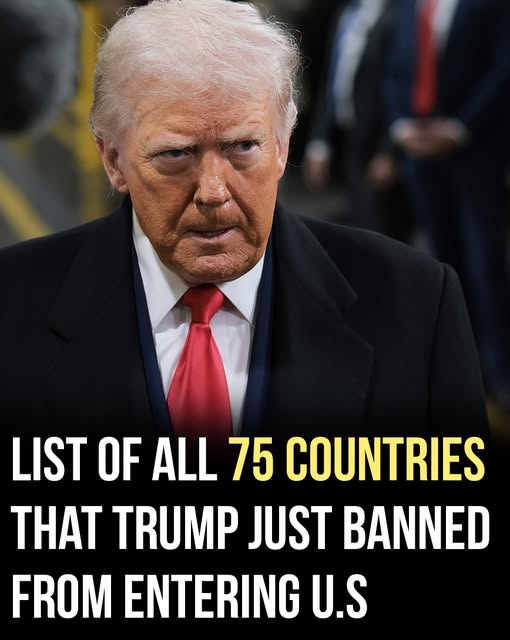
The United States government has announced a suspension of immigrant visa processing for citizens of 75 nations, effective January 21, 2026. The State Department said the move is part of a reassessment of visa procedures to ensure that new immigrants do not rely on public benefits upon arrival in the U.S.
This action marks one of the broadest restrictions on legal immigration in recent U.S. history. The suspension affects countries across Africa, the Middle East, Asia, Eastern Europe, Latin America, and the Caribbean, reflecting a significant shift in U.S. immigration policy.
State Department officials explained that consular officers have been instructed to deny visas under existing laws while the screening process is revised. A spokesperson emphasized the policy’s focus on economic self-sufficiency, stating, “The pause impacts dozens of countries – including Somalia, Haiti, Iran, and Eritrea – whose immigrants often become public charges on the United States upon arrival. We are working to ensure the generosity of the American people will no longer be abused. The Trump Administration will always put America First.”
Scope of the Suspension
The suspension applies to immigrant visas, which provide a pathway to permanent residency and, ultimately, U.S. citizenship. Temporary or non-immigrant visas, such as tourist, business, student, or work visas, are not included in the pause and continue to be processed under separate rules.
The freeze targets visa processing at U.S. embassies and consulates abroad, rather than entry into the United States itself. Individuals from affected countries who are already in the U.S. legally, including current visa holders and permanent residents, will not be automatically barred from reentry, although those with expiring visas may face disruptions.
List of Affected Countries
The 75 countries span multiple regions and include: Afghanistan, Albania, Algeria, Antigua and Barbuda, Armenia, Azerbaijan, Bahamas, Bangladesh, Barbados, Belarus, Belize, Bhutan, Bosnia, Brazil, Burma, Cambodia, Cameroon, Cape Verde, Colombia, Cote d’Ivoire, Cuba, Democratic Republic of the Congo, Dominica, Egypt, Eritrea, Ethiopia, Fiji, Gambia, Georgia, Ghana, Grenada, Guatemala, Guinea, Haiti, Iran, Iraq, Jamaica, Jordan, Kazakhstan, Kosovo, Kuwait, Kyrgyzstan, Laos, Lebanon, Liberia, Libya, Moldova, Mongolia, Montenegro, Morocco, Nepal, Nicaragua, Nigeria, Pakistan, Republic of the Congo, Russia, Rwanda, Saint Kitts and Nevis, Saint Lucia, Saint Vincent and the Grenadines, Senegal, Sierra Leone, Somalia, South Sudan, Sudan, Syria, Tanzania, Thailand, Togo, Tunisia, Uganda, Uruguay, Uzbekistan, and Yemen.
The list includes countries with varied historical and economic ties to the United States, from longstanding sources of immigration to nations with smaller immigrant populations.
Policy Rationale
The visa pause focuses on the concept of “public charge,” a provision in U.S. immigration law that allows officials to deny visas if applicants are likely to rely on government assistance. In recent years, public charge determinations have expanded to include financial resources, health, education, skills, and prior use of public benefits.
Officials have indicated that the freeze will remain in effect until the U.S. can implement procedures to ensure that new immigrants will not impose financial burdens on American taxpayers. The length of the pause is currently unspecified.
Legal and Economic Implications
Immigrant visas are a key route for individuals and families seeking permanent residence. These visas allow holders to work, live permanently, and eventually apply for U.S. citizenship. By halting new visa issuances, the policy disrupts family reunification, employment migration, and humanitarian relocation.
Non-immigrant visas, which cover short-term travel for study, tourism, or business, are not affected. Nonetheless, the suspension could affect international mobility and relationships with the countries involved.
Impact on Global Events
The suspension coincides with preparations for major global events, including the 2026 FIFA World Cup, co-hosted by the U.S., Canada, and Mexico. Concerns have arisen over whether players and fans from affected countries will be able to enter the U.S. for matches. While non-immigrant visas should allow short-term travel, no formal exemptions for such events have yet been announced.
Reactions and Broader Context
The visa suspension has drawn mixed responses. Supporters argue that it reinforces national sovereignty and economic self-sufficiency. Critics contend that most immigrants do not immediately access public benefits and are more likely to contribute economically.
The policy is part of a wider series of immigration measures pursued by the administration, which has also tightened travel restrictions and enhanced screening procedures across multiple visa categories. The full impact on U.S. immigration patterns, labor markets, and international relations is still to be determined.