
As Donald Trump’s second term continues to reshape the global political landscape, few issues have generated as much unease among allies and rivals alike as the administration’s intensified pursuit of Greenland. What was once dismissed during Trump’s first presidency as an unconventional idea has evolved into a central geopolitical objective, placing the world’s largest island at the heart of an emerging international crisis.
Since returning to the White House last January, the 79-year-old president has elevated Greenland from a speculative talking point to a matter of urgent national strategy. Despite strong resistance from Denmark, widespread concern among NATO partners, and skepticism within segments of the U.S. political system, the administration’s determination to acquire the Arctic territory has accelerated. The pace and tone of Washington’s actions have sent ripples through diplomatic circles, prompting fears of a confrontation that could test alliances long considered unbreakable.
Trump has repeatedly argued that Greenland is no longer merely a distant autonomous territory under Danish sovereignty, but a strategic linchpin in a rapidly militarizing Arctic. He maintains that both Russia and China view the island as a critical objective, and that American control is essential to preempt rival powers from gaining an advantage in the region.
“The Easy Way or the Hard Way”
In framing the issue, Trump has sought to move the conversation beyond economics or diplomacy, casting Greenland instead as a non-negotiable security imperative. In his view, the concept of leasing or limited access falls short of what is required in an era of renewed great-power competition.
“Countries have to have ownership and you defend ownership, you don’t defend leases. And we’ll have to defend Greenland,” Trump declared recently, signaling that the matter extends well beyond conventional negotiations. The statement unsettled observers on both sides of the Atlantic, but it was his follow-up remark that triggered widespread alarm. “We will do it ‘the easy way’ or ‘the hard way’.”
The comment was interpreted by many European leaders as an implicit threat, raising concerns that Washington might consider coercive measures to achieve its objective. Diplomatic tension surfaced almost immediately during a high-level meeting hosted by Vice President JD Vance, who welcomed ministers from Denmark and Greenland. Rather than producing common ground, the talks reportedly underscored deep divisions. Danish officials later described the discussions as marked by a “fundamental disagreement” over sovereignty, underscoring just how far apart the parties remain.
European and NATO Reaction
The prospect of a U.S. attempt to forcefully alter Greenland’s status has prompted an unusually unified response from European governments. Denmark, which retains authority over Greenland’s foreign and defense policy, has found strong backing from its allies. NATO members including France, Germany, and Sweden have publicly expressed support for Danish sovereignty and taken concrete steps to demonstrate their commitment.
Several European nations have deployed military personnel and resources to Greenland, framing the move as a defensive measure and a show of solidarity rather than an escalation. Nonetheless, the presence of additional forces has transformed the island into a focal point of military attention, raising the once-unthinkable possibility of a standoff between the United States and its closest allies.
For NATO, the situation presents a profound dilemma. The alliance was founded on collective defense and shared democratic values, yet it now faces internal strain driven by competing interpretations of security in the Arctic. While Washington argues that U.S. ownership would strengthen Western defenses, European partners fear that such a move would undermine international law and destabilize the very alliance it claims to protect.
The “Golden Dome” Strategy
At the core of Trump’s argument is his vision for a next-generation missile defense system known as the “Golden Dome.” The proposed shield is described by the administration as a sophisticated, multi-layered network designed to intercept missile threats before they reach U.S. territory. According to Trump, Greenland’s geographic position makes it indispensable to the project’s success.
“The United States needs Greenland for the purpose of National Security. It is vital for the Golden Dome that we are building,” he stated in a recent social media post. The Arctic island’s location along northern missile trajectories, he argues, provides unparalleled advantages for early detection and interception.
Supporters of the plan within the administration contend that the Arctic is rapidly becoming a central theater of competition as climate change opens new shipping lanes and access to natural resources. From this perspective, Greenland represents both a defensive asset and a strategic foothold in a region where Russia and China have steadily expanded their presence.
Moscow’s Stark Warning
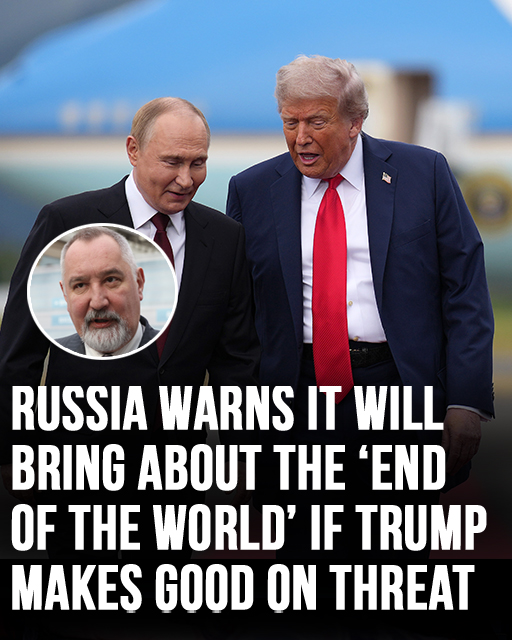
The renewed focus on Greenland has not gone unnoticed in Russia, where officials have responded with sharp rhetoric and dire warnings. Dmitry Rogozin, a former deputy prime minister and now a senator representing occupied Ukraine, delivered one of the most ominous assessments of Trump’s ambitions.
Rogozin acknowledged that Greenland’s geography is indeed advantageous for advanced defense systems. “Orbital sensors, ground interceptors, decision-making algorithms – all this requires advantageous geography,” he said, noting that the island’s Arctic position aligns closely with northern intercontinental ballistic missile routes.
However, he warned that forcibly seizing the territory to deploy nuclear-related infrastructure would upend the fragile balance that has prevented direct nuclear conflict since the end of World War II. Labeling Trump “eccentric,” Rogozin suggested that such actions could push the world toward irreversible catastrophe.
“This will be the beginning of the end of the world,” he warned. Rogozin also referenced Russia’s RS-28 Sarmat missile, commonly known as “Satan-2,” a 208-ton intercontinental weapon capable of traveling at speeds approaching 16,000 miles per hour. “In real life, this can only be tested once, but it is not certain that anyone will be left to prepare reports afterwards,” he added, underscoring the existential stakes he associates with the crisis.
Alternative Paths and Strategic Debate
While the administration continues to emphasize full ownership, some analysts argue that less confrontational options remain available. The United States already operates the Pituffik Space Base in northern Greenland, a long-standing installation that plays a role in missile warning and space surveillance.
Rasmus Sinding Søndergaard, an expert on U.S.-Danish relations, has suggested that Washington could expand or modernize its existing footprint rather than pursue annexation. He has pointed to a network of Cold War-era facilities across Greenland that could be refurbished to meet modern defense requirements. Such an approach, analysts say, could satisfy the technical needs of the “Golden Dome” while avoiding a diplomatic rupture with Denmark and NATO partners.
Proponents of this alternative argue that cooperation, rather than coercion, would reinforce Western unity at a time when shared challenges demand coordinated responses. Critics within Europe warn that pushing the issue to extremes risks alienating allies and handing strategic advantages to adversaries eager to exploit divisions within the Western alliance.
An Arctic Crossroads
As the administration weighs what Trump has framed as the “easy way” versus the “hard way,” Greenland has become a symbol of broader global tensions. The Arctic, once viewed primarily as a remote and cooperative region, is increasingly seen as a frontline in the competition between major powers.
The decisions made in the coming months could redefine security arrangements in the North Atlantic and beyond. Whether Greenland becomes the cornerstone of a new defense architecture or the spark for a deeper international crisis remains uncertain. For now, governments around the world are watching closely, aware that the outcome may shape global stability for decades to come.