
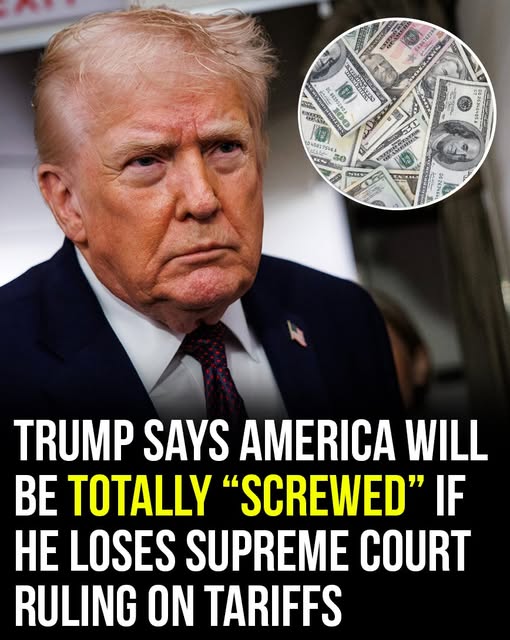
Former President Donald Trump has delivered a stark warning as the Supreme Court of the United States reviews the legality of his expansive tariff policies. Trump cautioned that invalidating his measures could throw the United States into what he described as a “complete mess,” highlighting both the economic and political weight of the Court’s decision.
Since returning to the White House for a second term, Trump has made tariffs a central pillar of his economic strategy. He portrays them not merely as negotiating tools, but as structural remedies for longstanding trade imbalances, the decline of U.S. manufacturing, and what he sees as systemic disadvantages faced by American producers. In Trump’s framing, tariffs serve multiple purposes: pressuring foreign governments, encouraging domestic manufacturing, generating federal revenue, and bolstering national security.
The Legal Challenge
The heart of the dispute concerns presidential authority. Trump’s administration relied on the International Emergency Economic Powers Act (IEEPA), declaring ongoing trade deficits a national emergency, to impose tariffs exceeding $150 billion on imports from countries including China, India, Canada, and members of the European Union.
Opponents argue that trade deficits do not qualify as a national emergency, warning that this use of IEEPA represents an unprecedented expansion of executive power. Lower courts sided with this interpretation: the U.S. Court of International Trade ruled the tariffs unlawful, a decision later upheld by the Federal Circuit Court of Appeals. The Supreme Court now faces the final word on the matter.
Trump has warned that striking down the tariffs could have far-reaching financial consequences. He claims the government might need to refund hundreds of billions of dollars already collected. Furthermore, companies and foreign governments that restructured supply chains or invested in new facilities in response to the tariffs could seek compensation, potentially raising exposure into the trillions of dollars—though whether such claims would succeed remains uncertain.
Presidential Authority vs. Congressional Oversight
The case extends beyond economics, touching on the limits of executive power. A ruling against Trump would reinforce Congress’s role in trade policy and restrict presidential emergency powers. Supporters of the tariffs argue that speed and flexibility are essential in global trade disputes, while critics assert that bypassing legislative oversight undermines democratic governance and risks destabilizing international markets.
Adding to the complexity, Trump has expanded his tariff approach into geopolitical territory. He recently announced a 25 percent tariff on imports from any country maintaining commercial ties with Iran, forcing third-party nations to choose between U.S. market access and trade with Tehran. The move has drawn criticism from economists, foreign governments, and U.S. businesses, which cite higher compliance costs and supply-chain disruptions.
Impact on Businesses and Consumers
The tariffs have created widespread uncertainty for U.S. businesses and consumers. Importers face volatile costs, manufacturers must constantly reassess sourcing, and shoppers encounter higher prices on a range of goods. More than 1,000 lawsuits challenging the tariffs reflect the broad concern over both scope and legality.
As the Supreme Court deliberates, the case is shaping up as a defining test of economic power and executive authority. Upholding the tariffs would validate Trump’s trade-first approach and strengthen presidential authority in economic emergencies. Striking them down, however, could force a policy rollback, requiring a reconsideration of U.S. trade strategy.
Long-Term Implications
The Court’s ruling will influence more than just the immediate tariff regime. It will clarify how far a president can go in reshaping the U.S. economy without legislative approval, setting a precedent for the balance of power between the executive branch and Congress. In a moment where law, economics, and geopolitics intersect, the outcome will shape American trade policy for years to come.