
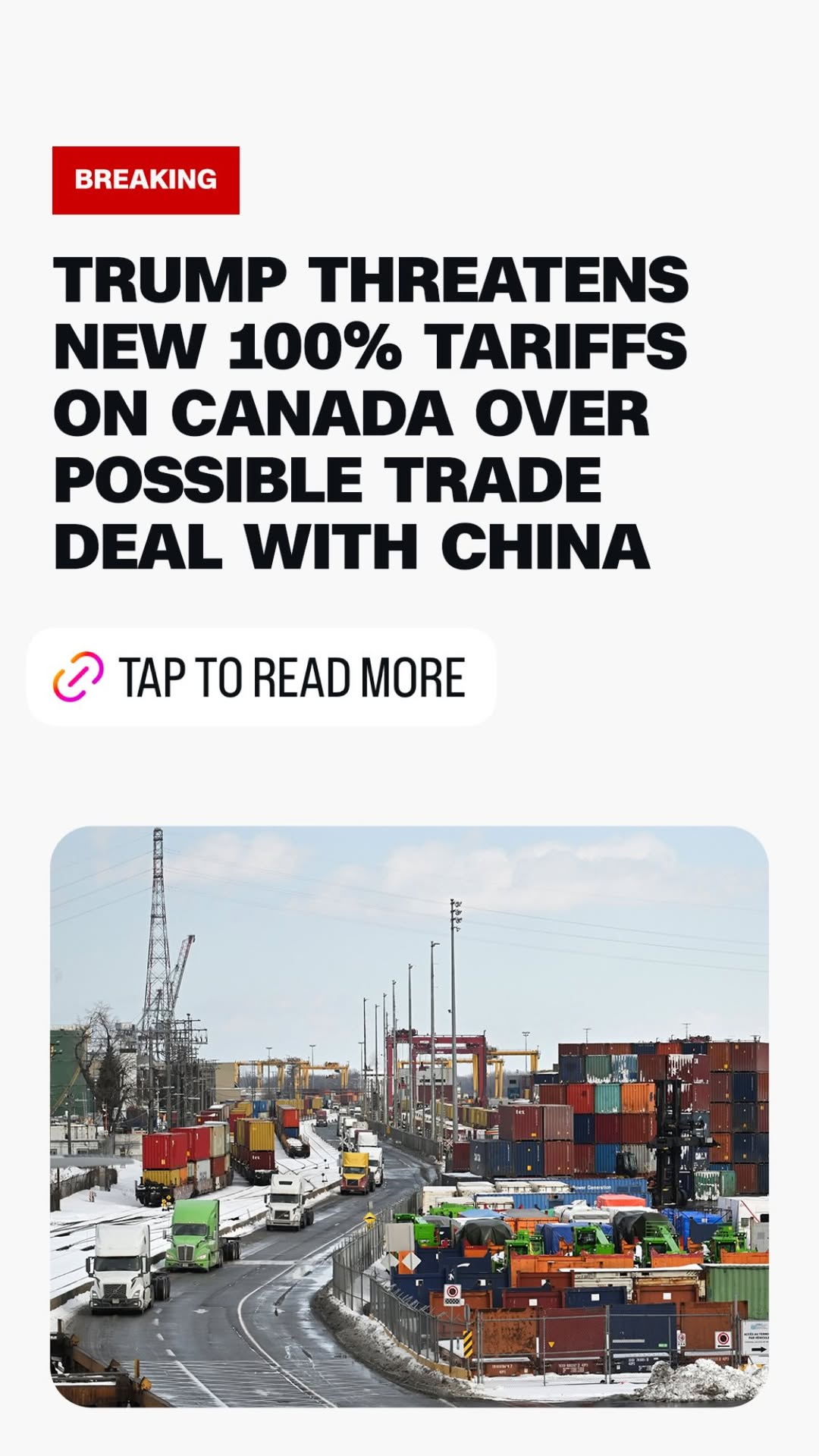
President Donald Trump escalated tensions with Canada on Saturday, warning that he could impose 100% tariffs on Canadian imports if the country finalizes a trade deal with China. The comments mark a sharp turn from his earlier statements and add a new layer of uncertainty to U.S.-Canada trade relations.
Trump’s Latest Threat
On Truth Social, Trump directly targeted Canadian Prime Minister Mark Carney, mocking him as “governor” — a term the former president has also used for former Prime Minister Justin Trudeau. Trump wrote:
“If Governor Carney thinks he is going to make Canada a ‘Drop Off Port’ for China to send goods and products into the United States, he is sorely mistaken. China will eat Canada alive, completely devour it, including the destruction of their businesses, social fabric, and general way of life.”
The message comes just weeks after Trump appeared to take a more neutral stance on a potential Canada-China trade agreement. On January 16, he told reporters, “It’s a good thing for (Carney) to sign a trade deal. If you can get a deal with China, he should do that.”
Background: Canada-China Relations
Earlier this month, Carney met with Chinese President Xi Jinping to establish a “new strategic partnership” between Canada and China. The agreement included easing tariffs on Chinese electric vehicles, allowing up to 49,000 EVs annually into the Canadian market, and anticipated reductions in tariff barriers on Canadian canola, lobster, and peas later this year.
While Trump’s statement threatens 100% tariffs, it remains unclear what specific conditions would trigger the measure or how such a sweeping tariff would be implemented. Requests for comment from both the White House and Canada’s Prime Minister’s Office were not immediately returned.
Carney’s Warning on Economic Pressures
Canada has been vocal about the growing risks of economic coercion in global trade. On Tuesday at the World Economic Forum in Davos, Switzerland, Carney warned that stronger nations increasingly use “economic integration as weapons,” “tariffs as leverage,” and “supply chains as vulnerabilities to be exploited.”
Without explicitly naming the United States, Carney described the situation as a global “rupture” rather than a simple transition, emphasizing that “middle powers must act together because if we’re not at the table, we’re on the menu.”
Implications for Trade and the Economy
Trump’s new threat could have far-reaching consequences. Canadian exports compliant with the United States-Mexico-Canada Agreement (USMCA) have previously been exempt from some Trump-era tariffs, but 100% sectoral tariffs could disrupt trade across multiple industries, including autos, steel, aluminum, lumber, and energy. These sectors are among Canada’s key exports to the United States.
Canada has already faced economic pressure from prior U.S. tariffs. In October, the country’s unemployment rate hit its highest level in nine years, reflecting the impact of trade restrictions on Canadian businesses. At the same time, the U.S. economy has felt strain due to reduced Canadian spending. Statistics Canada reports that land travel to the U.S. dropped 31% through the end of September, while exports of American spirits to Canada fell 85% in the second quarter, according to the Distilled Spirits Council of the United States.
A Pattern of Trump Tariff Threats
This latest statement is consistent with Trump’s approach to international negotiations, which often involves high-stakes threats. Just last week, he threatened a 10% tariff on goods from Denmark, Norway, Sweden, France, Germany, the U.K., the Netherlands, and Finland over Greenland-related negotiations. After claiming a framework agreement had been reached, the tariffs were suspended.
Observers have even coined a term for the pattern of aggressive tariff threats that are later reversed: TACO — “Trump Always Chickens Out.” Whether the Canada tariffs will follow a similar path remains uncertain.
Legal and Political Considerations
The legality of Trump’s proposed tariffs could also face scrutiny. The Supreme Court is expected to rule soon on whether the president can leverage emergency powers under the International Emergency Economic Powers Act to impose tariffs. Justices have expressed skepticism over the administration’s interpretation, as the law does not explicitly mention tariffs.
The ongoing dispute also highlights personal tensions between the two leaders. At Davos, Trump stated,
“Canada lives because of the United States. Remember that, Mark, the next time you make your statements.”
Carney responded the following day, asserting,
“Canada doesn’t live because of the United States. Canada thrives because we are Canadian.”
Uncertainty Ahead
Trump’s new threat creates further uncertainty for businesses and investors on both sides of the border. The potential for sweeping tariffs could disrupt supply chains, increase prices for consumers, and trigger retaliatory measures from Canada.
The situation underscores the complexity of U.S.-Canada trade relations, where political rhetoric, personal dynamics between leaders, and international agreements intersect. Whether Trump will follow through on the 100% tariff threat or eventually back down remains a key question for analysts and the global market.
As negotiations continue, the world will be watching how both nations balance trade interests, diplomatic relations, and the broader implications for the North American economy.
This is a developing story and updates are expected as new information emerges.