
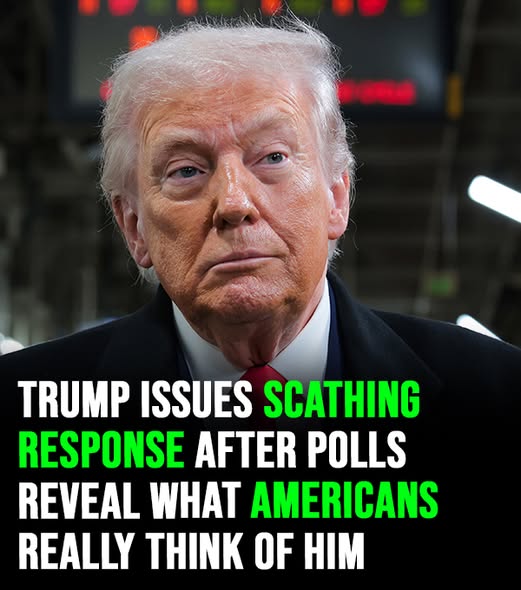
Donald Trump is confronting renewed political pressure as recent polling data show his approval rating slipping further below majority support. While the president and his administration continue to highlight what they describe as economic improvements, including easing inflation and lower food prices, several unresolved controversies and policy disputes have contributed to growing public dissatisfaction ahead of the midterm election cycle.
During his return to office, Trump initially entered his second term with relatively solid backing from voters. Over time, however, that support has eroded. Surveys released in recent weeks from a range of organizations, spanning the political spectrum, indicate that more Americans now disapprove of his performance than approve. The findings have sparked debate within political circles and prompted an aggressive response from Trump himself.
The president has experienced a turbulent first year back in the White House. While administration officials point to selected economic indicators as signs of progress, critics argue that broader challenges have overshadowed those claims. The handling of immigration enforcement, lingering questions tied to the Epstein files, and diplomatic tensions involving Greenland have all drawn scrutiny. These issues have remained prominent in public discussion and appear to have weighed on perceptions of the administration’s effectiveness.
As a result, Trump’s standing in national polls has weakened. Multiple surveys suggest that dissatisfaction has grown across several key policy areas, contributing to a decline in overall approval. The trend has fueled speculation about the political landscape leading into the midterms, even as Trump continues to project confidence and dismiss unfavorable data.
One nationwide survey conducted through January 8, 2026, found that 59 percent of U.S. adults disapprove of Trump’s performance as president, while 40 percent approve. The results reflect a clear majority expressing dissatisfaction with his leadership at this stage of his term. The same survey also measured public opinion on specific policy areas that have defined much of Trump’s agenda.
On economic management, 37 percent of respondents said they approve of Trump’s performance, compared with 62 percent who disapprove. Immigration policy produced similar numbers, with 38 percent approving and 61 percent disapproving. Views on foreign policy and trade negotiations followed the same pattern, showing 37 percent approval and 61 percent disapproval in each category. The poll noted that all surveys include a margin of error and that results can differ among demographic groups, but the overall picture pointed to broad unease.
Other national surveys have reinforced the same general trend. A New York Times survey conducted in partnership with Siena University placed Trump’s approval rating at roughly 40 percent. Many respondents in that poll expressed dissatisfaction with the economy and concern about the country’s overall direction, suggesting that economic messaging alone has not been enough to reassure voters.
Additional polling from major outlets has shown modest variation but consistent weakness in the president’s numbers. A Wall Street Journal survey placed Trump’s approval rating at 45 percent, while a Reuters/Ipsos poll showed it at 41 percent. An aggregate of national polls compiled by RealClearPolitics currently places Trump’s approval at about 42 percent, with 55 percent disapproving. Taken together, the figures suggest that the president has struggled to regain majority approval after slipping below the 50 percent mark last March.
Political analysts note that partisan divides have become more entrenched as Trump’s second term has progressed. Republican support has remained relatively steady, while Democratic opposition has hardened. Republican pollster Daron Shaw summarized the dynamic by noting that “Support among Republicans has remained strong, but opposition from Democrats has become more fixed.”
Despite the unfavorable numbers, Trump has shown little inclination to soften his rhetoric or adjust his public posture. Instead, he has responded forcefully to the polls themselves, accusing media organizations and polling firms of bias and manipulation. In recent days, he has intensified his criticism, framing negative surveys as part of a broader effort to undermine him politically.
Following the release of several polls, Trump issued a lengthy statement on Truth Social in which he attacked what he described as “fake and fraudulent polling.” His remarks targeted a range of media outlets, including some that have historically been viewed as friendly to Republicans. Trump also revisited claims related to the 2020 election, arguing that polling has been used as a tool to influence voters rather than measure public opinion.
In his post, Trump used especially strong language to condemn pollsters and news organizations. “Fake and Fraudulent Polling should be, virtually, a criminal offense. As an example, all of the Anti Trump Media that covered me during the 2020 Election showed Polls that were knowingly wrong;” Trump wrote. “They knew what they were doing, trying to influence the Election, but I won in a Landslide, including winning the Popular Vote, all 7 of the 7 Swing States, the Electoral College was a route, and 2,750 Counties to 525. You can’t do much better than that, and yet if people examined The Failing New York Times, ABC Fake News, NBC Fake News, CBS Fake News, Low Ratings CNN, or the now defunct MSDNC, Polls were all fraudulent, and bore nothing even close to the final results.”
Trump continued his criticism by expanding his attack to include polling conducted by outlets often seen as more favorable to conservative audiences. “Something has to be done about Fraudulent Polling. Even the Polls of FoxNews and The Wall Street Journal have been, over the years, terrible! There are great Pollsters that called the Election right, but the Media does not want to use them in any way, shape, or form. Isn’t it sad what has happened to American Journalism, but I am going to do everything possible to keep this Polling SCAM from moving forward!”
The president’s response underscores a pattern that has defined much of his political career: confronting criticism head-on and challenging the credibility of institutions that produce unfavorable assessments. While such tactics have energized his core supporters, they have also reinforced skepticism among voters who view the attacks as dismissive of legitimate concerns.
Trump has remained highly visible in recent weeks, appearing at events across the country and meeting with foreign leaders. In late December, he held a bilateral meeting with Israeli Prime Minister Benjamin Netanyahu at his Mar-a-Lago club in Palm Beach, Florida, where the two leaders discussed Middle East security and the U.S.-Israel partnership. In early January, Trump addressed House Republicans at a retreat in Washington, D.C., outlining priorities for the 2026 legislative agenda. He has also traveled to key industrial states, including Michigan, where he toured the Ford River Rouge complex and spoke to business leaders at the Detroit Economic Club.
These appearances are part of a broader effort to project momentum and leadership despite polling setbacks. Administration officials continue to argue that economic indicators will eventually translate into improved public sentiment. They also point to Trump’s strong standing among Republican voters as a foundation for future political battles.
Still, the polling data highlight the challenges facing the president as the political calendar moves closer to the midterms. With a majority of Americans expressing dissatisfaction, Trump enters the next phase of his term under increased pressure to demonstrate tangible results on issues that resonate beyond his base. Whether his strategy of attacking polls and media coverage will blunt the impact of negative numbers remains uncertain.
For now, Trump’s approval ratings continue to reflect a deeply divided electorate. His supporters remain loyal, while critics appear increasingly firm in their opposition. As debates over policy, leadership, and credibility continue, the polls themselves have become another front in the ongoing political struggle surrounding his presidency.