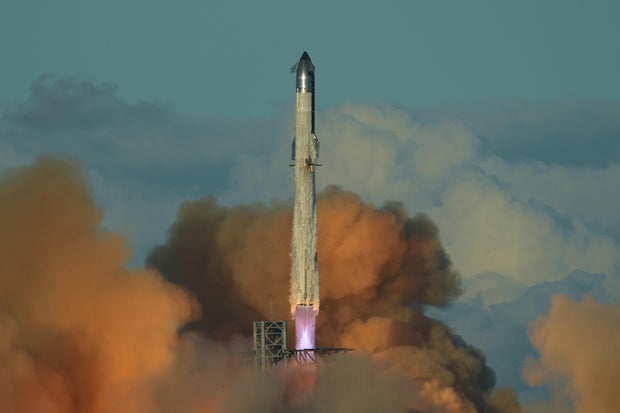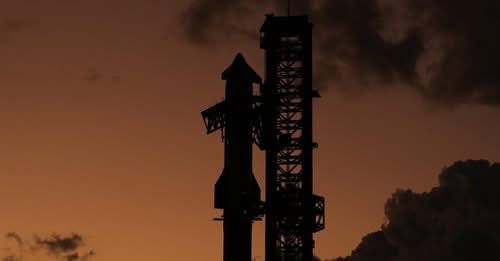
SpaceX achieved another major milestone on Monday as its Super Heavy–Starship rocket completed its 11th test flight, showcasing steady progress toward the company’s long-term goal of interplanetary travel. The massive rocket — the most powerful ever built — lifted off from SpaceX’s Starbase facility near Boca Chica Beach, Texas, lighting up the evening sky in a spectacle that marked a new step in reusable launch vehicle technology.
SpaceX CEO Elon Musk made a rare appearance on the company’s livestream moments before liftoff, saying it was his first time watching a Starship launch outdoors. “Normally I’m in mission control,” Musk said. “It’s going to be much more visceral this way.”
Moments later, the 403-foot rocket roared to life, producing an enormous plume as it climbed toward orbit. After separating from the spacecraft, the Super Heavy booster performed a controlled descent into the Gulf of Mexico, while the Starship continued into space before making a planned reentry over the Indian Ocean. As with previous test flights, neither component was recovered, allowing engineers to focus on data collection and flight performance.
This 11th flight builds on SpaceX’s series of increasingly successful Starship tests following several early setbacks. The August flight — widely seen as a turning point — demonstrated that the vehicle could survive key flight stages without catastrophic failure. Monday’s mission went a step further, incorporating complex maneuvering tests designed to simulate future landings.
The launch also plays a critical role for NASA, which is relying on a modified version of Starship to return astronauts to the Moon later this decade under the Artemis program. The spacecraft’s massive lift capacity and full reusability make it central to future lunar and Mars missions.