
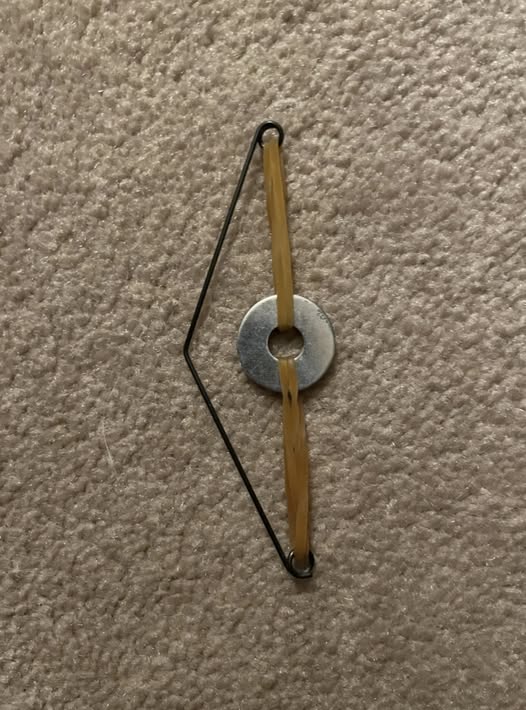
It often emerges during the quiet rituals of spring cleaning or when rummaging through a box of long-forgotten winter clothes. Amid discarded papers and miscellaneous household items, something small and peculiar catches the eye: a skeletal assemblage of bent wire, a worn rubber band, and a solitary metal washer. At first glance, it might be dismissed as nothing more than broken office supplies or the remnants of a failed craft attempt.
But for those familiar with early 20th-century humor, recognition comes quickly. This is no ordinary scrap. It is the core of the “Rattlesnake Envelope” prank—a mechanical gag that has been orchestrating jump scares for more than a century.
The Mechanics Behind the Surprise
Despite its intimidating name, the rattlesnake envelope contains no actual snakes. Instead, it relies on the ingenuity of simple mechanical physics. The device is a spring-loaded contraption designed to replicate the sudden, rattling strike of a viper the moment someone opens the envelope. Its design is both primitive and effective, a testament to human creativity long before the era of digital pranks.
The process is elegantly simple:
Setting the Trap: The coiled wire is tightly wound, storing potential energy, and then positioned flat within a standard business envelope.
Luring the Victim: The envelope is sealed, often bearing an attention-grabbing warning like “Open Carefully” or “Confidential,” ensuring the recipient’s full curiosity and focus.
Delivering the Shock: As soon as the flap is lifted, the tension releases instantly. The wire springs outward with a metallic snap, vibrating the envelope and eliciting a startled reaction. The result is a sudden, harmless jolt—an analog heart-stopper in an era before digital entertainment.
This design demonstrates a clever understanding of timing, surprise, and psychological misdirection, reflecting a period when humor was delivered physically, one envelope at a time.
From Patent to Popular Culture
The rattlesnake envelope has a documented history dating back to the early 1900s, with its first patents marking the formalization of what would become a cultural phenomenon. Its popularity peaked between the 1930s and 1950s, during a golden age for American joke shops and mail-order novelty items. Companies such as Johnson Smith & Co. featured the device prominently in their catalogs, marketing it as the ultimate “jump scare” for children and adults alike.
The gadget appeared under a variety of names, including “snake-in-the-box” and “envelope jacks,” and became a household staple. Children used it to prank siblings, office workers employed it to enliven dull afternoons, and families sent them as playful surprises for April Fools’ Day. The rattlesnake envelope captured a moment in time when humor was tactile, carefully packaged, and delivered by mail.
Considerations and Safety
Although the device is composed of light-gauge wire and rubber designed to startle rather than harm, caution is necessary. Modern pranksters are advised to consider the physiological impact on recipients. The sudden jolt can be intense, particularly for small children, the elderly, or individuals with heart conditions or anxiety disorders.
The context of the prank also matters. Presenting it in a manner that mimics official communications, such as legal notices or government correspondence, can turn a harmless joke into a cause of genuine distress. Practitioners of the art emphasize that the most successful pranks are those that balance surprise with safety, delight without danger.
DIY Revival of a Classic
For enthusiasts eager to recreate the experience, the rattlesnake envelope can be assembled using common household materials:
-
A metal coat hanger, cut and shaped into a coiled spring.
-
A rubber band, providing the necessary tension.
-
A small washer or bead, functioning as the “head” of the snake and adding weight.
Construction involves bending the wire into a tight spiral with an extended “tail” to anchor the coil. The rubber band is looped around the coil and attached to the tail, while the washer serves as the striking point. Flattened under an envelope flap, the device is ready to deliver its jump scare. Testing on oneself first is recommended to ensure proper operation.
This DIY approach keeps alive a century-old tradition, connecting modern pranksters to a lineage of playful ingenuity. Unlike digital pranks, the rattlesnake envelope relies on physical interaction, timing, and anticipation—qualities that remain surprisingly compelling even in the age of viral videos.
Why the Rattlesnake Envelope Endures
In a world dominated by TikTok trends and social media memes, the rattlesnake envelope offers a uniquely tangible form of humor. Its appeal lies in its simplicity: a combination of wire, rubber, and a small metal piece can evoke a memorable, heart-pounding reaction.
Discovering one tucked in an old drawer is more than a nostalgic moment; it is a window into past domestic creativity. The gadget is a reminder that humor does not require screens or electricity—sometimes, it only needs a little mechanical trickery and an understanding of human psychology.
The envelope also represents a historical connection to social interaction in the pre-digital era. Sending mail, sharing laughter, and orchestrating harmless surprise were forms of entertainment that relied on patience, subtlety, and craft. Each device was a miniature time capsule of innovation, showcasing the ways people found joy in everyday life.
Cultural and Historical Significance
The rattlesnake envelope reflects broader societal trends in entertainment and novelty from the early to mid-20th century. The joke shops of the 1930s through 1950s catered to a growing appetite for playful diversion, and mail-order catalogs provided access to humor for remote communities.
This device illustrates the ingenuity inherent in early mechanical toys and pranks. Unlike modern digital gags that rely on algorithms or cameras, the rattlesnake envelope depends entirely on physics and timing. Its lasting presence in collections and nostalgic narratives underscores its impact as more than a simple gag; it is a cultural artifact.
A Nod to the Past
When spring cleaning uncovers one of these small coils, it is worth pausing to appreciate its history. Far from being mere clutter, the rattlesnake envelope embodies a form of entertainment that was intentional, interactive, and carefully crafted. Sharing it with friends—or even sending it through the mail—can provide a fleeting, joyful surprise in a world often dominated by predictable routines.
The philosophy behind the device is simple yet enduring: the best pranks are never cruel; they are brief, clever, and met with laughter. A rattlesnake envelope is more than a mechanical trick—it is a celebration of human creativity, a reminder that even small objects can create moments of wonder and delight.
As long as letters continue to move through the postal system, there will always be room for one of these tiny mechanical serpents to lurk in the shadows, ready to startle and amuse. Its legacy endures because it combines suspense, surprise, and a physical manifestation of humor that has transcended generations.
“The best pranks aren’t mean—they’re mischievous, momentary, and met with laughter.” In that simple credo, the rattlesnake envelope finds its enduring charm, proving that even in the digital age, there is still magic in the unexpected jolt of a cleverly designed envelope.