
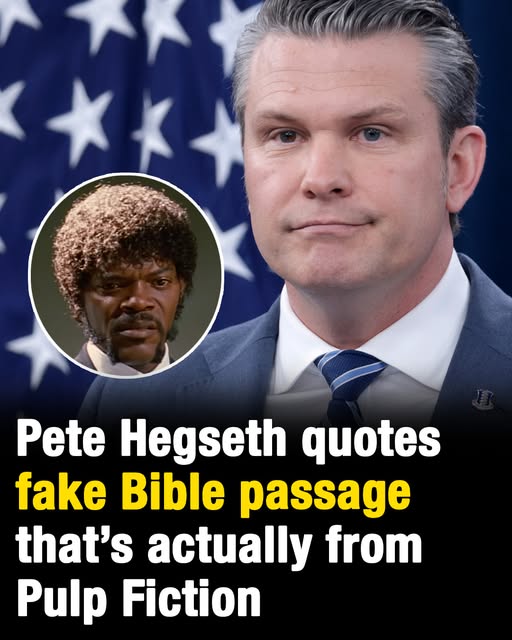
Pete Hegseth Faces Backlash After “Bible Quote” Mistakenly Echoes Pulp Fiction Dialogue
A Public Speech Sparks Unexpected Controversy
Pete Hegseth has frequently referenced religious themes in public appearances, often incorporating expressions of faith into his speeches. However, a recent address quickly drew attention for a different reason.
During a Wednesday event at the Pentagon, Hegseth delivered remarks as part of a worship service connected to ongoing military operations. What was intended as a prayerful reflection instead became a viral controversy after a passage he recited was widely identified as incorrect.
The Passage That Drew Attention
While speaking at the podium, Hegseth read a dramatic passage he attributed to scripture. The wording described themes of duty, protection, and vengeance, presented in a style resembling biblical language.
The speech included lines about guiding others through darkness, brotherhood, and retribution, concluding with a formal sign-off referencing a military call sign.
However, observers quickly pointed out that the passage was not part of the Bible as presented.
Connection to a Well-Known Film
The wording Hegseth used closely matched dialogue from the 1994 film Pulp Fiction, spoken by Samuel L. Jackson’s character, who attributes a modified version of Ezekiel 25:17 as scripture.
The film’s monologue is itself a stylized adaptation of biblical language, blending direct reference to scripture with fictional additions and dramatic reinterpretation.
While the original biblical verse exists in the Book of Ezekiel, its phrasing is notably shorter and differs significantly from the cinematic version.
The Original Biblical Reference
The verse from Ezekiel 25:17 contains language about judgment and divine retribution but does not include the expanded narrative found in the film.
The difference between the original scripture and the movie adaptation has long been discussed in popular culture, particularly due to the film’s iconic performance.
Social Media Reaction
Following the speech, reactions spread rapidly across social platforms, where users debated the mix-up and its implications.
Some comments criticized the confusion between a cinematic monologue and a religious text, while others framed the incident as a broader commentary on political communication.
Users expressed disbelief that the passage had been presented as scripture, and many highlighted the resemblance to the well-known film dialogue.
The Debate Over Context and Intent
As the discussion developed, attention turned to whether the passage was intentionally used as inspiration or mistakenly presented as biblical text.
Supporters argued that the wording reflected a tradition of adapting familiar cultural references into motivational or ceremonial language.
Critics, however, viewed the moment as a lapse in accuracy during a formal setting.
Pentagon Response to the Incident
The Pentagon addressed the situation through a statement issued by its public affairs office.
A spokesperson explained that the prayer referenced during the event was intended as a custom message used within a combat search and rescue context.
The statement described the wording as being inspired by dialogue from Pulp Fiction, while also connecting it to the biblical verse in Ezekiel 25:17.
Clarification of the Intended Meaning
The official response emphasized that both the prayer and the film dialogue were linked conceptually to the same scripture passage.
It further stated that criticism of the remarks as a misquote was inaccurate, framing the interpretation as consistent with its intended reference.
The statement rejected claims that the passage had been incorrectly attributed, describing such interpretations as unfounded.
Public Interpretation and Ongoing Discussion
The incident has continued to generate discussion about the use of religious language in political and military settings.
It also highlights how cultural references can take on new meaning when placed in formal or institutional contexts.
For many observers, the moment became an example of how easily popular media and religious language can intersect in public discourse.
A Moment That Drew Wide Attention
What began as a routine speech ultimately became a widely discussed moment online and in media commentary.
The combination of religious tone, cinematic reference, and official response ensured that the incident remained in the public conversation.
As debate continues, the episode underscores the scrutiny that accompanies high-profile political figures and their public remarks.