
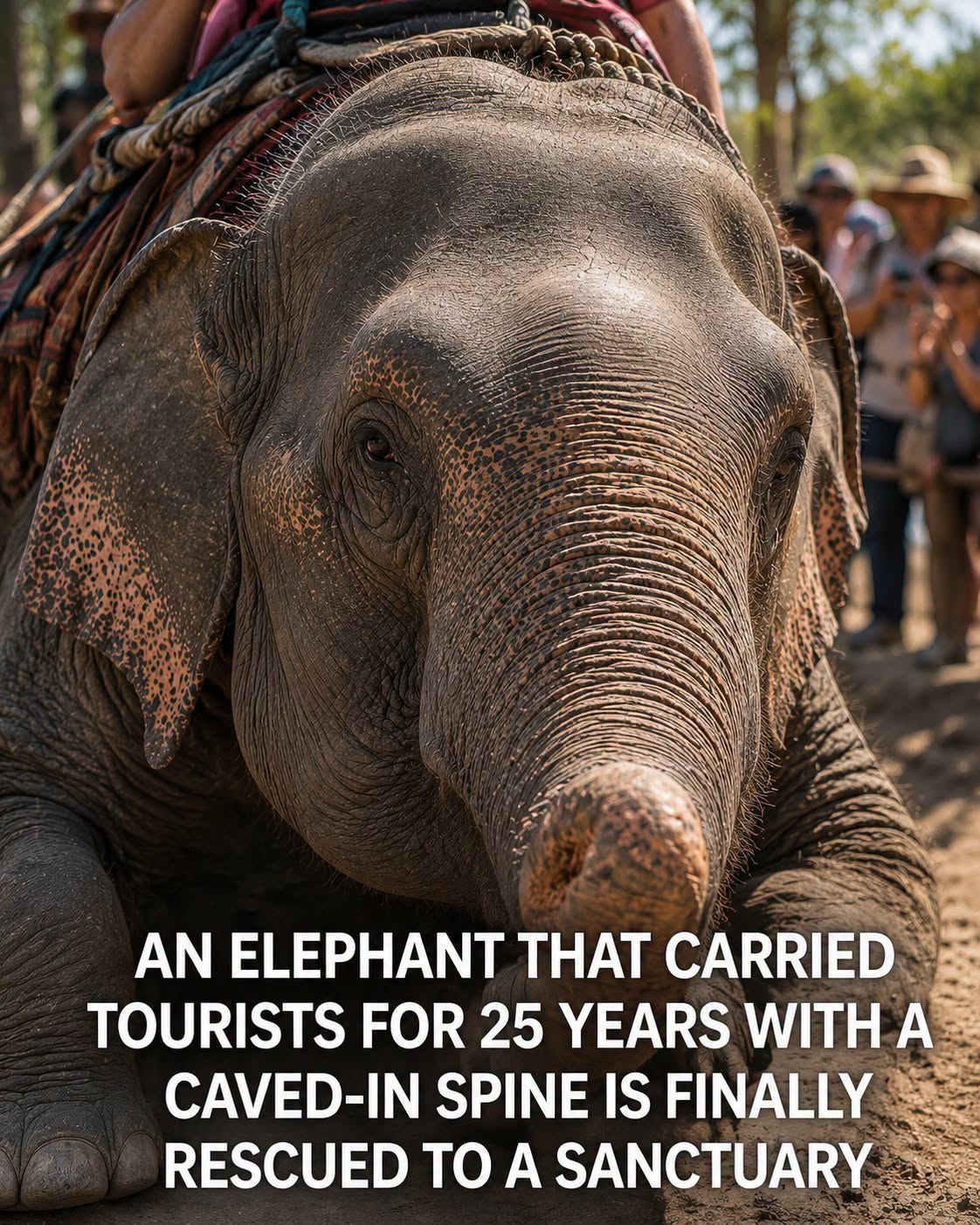
Pai Lin: The Elephant Whose Spine Collapsed Beneath Years of Tourist Rides
For countless seasons, a female elephant named Pai Lin carried visitor after visitor on her back, enduring heavy loads that slowly but relentlessly reshaped her skeleton. The constant pressure of hauling people and equipment across uneven terrain took a devastating toll, bending her spine into a severe and permanent curve that would mark her body for the rest of her life.
Her story is not one of sudden tragedy, but of slow, grinding wear. Each ride added another layer of strain to her young frame, and over time, the accumulated weight proved too much for her bones to bear. The result was a twisted, misshapen back—a visible scar of a life spent serving the tourism industry.
A Rescue That Came Just in Time
In 2006, Pai Lin’s circumstances changed when she was rescued and brought to the Wildlife Friends Foundation Thailand. It was there that the rides finally stopped. The burdens that had defined her existence were removed, and for the first time in years, she was free to simply walk at her own pace, rest when she needed, and live without the constant demand to perform.
The foundation provided her with a sanctuary where the pressures of commercial entertainment no longer applied. Instead of carrying tourists, she could spend her days grazing, bathing, and interacting with other elephants in a more natural setting. The transition marked the beginning of a quieter chapter in her life, one where her welfare took priority over profit.
Yet, the physical damage she sustained during her working years could not be undone. The curvature of her spine remained, a permanent reminder of the price she paid for human amusement. While her daily life improved dramatically after the rescue, her body continues to bear the evidence of her past.
The Hidden Cost of Elephant Tourism
Pai Lin’s condition highlights a broader issue that often goes unnoticed by visitors. Tourists who climb onto the backs of elephants for a photo or a short trek rarely see the long-term consequences of that interaction. The animals may appear calm and cooperative, but the physical strain of carrying heavy loads day after day can cause lasting damage to their spines, joints, and muscles.
In many cases, the training methods used to make elephants compliant involve harsh techniques that break their spirit. The gentle giants that tourists admire are often subjected to routines that prioritize human enjoyment over animal welfare. The result is a population of elephants living with chronic pain, deformities, and psychological trauma that are invisible to the casual observer.
The tourism industry has long marketed elephant rides as a unique and memorable experience. However, the reality behind that experience is far less pleasant for the animals involved. The weight of a howdah—the wooden seat placed on the elephant’s back—combined with the weight of multiple riders, can exceed what the animal’s spine is designed to support.
A Life Transformed by Compassion
At the Wildlife Friends Foundation Thailand, Pai Lin found a different kind of existence. The sanctuary offered her space to roam, access to proper veterinary care, and a diet suited to her needs. More importantly, it offered her dignity—a chance to live as an elephant should, without the constant pressure to perform for human audiences.
Her days became her own. She could choose when to move, when to rest, and when to socialize with other elephants. The freedom she gained in 2006 was a dramatic departure from her previous life, and while her body still showed the scars of her past, her daily experience was transformed.
Those who care for her have noted that she adapted well to her new surroundings. The stress of performing was replaced by the calm of sanctuary life. Though her spine remains curved, her overall health and well-being improved significantly once the heavy loads were removed from her back.
What Tourists Never See
The story of Pai Lin serves as a powerful example of the hidden consequences of animal-based entertainment. Tourists see a smiling elephant, but they do not see the years of strain that led to a deformed spine. They hear a trainer’s commands, but they do not hear the animal’s silent suffering.
This disconnect between perception and reality is at the heart of the ethical debate surrounding elephant tourism. Many travelers are unaware that the very activities they enjoy are causing harm to the animals they claim to love. The demand for rides and shows perpetuates a cycle of exploitation that leaves lasting marks on the creatures involved.
For elephants like Pai Lin, the damage is physical and visible. For others, the harm may be less obvious but equally profound. The psychological toll of captivity, the disruption of natural social structures, and the denial of basic freedoms all contribute to a diminished quality of life.
The Case for Ethical Treatment
As awareness of these issues grows, more travelers are seeking out ethical alternatives to traditional elephant attractions. Sanctuaries that prioritize animal welfare over entertainment are becoming increasingly popular, offering visitors the chance to observe elephants in a more natural setting without demanding that the animals perform or carry loads.
These ethical operations focus on rehabilitation and care rather than exploitation. They recognize that elephants are sentient beings with complex needs, and they structure their programs around those needs rather than around human desires. The result is a more respectful and sustainable approach to wildlife tourism.
Pai Lin’s story is a reminder that animals used for entertainment often pay a lasting physical price that tourists never see. Her deformed body stands as quiet testimony to the cost of a life spent serving human amusement. But her rescue also demonstrates that change is possible—that with compassion and commitment, the lives of these animals can be improved.
Pai Lin: A Future Built on Respect
The legacy of Pai Lin extends beyond her own story. She represents countless other elephants who continue to suffer in the name of entertainment, and she embodies the hope that their circumstances can be changed. Her presence at the sanctuary is not just a refuge for one animal, but a symbol of a better way forward.
By choosing to support ethical sanctuaries and refusing to participate in activities that harm animals, tourists can help shift the industry toward more humane practices. Every decision matters, and every visitor has the power to make a difference.
Pai Lin’s spine may never straighten, and the physical marks of her past will remain. But her life today is a testament to the importance of safety, dignity, and genuine care for all creatures. She serves as a quiet but powerful reminder that the animals we enjoy should be treated with the respect they deserve—not as tools for our entertainment, but as living beings with their own worth.
Her story encourages reflection on the choices we make as consumers and travelers. It urges us to look beyond the surface and consider the unseen consequences of our actions. And it inspires hope that, with greater awareness and compassion, the lives of animals like Pai Lin can be filled with peace rather than pain.
In the end, Pai Lin’s journey from a life of heavy burdens to one of sanctuary and rest is a story of resilience. It is a reminder that even after years of hardship, a better life is possible. And it is a call to action for all of us to ensure that no other elephant has to endure what she went through.