
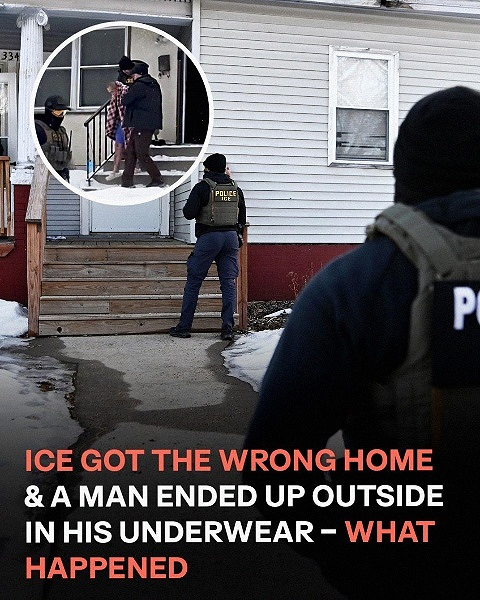
A Minnesota man was forcibly removed from his home in nothing but his underwear during an immigration raid by federal agents, prompting widespread criticism and renewed scrutiny of U.S. Immigration and Customs Enforcement (ICE) operations. Family members say the raid, conducted without a warrant, left the household shaken and raised serious questions about enforcement practices.
Nap Turns Into Nightmare
ChongLy “Scott” Thao’s quiet Sunday afternoon erupted into chaos when his daughter-in-law alerted him to pounding at the door. ICE agents were reportedly demanding entry, guns drawn. Despite Thao’s repeated requests to avoid opening the door, agents forced their way inside, shouting commands at him and his family.
“I was shaking. They didn’t show any warrant; they just broke down the door,” Thao recalled. He stepped outside wearing only sandals and shorts, wrapped hastily in a blanket. His four-year-old grandson watched the scene unfold, terrified.
Neighbors captured videos of the raid, recording agents moving through the house and shouting commands. Some witnesses blew whistles and yelled at the armed officials to leave, documenting a chaotic and unsettling scene.
Identity Verification Denied
Thao, a long-time U.S. citizen, attempted to provide identification to the agents, but officials reportedly refused to verify his status on the spot. He was taken to a remote location and ordered out of the vehicle in freezing temperatures for photographs. Thao feared for his life, concerned that the agents might cause him harm.
After roughly one to two hours, ICE agents confirmed Thao’s citizenship and returned him home. No apology was issued for the raid, the forced entry, or the distress caused to his family.
DHS Attributes Raid to Mistaken Identity
The Department of Homeland Security (DHS) explained that the operation targeted two convicted sex offenders. According to DHS, Thao lived at the same residence as the intended targets and initially resisted fingerprinting and facial recognition checks.
Thao’s family strongly disputes this account. Public records indicate that only Thao, his son, daughter-in-law, and grandson live at the St. Paul home. The closest registered sex offender resides more than two blocks away.
Prior to the raid, Thao’s son was briefly stopped while driving a borrowed vehicle. Officials suggest that the car owner’s first name matched that of an unrelated convicted offender, possibly contributing to the confusion.
Family Prepares Civil Rights Lawsuit
Thao has announced plans to pursue legal action against DHS, citing violations of his civil rights and the traumatic nature of the encounter. “I no longer feel safe in my own home,” he said. Family members also pointed to a historical context of vulnerability: Thao’s mother, a nurse, fled Laos following the communist takeover and had worked with U.S.-backed operations during the Vietnam-era “Secret War,” caring for CIA-supported Hmong soldiers from 1961 to 1975. She passed away in late December 2025, adding further personal grief to the family’s ordeal.
Previous ICE Incidents in Minnesota
ICE operations targeting U.S. citizens have drawn criticism in Minnesota in recent months. Earlier in January, Renee Nicole Good was fatally shot by an ICE agent in Minneapolis under disputed circumstances. Local officials, including Governor Tim Walz and Mayor Jacob Frey, questioned the federal account, calling the shooting “preventable” and “unnecessary.”
President Donald Trump defended the officer involved, claiming the action was in self-defense, while DHS Secretary Kristi Noem labeled the incident “domestic terrorism,” citing obstruction of officers. Mayor Frey countered this narrative, describing the federal account as false and the victim as non-threatening.
Increased Federal Presence Sparks Concern
The Twin Cities are experiencing an intensified presence of ICE and Homeland Security Investigation (HSI) agents, with reports suggesting that as many as 2,000 federal personnel could be deployed in the region. This heightened activity has raised fears among residents regarding enforcement tactics, potential errors, and overall public safety.
ChongLy Thao’s experience illustrates the dangers of mistaken identity and aggressive enforcement practices. Families and neighbors have voiced concern about the risks posed by federal raids, highlighting the need for accountability and oversight in ICE operations.
Thao’s planned lawsuit may serve as a test case in evaluating how federal agencies conduct raids, verify identities, and protect the rights of U.S. citizens. The incident underscores ongoing debates over the balance between law enforcement authority and civil liberties.