
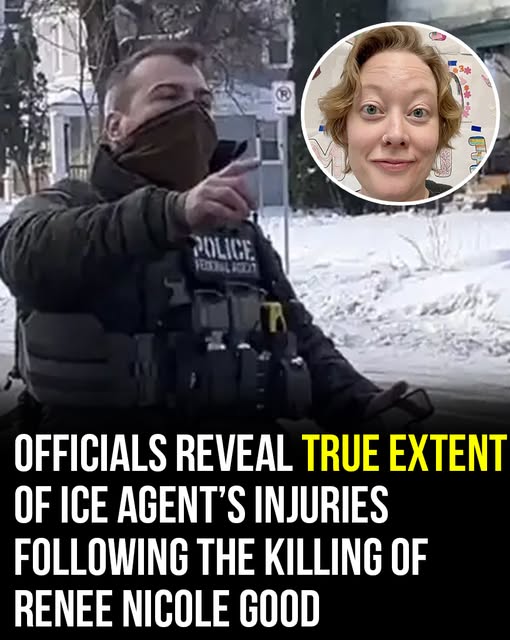
Minneapolis remains on edge following the January 7 fatal shooting of Renee Good by ICE agent Jonathan Ross, as the city grapples with ongoing civil unrest and a deepening constitutional standoff between state and federal authorities. New details about the physical condition of the agent have added a fresh dimension to an already contentious investigation. U.S. officials say Ross sustained internal bleeding to the torso during the confrontation, a fact confirmed by the Department of Homeland Security (DHS), though the precise severity of the injury has not been disclosed.
Conflicting Accounts of the Shooting
The incident occurred on a residential street when Renee Good, behind the wheel of her Honda Pilot, allegedly attempted to drive away as ICE officers demanded she exit the vehicle. Video footage from the scene shows physical contact between Ross and Good’s SUV during the moments leading up to the shooting. Ross fired multiple rounds, striking Good in the head.
Federal officials, including the Trump administration and Deputy Attorney General Todd Blanche, have defended the agent’s actions as self-defense, citing the confrontation as a violent encounter that left Ross injured. Local leaders and activists, however, dispute this narrative, describing it as inconsistent with the circumstances captured on video and claiming it obscures the facts of the case.
“There is currently no basis for a criminal civil rights investigation,” Blanche said, indicating that Minnesota state authorities would be excluded from the FBI-led probe. Legal experts have criticized this decision, arguing that it raises concerns about transparency and accountability in federal investigations involving state residents.
Fundraising and Ethical Questions
The shooting has polarized the community, prompting competing crowdfunding campaigns. A fundraiser for Agent Ross has reportedly raised over $700,000, while a campaign supporting Good’s widow and young son has surpassed $1.1 million.
The legality of funds intended for Ross remains uncertain. Under U.S. Office of Government Ethics rules, federal employees are generally prohibited from receiving outside compensation for their official duties, meaning that access to the raised funds could be restricted. This has added an ethical layer to the public debate surrounding the shooting and its aftermath.
A Second Incident Deepens Instability
Minneapolis faced further turmoil on Wednesday with a second federal shooting incident. DHS confirmed that an officer fired at a suspect’s leg after the individual attacked law enforcement with a snow shovel and broom handle.
The episode occurred just miles from the site of Good’s death and sparked renewed confrontations between federal officers and demonstrators. Tear gas and chemical irritants have been deployed repeatedly as part of “Operation Metro Surge,” a federal enforcement initiative that local officials claim has resulted in residents being pulled from vehicles and homes without clear justification.
Legal Battle Moves to Federal Court
The dispute over federal enforcement has entered the courtroom, with Minnesota filing a lawsuit challenging the federal crackdown. U.S. District Judge Katherine Menendez is overseeing the case.
During a recent hearing, Minnesota Assistant Attorney General Brian Carter urged for calm and de-escalation. “What we need most of all right now is a pause. The temperature needs to be lowered,” Carter said.
Judge Menendez has prioritized the state’s request for a restraining order, giving the Justice Department a deadline of Monday to issue a formal response.
Mayor Frey Raises Concerns About Racial Profiling
Meanwhile, Minneapolis Mayor Jacob Frey has escalated public criticism of federal actions, alleging systematic racial profiling during enforcement operations.
“What we see right now is discrimination taking place only on the basis of race: Are you Latino or are you Somali?” Frey told reporters. “They have pulled U.S. citizens off the streets. You don’t need to take my word for it; this has been very well documented.”
These statements highlight ongoing tension between federal authorities carrying out ICE operations and local leaders advocating for residents’ civil rights and public safety.
The City in a Federal-State Standoff
The combination of federal enforcement, legal maneuvering, and public protests has left Minneapolis in a precarious position. Residents have witnessed federal tactical teams patrolling neighborhoods, while the state government pursues legal action to limit what it describes as excessive federal intrusion.
Experts note that such clashes between local and federal authorities are rare but legally complex. They raise questions about the balance of power under the U.S. Constitution, particularly when federal enforcement actions intersect with local civil rights concerns.
The community continues to respond with vigils, protests, and public forums, reflecting deep divisions over law enforcement practices, civil liberties, and accountability. Both federal and state officials are under pressure to navigate the legal, ethical, and political challenges while maintaining public safety.
Looking Ahead
As the Monday legal deadline approaches, all eyes remain on Minneapolis. The outcome of the restraining order and ongoing investigation will likely shape the city’s relationship with federal authorities for months to come. Meanwhile, public sentiment remains volatile, with residents caught between federal enforcement operations and a local government striving to assert its authority.
The death of Renee Good, the injury of Agent Ross, and the resulting civil unrest underscore the complexity of law enforcement in a divided political and social environment. Minneapolis serves as a flashpoint for broader debates on policing, federal authority, civil rights, and racial equity in the United States.