
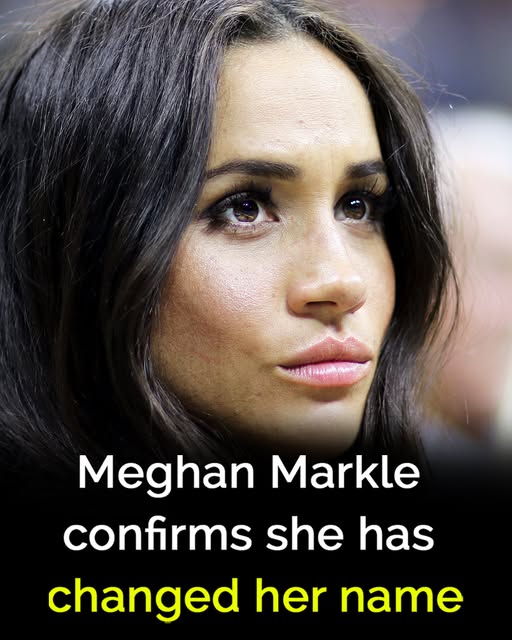
Meghan, the Duchess of Sussex, has publicly confirmed that she is now using “Sussex” as her last name, aligning herself with her husband, Prince Harry, and their two children, Archie and Lilibet. The move has drawn widespread attention, sparking renewed discussion about royal naming customs, personal identity, and how titles are used within the modern royal family.
The development came to light through Meghan’s new Netflix lifestyle series, With Love, Meghan, which has generated conversation not only for its content but also for the personal revelations woven into the episodes. During the show, Meghan made it clear that she no longer identifies by her maiden name in everyday settings, instead embracing “Sussex” as a shared family name.
A Moment That Brought the Change Into Focus
The topic surfaced during a conversation on With Love, Meghan when Meghan corrected her friend and guest, Mindy Kaling, after Kaling referred to her by her former surname. Addressing the moment directly, Meghan said, ”It’s so funny you keep saying Markle.”
She then clarified her choice, adding, ”You know it’s Sussex now. You have kids and you go, I share my name with my children. I didn’t know how meaningful it would be to me, but it just means so much to go, this is our family name. Our little family now.”
The exchange quickly circulated online, with viewers and commentators noting that Meghan was publicly asserting a name that differs from how she is commonly identified in media coverage.
Reinforcing the Message Beyond the Show
Meghan reiterated the same sentiment in a recent interview with People, emphasizing the emotional importance the name holds for her. She and Prince Harry were granted the titles Duke and Duchess of Sussex by Queen Elizabeth II upon their marriage in 2018. Under existing royal conventions, their children later became Prince Archie and Princess Lilibet of Sussex.
Reflecting on the shared identity, Meghan explained, ”It’s our shared name as a family, and I guess I hadn’t recognized how meaningful that would be to me until we had children. I love that that is something that Archie, Lili, H, and I all have together. It means a lot to me.”
She went on to describe the name “Sussex” as ”a part of our love story,” framing the decision as a personal and family-centered choice rather than a symbolic break or political statement.
Public Use of the Name “Meghan Sussex”
While Meghan remains formally styled as the Duchess of Sussex, her recent public appearances suggest that she is increasingly comfortable using “Sussex” as a surname in less formal contexts. This approach was evident during her appearance on The Drew Barrymore Show on March 6, where she discussed her current projects.
Introducing the segment, host Drew Barrymore referred to her guest by saying, ”This is the Fast Five with Meghan Sussex.” The moment marked one of the first times Meghan was publicly introduced using “Sussex” as though it were a conventional last name.
Although titles and surnames operate differently within royal protocol, the introduction reinforced Meghan’s preference and further fueled discussion about whether the usage aligns with tradition.
Why the Decision Has Drawn Criticism
The adoption of “Sussex” as a surname has not been universally accepted. Some royal observers and fans have questioned the choice, arguing that “Sussex” is technically a territorial designation associated with a dukedom rather than a conventional family name.
Critics have also pointed out that Meghan has limited personal ties to the English county itself, which has led some to view the choice as symbolic rather than practical. Others have suggested that the legally appropriate surname for Meghan and her children should be “Mountbatten-Windsor,” a name historically used by descendants of Queen Elizabeth II and Prince Philip.
One royal fan commented, “Her name is NOT Meghan Sussex. Her name is technically Rachel Mountbatten-Windsor. Sussex is a county in England & part of a courtesy title – NOT her last name.”
Another questioned the on-air correction of Mindy Kaling, writing, “So who criticizes a guest like that? And her last name is not Sussex. Wouldn’t it be Mountbatten-Windsor?”
A third observer added, ”’Duchess of Sussex’ is a courtesy title she holds only through her marriage. It is not her surname, and I’m quite sure she doesn’t have ‘Meghan Sussex’ on her California driver’s license. Legally, her last name should be Mountbatten-Windsor.”
Reaction From Meghan’s Father
The discussion has also prompted comments from Meghan’s father, Thomas Markle, who expressed disappointment over her decision to move away from the Markle name. He suggested that the choice would have upset his late mother and framed it as a rejection of family heritage.
He stated, “My mum loved Meghan very much but she would be so disappointed to hear that Meghan no longer wants to use the name ‘Markle.’ My mother was proud to be a Markle. So am I.”
Thomas Markle also criticized Meghan’s appearance on the Netflix series, claiming that she came across as overly focused on perfection and lacking authenticity. His remarks are part of a long-standing and highly publicized estrangement between father and daughter that dates back to 2018, when he did not attend Meghan’s wedding.
While some observers sympathize with his perspective, others note that his frequent media appearances have contributed to the ongoing distance between them.
How Royal Naming Traditions Actually Work
Despite the criticism, established royal etiquette supports Meghan’s use of “Sussex” as a surname in appropriate contexts. Many members of the royal family have historically used their titles as surnames, particularly in informal or professional settings.
Debrett’s, a recognized authority on British etiquette, explains the practice clearly: ”The Duke and Duchess of Sussex can, and do, use ‘Sussex’ as their surname. This follows the tradition when Prince Harry used ‘Wales’ as his surname while serving in the army, reflecting his status as the son of the Prince of Wales. Now that he’s the Duke of Sussex, his wife and children are also entitled to use ‘Sussex’ as their surname.”
This precedent illustrates that the use of a title-derived surname is neither unusual nor improper within royal custom, even if it differs from legal documentation or public expectations.
Media Usage Likely to Remain Mixed
Despite Meghan’s stated preference, it is unlikely that the media will fully abandon the name “Meghan Markle” in the near future. The name remains widely recognized, and publications continue to use it for clarity and consistency, as seen in recent coverage including her feature in People.
As a result, both names are likely to coexist in public discourse, with “Meghan Markle” remaining dominant in headlines while “Meghan Sussex” appears more frequently in personal, informal, or family-oriented contexts.
A Personal Choice in a Public Spotlight
Meghan’s decision to use “Sussex” as her surname has clearly resonated beyond her immediate circle, touching on broader conversations about identity, tradition, and modern interpretations of royal life. While opinions remain divided, the move itself aligns with long-standing practices within the royal family and reflects her desire to emphasize unity within her household.
As discussions continue, the choice underscores how even seemingly small personal decisions can attract intense scrutiny when made by figures with global visibility.