
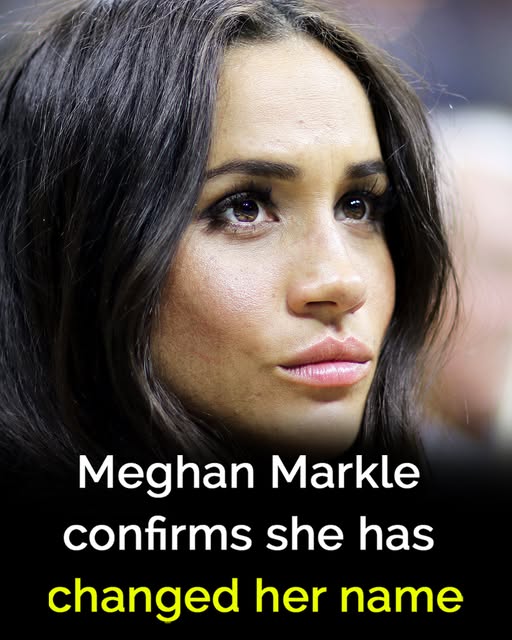
Meghan, the Duchess of Sussex, has once again become the focus of public discussion after clarifying that she no longer uses “Markle” as her last name. Instead, she has been identifying herself as “Sussex,” aligning her family name with Prince Harry and their children, Archie and Lilibet. The clarification, delivered casually but firmly, has prompted renewed debate over royal naming conventions, personal identity, and the blurred lines between tradition and modern public life.
The moment that reignited the conversation occurred on Meghan’s recently released Netflix series, With Love, Meghan. During an on-camera exchange with Mindy Kaling, Kaling referred to her as “Meghan Markle.” Meghan responded with a smile and a gentle correction, noting that she now goes by “Sussex.” She explained that the change was rooted in personal meaning rather than public positioning. Becoming a mother, she said, reshaped how she thought about names and family identity, and sharing the same name as her children carried unexpected emotional importance.
Meghan framed the shift as a reflection of family unity. For her, “Sussex” represents the household she and Prince Harry have built together, rather than merely a title acquired through marriage. She has spoken of the name as something that connects her to her husband and children in a tangible way, describing it as a symbol of togetherness that grew more significant after the birth of Archie and Lilibet.
The timing of the clarification has amplified its impact. With Love, Meghan marks a new chapter in her public career, focusing on lifestyle themes such as home, food, hosting, and everyday rituals. As with many of her projects, the series has been closely examined for what it suggests about her evolving public image. The name discussion, layered on top of a high-profile streaming release, quickly became a focal point for interpretation, speculation, and criticism.
Public reactions have varied widely. Supporters view the choice as a natural progression for a woman emphasizing her role as a wife and mother. Critics argue that “Sussex” is a title rather than a surname and question whether it should be used in casual or public settings as a family name. The disagreement reflects a broader confusion around how names function within royal life, where conventions differ sharply from those of the general public.
In most households, a surname is fixed and tied directly to legal documentation. Within royal families, however, names can be flexible and context-dependent. Titles often serve as functional surnames, particularly in situations where a last name is required but full formal styles are unnecessary. Individuals may use different names depending on whether the setting is ceremonial, professional, or private, and those choices can change over time.
Critics of Meghan’s choice frequently point to the convention that members of the British royal family legally fall under the surname “Mountbatten-Windsor.” From that perspective, they argue that “Sussex” is a territorial designation linked to a dukedom rather than a traditional last name. Some have also noted that Sussex is a geographic region and questioned the appropriateness of adopting it as a personal identifier, particularly given Meghan’s residence in the United States.
Online commentary has reflected these divisions. One group maintains that using a title as a surname is common practice within royal circles and does not merit controversy. Another group views the move as inaccurate or overly performative, suggesting that the name is being used selectively for image purposes. A recurring argument is that “Sussex” would not appear on everyday legal documents, reinforcing the idea that its use is symbolic rather than official.
The way the name has been spoken publicly has also fueled discussion. In at least one prominent talk-show appearance, Meghan was introduced as “Meghan Sussex,” a phrasing that struck many viewers as unusually formal or deliberate. Hearing the name used in that format, rather than reading it in print, made the shift feel more concrete and intensified reactions. For some, it sounded streamlined and consistent. For others, it underscored concerns about blending titles with personal naming conventions.
This debate exists within a larger pattern of scrutiny surrounding Meghan’s choices. When she uses “Markle,” she is sometimes criticized for leaning into celebrity. When she uses “Sussex,” she faces accusations of clinging to royal status. Using her formal title can draw claims of inconsistency, while avoiding it can lead to accusations of disrespect. The conflicting expectations highlight how difficult it has become for her to satisfy all audiences simultaneously.
Adding to the complexity, Meghan’s father, Thomas Markle, has publicly criticized her decision to move away from the Markle surname. He has described it as a rejection of the family name and suggested it would have been painful for his late mother, whom he says valued the Markle identity. He has also used the moment to criticize Meghan’s public image more broadly, characterizing her as overly focused on presentation. Their strained relationship has been well documented, and his repeated public statements continue to generate controversy, with opinions sharply divided on his role in the ongoing family rift.
Beyond the personal disputes and online reactions, there is historical precedent for using titles as surnames within the royal family. Members of the monarchy have long adopted territorial designations as working last names, particularly in education or military contexts. Prince Harry himself previously used a title-based surname during his service in the armed forces, reflecting an established practice rather than a novel invention.
Formal royal naming conventions, however, remain complex. Legal names, styles, titles, and everyday usage do not always align neatly, leading to frequent misunderstandings among the public. Some discussions focus on legal accuracy, while others emphasize custom or personal preference. As a result, debates about names often persist without resolution, fueled by differing interpretations of what constitutes a “last name” in royal life.
In Meghan’s case, the use of “Sussex” appears to be a statement of personal identity rather than a legal declaration. It signals how she wishes to be addressed in daily interactions and public conversation, particularly when emphasizing her role within her immediate family. Whether media organizations and the wider public adopt the change remains uncertain. Many outlets continue to use “Meghan Markle” because it remains the most widely recognized name associated with her public profile.
Ultimately, the renewed focus on Meghan’s surname reflects how symbolic details can take on outsized meaning in the lives of high-profile figures. The name “Sussex” has become a stand-in for broader conversations about belonging, status, and authenticity. As with many debates tied to public identity, the volume of the reaction has far exceeded the practical implications of the choice itself.