
Why Do Some Restrooms Say “WC”? The Surprising History Behind a Common Sign
A Simple Sign That Leaves Many People Confused
Most people have encountered the letters “WC” at some point while traveling through airports, hotels, restaurants, or public buildings. Despite its widespread use, many are unsure what the abbreviation actually means.
The confusion has sparked countless online discussions, with people debating whether the room should be called a bathroom, restroom, washroom, toilet, lavatory, or something else entirely.
While each term refers to roughly the same place, the origins behind these names reveal an interesting piece of social and architectural history.
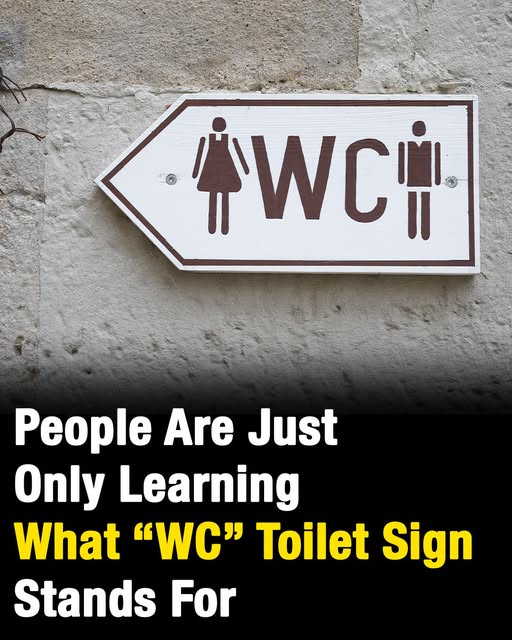
The abbreviation “WC” stands for “water closet,” a term that dates back to a time when indoor plumbing was still a relatively new innovation.
A Viral Debate About Restrooms and Washrooms
The discussion gained renewed attention when a couple shared a lighthearted video highlighting differences in restroom terminology.
In the video, a man notices a sign labeled “washroom” and questions the name.
He jokingly wonders why it is called a washroom when the main activity most people associate with the space is not washing.
His wife responds with a similar observation about the word “restroom,” asking whether people actually rest there.
The exchange resonated with viewers because it highlighted how strange many restroom-related terms sound when examined literally.
People quickly joined the conversation, sharing the words commonly used in their own regions.
Some preferred “bathroom,” others said “restroom,” while many mentioned “washroom,” “toilet,” or “WC.”
The discussion demonstrated just how many different names exist for the same basic facility.
What Does “Water Closet” Actually Mean?
The term “water closet” originated during the development of indoor plumbing systems.
Historically, it referred to a small room or compartment that contained a flushing toilet.
Unlike modern bathrooms, these early spaces were often separate from areas used for bathing.
The name itself combined two simple concepts.
“Water” referred to the plumbing system that made flushing possible.
“Closet” described a small enclosed room.
Together, the phrase identified a private space containing a water-flushed toilet.
Over time, the abbreviation “WC” became widely recognized and remains common in many countries today.
Although many people no longer use the full phrase “water closet” in everyday conversation, the abbreviation continues to appear on signs throughout the world.
How Bathrooms Were Different in the Past
To understand why the term developed, it helps to look at how homes were designed before modern plumbing became widespread.
For much of the nineteenth century, indoor toilets were uncommon.
Many households relied on outdoor facilities for sanitation.
At the same time, rooms used for bathing served a different purpose entirely.
A bathroom was literally a room where someone took a bath.
Because bathing and toilet facilities were often separated, different names naturally developed for each space.
As plumbing technology improved and became more affordable, indoor toilets began appearing in homes.
Rather than placing them directly inside existing bathing areas, many homeowners initially installed them in separate rooms.
Those rooms became known as water closets.
The Rise of the Modern Bathroom
By the early twentieth century, residential design began changing.
Advances in plumbing made it easier and more practical to combine bathing and toilet facilities into a single room.
This arrangement saved space and simplified construction.
As a result, the modern bathroom gradually became the standard design.
Even though toilets and bathtubs now commonly occupy the same room, the older terminology never completely disappeared.
Many people continued referring to the toilet area as the water closet.
In some homes, particularly larger residences, a separate enclosed toilet room still exists inside the main bathroom.
These smaller rooms are often called water closets even today.
The term has therefore survived long after the architectural arrangements that originally inspired it.
Why So Many Different Names Exist
One reason restroom terminology creates confusion is that different regions developed their own preferred expressions.
Language often evolves according to local customs and cultural habits.
As a result, people around the world use a surprising variety of names for the same space.
In many parts of the United States, “bathroom” is the most common term.
Others prefer “restroom,” particularly in public settings.
In Canada, “washroom” is widely used and often considered the standard expression.
Elsewhere, people may refer to the facility as a toilet, lavatory, loo, or WC.
Each term reflects historical influences and regional preferences.
None is necessarily more correct than the others.
The Curious Logic Behind Restroom Names
When examined literally, many restroom-related terms appear somewhat illogical.
For example, most public restrooms do not contain bathtubs.
Yet millions of people continue calling them bathrooms.
Similarly, few people actually rest inside a restroom.
The primary purpose of the space is entirely different.
Washroom may seem more practical because handwashing is a routine activity there.
However, that term also fails to describe the room’s primary function completely.
The persistence of these names demonstrates how language often prioritizes tradition over strict accuracy.
Words frequently survive long after their original meanings have evolved.
Restroom terminology provides a perfect example of that process.
Why WC Remains Popular Internationally
Despite the existence of many local terms, “WC” continues to serve an important purpose.
Because it is widely recognized internationally, it functions as a useful universal label.
Travelers moving between countries may not immediately recognize local words for restroom facilities.
However, many understand the abbreviation WC.
For that reason, hotels, airports, train stations, and tourist destinations frequently use the designation.
It helps visitors identify restroom facilities regardless of language barriers.
The simplicity of the abbreviation makes it especially practical in international environments.
As global travel increased, the usefulness of a broadly understood symbol became even more apparent.
Today, WC remains one of the most recognizable restroom indicators in the world.
Online Discussions Reveal Cultural Differences
Conversations about restroom terminology often reveal fascinating cultural distinctions.
People from different countries are sometimes surprised to discover how others describe the same facility.
What seems completely normal in one region may sound unusual elsewhere.
These differences frequently become topics of humor and curiosity online.
Travelers often share stories about asking for a washroom, restroom, or toilet and receiving puzzled reactions.
Such experiences highlight how deeply local language influences everyday communication.
Even simple requests can reveal unexpected cultural differences.
At the same time, these conversations remind people that language is constantly adapting and changing.
The words we use often reflect historical traditions that remain embedded in daily life.
The Evolution of Everyday Language
The story of the water closet illustrates a broader truth about language.
Many common expressions no longer match their original meanings.
Words survive because people continue using them, not necessarily because they remain perfectly accurate.
Over time, meanings shift while familiar terms stay in circulation.
Bathroom, restroom, washroom, and water closet all originated under different circumstances.
Each reflected a particular era, architectural design, or social convention.
As those circumstances changed, the language adapted but rarely disappeared completely.
Instead, multiple terms continued existing side by side.
The result is the diverse vocabulary people use today.
A Small Sign With a Long History
What appears to be a simple abbreviation on a restroom door carries more history than many people realize.
The letters WC connect modern travelers to a period when indoor plumbing represented a major technological advancement.
They reflect changing home designs, evolving sanitation systems, and shifting cultural habits.
Although the phrase “water closet” may sound old-fashioned, its influence remains visible in countless public spaces around the world.
The term continues to serve as a practical and recognizable way to identify restroom facilities.
At the same time, it reminds us how language preserves pieces of the past in everyday life.
Most people may never think twice about a WC sign, but behind those two letters lies a surprisingly rich story of history, architecture, and communication.
Whether you call it a bathroom, restroom, washroom, toilet, loo, lavatory, or WC, the purpose remains the same. The name may vary, but the destination is universally understood.