
Public images often suggest that fame and success smooth out life’s rough edges. For actors at the top of their profession, the assumption is frequently that achievement, financial security, and recognition provide a kind of permanent safety net. Yet the reality behind the spotlight can be far more complicated. In a newly released autobiography, Josh Brolin presents a detailed account of a life shaped not only by career milestones but also by instability, difficult family dynamics, and a long struggle with addiction.
The book, titled “From Under the Truck,” offers a personal narrative that traces Brolin’s early years, his path into acting, and the experiences that eventually led him to confront his dependence on alcohol and drugs. Rather than focusing on accolades or high-profile roles, the memoir centers on formative memories and moments of reckoning that altered the course of his life. It is written as a reflection on where he came from and how he arrived at his current sense of stability.
Brolin’s story begins with a childhood that was far from ordinary. His mother, Jane, worked as a wildlife conservationist, a profession that brought the natural world directly into the family’s daily life. For Brolin and his brother Jess, this meant growing up in close proximity to animals that most people only encounter from a distance. Some of those early memories, as described in the memoir, are marked by a mixture of adventure and danger.
He recounts a disturbing parenting practice that left a lasting impression. According to Brolin, his mother would sometimes encourage wild animals such as cougars, coyotes, and bobcats to chase the boys. She would shout ‘Sic ’em,’ and the animals would run after them. The experience was not presented as a game but as something that demanded immediate and frantic reactions. In the book, Brolin writes, “You knew if you didn’t get on the other side of that shut door within a couple of seconds, you’d be cleaning up fresh bloody marks somewhere on your body for the rest of the day.”
Despite how alarming these stories sound, Brolin has said he is “loath to say” that they were horrifying. In interviews connected to the book’s release, he has acknowledged that his mother could be difficult to be around, yet he has also expressed that she remained someone he wanted in his life. The complexity of that relationship runs through much of his recollection of childhood, blending affection, fear, and a sense of unpredictability.
Jane Brolin died in a car accident in 1995 at the age of 55. For her son, that number took on an unexpected significance during the years when his addiction was at its worst. He has spoken about a period when he considered 55 to be a reasonable age to die, believing that reaching that point meant a person had already lived a full life. That perspective, shaped by grief and substance abuse, would later change dramatically.
Today, Josh Brolin is 56, a year older than his mother was when she died. Reaching that age has forced a reassessment of his earlier beliefs. He has described realizing that 55 is not, in fact, a long life and that his earlier thinking was the product of a distorted outlook during his years of heavy drinking. The passage of time, combined with sobriety, has given him a different understanding of aging and longevity.
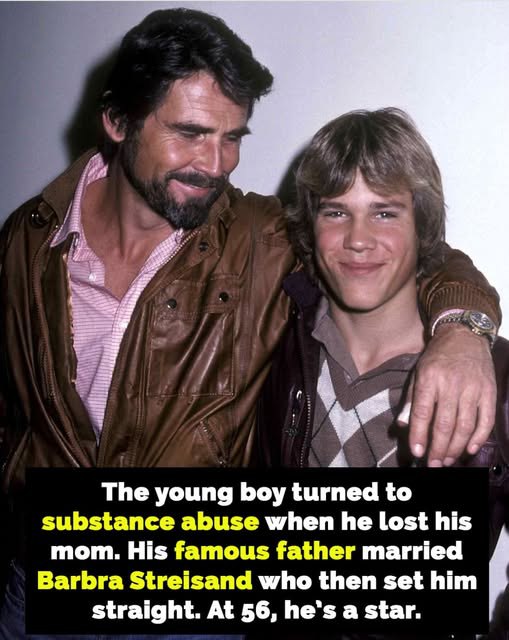
Family relationships continue to play a prominent role in his story. Brolin is the son of actor James Brolin, who is married to Barbra Streisand. Over the years, he has spoken about Streisand’s role in his life as a stepmother and about the direct, sometimes uncomfortable honesty she brought into their interactions. One particular exchange stands out in his recollections and is included in discussions surrounding the memoir.
He once described walking into their home and asking for a drink, saying, “Well into our happily-ever-after I walked into their house one day: ‘I’ll have a glass of wine’, I said. She looked at me and cocked her head, so I repeated myself. ‘I’ll have a glass of red wine, please.’” The moment did not pass quietly. He continued, “She took a slow breath then hit me with it: ‘Aren’t you an alcoholic?’ It was a pretty ballsy thing to say … She always had a way of washing her tongue with a bulls*** cleanser before she talked with me.” He added further detail about the exchange: ”(I said) ‘I’m an alcoholic, but I like red wine’. (She said) ‘You shouldn’t drink’.”
These comments, blunt as they were, are remembered by Brolin with a sense of appreciation. He has characterized them as examples of “tough love,” moments that, while uncomfortable, reflected genuine concern for his well-being. Rather than resenting the confrontation, he has said he looks back on it fondly as part of the support system that eventually helped him commit to sobriety.
The memoir also traces the early beginnings of his substance use. Brolin writes that he tried marijuana when he was nine years old and took LSD at 13. These experiences, occurring at such a young age, set the stage for a long and difficult relationship with drugs and alcohol. Over time, his use escalated, and the consequences became increasingly serious, affecting both his personal life and his sense of self.
One of the most pivotal moments described in the book took place in 2013, when Brolin visited his grandmother as she lay dying at the age of 99. He arrived at her bedside after waking up on the street, still suffering from a hangover and smelling of alcohol. The contrast between her long life and his own condition proved to be a turning point. The scene forced him to confront the reality of what his addiction had done to him and what it might still take away.
Reflecting on that day, Brolin has said, “I knew that was going to be the last time I drank.” The decision marked the beginning of a sustained period of sobriety that has now lasted more than a decade. Since then, he has spoken openly about the changes that came with giving up alcohol and about how different life feels without it.
His assessment of sobriety is direct and unambiguous. “I love being sober. I have more fun,” he has said. He has also added, “There’s nothing that I go through that I am absolutely certain wouldn’t be worse if I was drinking.” These statements reflect a shift from seeing alcohol as a source of relief or escape to recognizing it as an obstacle to stability and enjoyment.
At 56, Brolin has described finding a new appreciation for aging itself. Rather than viewing getting older as a decline, he sees it as a chance to slow down and let go of constant restlessness. “I like getting older. It’s like a great excuse to finally go, ‘OK, just mellow out, you don’t need to constantly spin,’” he has said. This outlook stands in sharp contrast to the mindset he once held during his years of addiction, when the future seemed less important than immediate escape.
The memoir does not present his life as a simple story of downfall and recovery. Instead, it portrays a long process marked by contradictions, setbacks, and gradual change. His childhood experiences, particularly those involving his mother, are described with nuance rather than easy judgment. The book acknowledges both the affection he felt and the fear he carried, illustrating how complicated family bonds can shape a person long after childhood ends.
Similarly, his account of addiction avoids simplification. By detailing how early his substance use began and how deeply it became intertwined with his daily life, Brolin emphasizes that recovery was not the result of a single decision but of a series of realizations and hard choices. The moment at his grandmother’s bedside stands out because it condensed years of struggle into one undeniable truth: he wanted more years, and he wanted them to be different from the ones he had been living.
“From Under the Truck” also serves as a reminder that public success does not erase private difficulties. While Brolin’s career has placed him in prominent roles and brought him widespread recognition, the memoir focuses less on professional triumphs and more on the personal costs that accompanied them. The contrast between public perception and private reality is a recurring theme, underscoring how easily the two can diverge.
The book’s release has drawn attention not because it reveals scandal, but because it offers a candid look at resilience and change. By sharing details about his upbringing, his family relationships, and his years of addiction, Brolin provides a narrative that extends beyond celebrity and into broader questions about responsibility, self-awareness, and the possibility of starting over.
Now more than a decade into sobriety, he presents himself as someone who values stability and perspective over chaos and excess. The reflections included in the memoir suggest that the passage of time has brought not only distance from past mistakes but also a clearer understanding of what he wants from the years ahead.
In telling this story, Brolin does not position himself as a symbol or a cautionary tale. Instead, the memoir stands as a personal record of how a life can change direction, even after years of destructive habits. It is a chronicle of experiences that shaped him, the losses that altered his outlook, and the decisions that allowed him to move forward.
For readers, the book offers insight into a journey that is both specific to Brolin and broadly recognizable. The challenges of family, the pull of addiction, and the difficulty of redefining oneself are not unique to any one profession or level of fame. By placing these experiences at the center of his narrative, he shifts the focus away from celebrity and toward the universal struggle to find balance and meaning.
As he continues his career and his life in sobriety, Brolin’s story, as presented in “From Under the Truck,” stands as an account of endurance and change. It documents how early experiences can leave deep marks, how addiction can distort perspective, and how a single moment of clarity can begin a long process of recovery. Above all, it shows a man reassessing his past and choosing to move forward with a renewed sense of purpose.