
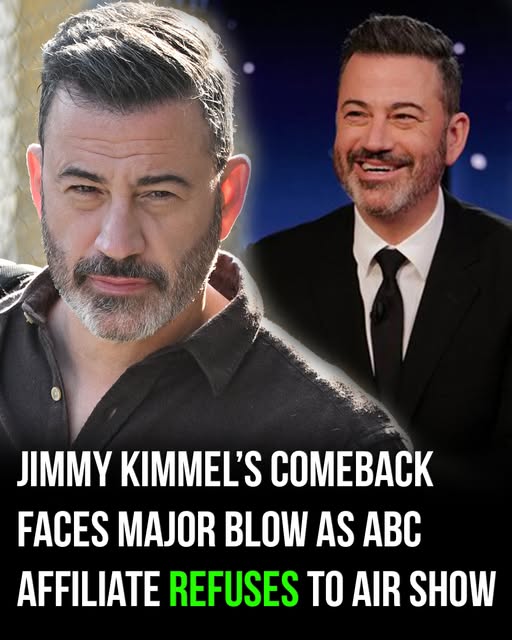
For decades, late-night television has served as a cultural touchstone in the United States, blending comedy, social commentary, and sharp critiques of politics and society. Jimmy Kimmel, one of the most prominent figures in this arena, has built a career as a host willing to push boundaries, delivering humor and insight to millions of viewers nightly. Yet his highly anticipated return to Jimmy Kimmel Live! after a temporary suspension has become a lightning rod for controversy, revealing tensions between networks, affiliates, and the increasingly polarized expectations of audiences.
The Suspension: Disney’s Response to Public Backlash
Earlier this year, Kimmel faced a storm of criticism for comments he made regarding a recent national tragedy. While intended as humor, critics argued the remarks were insensitive, sparking widespread outrage and prompting ABC to temporarily remove the show from its schedule. Disney, the parent company, framed the suspension as a temporary pause designed to give the public space to process the events in question.
In an official statement, Disney executives emphasized that Kimmel had addressed the controversy internally and that leadership had ultimately agreed he should return. A date was set for his comeback, signaling an attempt to balance accountability with the preservation of a major network asset.
Sinclair’s Intervention: A Powerful Affiliate Pushback
Just as Kimmel’s return seemed imminent, Sinclair Inc., one of the largest operators of local television stations in the country and a key ABC affiliate in nearly 40 markets, announced it would not broadcast the show. Instead, stations under Sinclair’s control would replace Kimmel’s late-night slot with local news or alternative programming.
Sinclair cited concerns about responsibility and content standards as the core reasons for its refusal, demanding a series of concrete actions before the program could air:
-
A public apology to individuals directly affected by the tragedy referenced in Kimmel’s remarks.
-
A meaningful personal gesture, such as financial contributions to organizations connected to the incident.
-
Clear assurances from ABC that future broadcasts would adhere to standards appropriate for national television.
Until these conditions are met, Sinclair has made it clear that Kimmel will remain off the air in its markets.
Affiliate Influence vs. Network Authority
The standoff highlights a larger question about the power dynamics between national networks and local affiliates. While ABC and Disney control programming decisions at the network level, affiliates are responsible for distributing content to millions of households. Sinclair’s refusal to air Kimmel’s show cuts off a significant portion of the audience, potentially impacting ratings and advertising revenue while undermining the network’s strategy for reintroducing its late-night lineup.
For Kimmel, the controversy also underscores a cultural tension: the role of late-night hosts in today’s media landscape. Traditionally, hosts have walked a line between satire and social commentary, often pushing the envelope on politically or socially sensitive topics. However, in an era of heightened public sensitivity and polarized media consumption, the margin for error has narrowed considerably.
Impact on Viewers
Audiences in Sinclair-controlled markets are now faced with uncertainty. Many have relied on tuning in to Jimmy Kimmel Live! at the same time each evening for years. While streaming and on-demand platforms offer alternatives, the disruption signals a fracture in the traditional model of national content delivery. For loyal viewers, it is more than an inconvenience—it is a tangible reminder of how fragmented the media landscape has become.
The Debate Over Accountability
The situation also reignites broader questions about accountability in media. Should late-night hosts, whose work blends entertainment and commentary, be held to the same standards as journalists? Or does the nature of their role allow for greater creative and comedic license?
Kimmel has not publicly issued the apology Sinclair demands, though insiders indicate discussions are ongoing. Disney, meanwhile, faces the difficult task of defending its talent while maintaining crucial relationships with affiliates, whose cooperation is essential to distributing programming nationwide.
Possible Outcomes and Broader Implications
Whether Jimmy Kimmel Live! will return to all ABC affiliates remains uncertain. If Sinclair maintains its position, the standoff could continue for weeks or months, significantly reshaping the show’s audience reach and altering the dynamics of late-night television. The outcome could set a precedent, signaling how far networks and personalities can go in balancing comedy, controversy, and accountability in an increasingly divided media environment.
The controversy also raises questions about the evolving expectations of viewers. Audiences today are quick to voice disapproval, and social media amplifies every misstep. Networks must navigate public sentiment, affiliate pressures, and the cultural role of their personalities—a balancing act far more complex than simply scheduling entertainment.
Conclusion: A Turning Point for Late-Night Television
For now, Jimmy Kimmel’s return remains in limbo. Approved by ABC’s leadership yet blocked by a powerful affiliate group, the situation exposes a growing tension in the television industry: the clash between creative freedom, public accountability, and the distribution power held by local stations.
For late-night television as a whole, the stakes are high. How this situation resolves could redefine the boundaries of satire, the influence of affiliates, and the responsibilities of networks in an era where public scrutiny is immediate and relentless.
In a media landscape that is increasingly fragmented and highly reactive, the saga of Jimmy Kimmel’s return may be remembered not only for its controversy but as a case study in the challenges of modern entertainment, accountability, and the power of local affiliates in shaping national discourse.