
How an Old Kitchen Tool Continues to Fascinate the Internet Decades After Its Peak Popularity
Mysterious Objects and Online Curiosity
The internet has transformed the way people solve everyday mysteries. When an unfamiliar object is discovered in an attic, basement, garage, or antique shop, many individuals now turn to social media and online communities for answers.
Photographs of unusual tools frequently spark widespread discussions. What initially appears strange, outdated, or even impossible to identify often turns out to have a practical purpose rooted in everyday life from an earlier era.
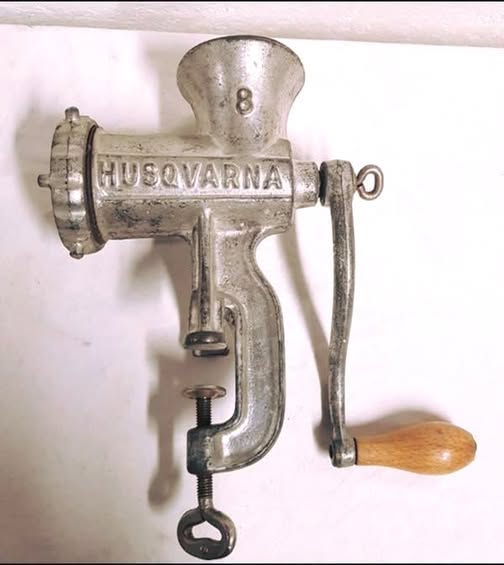
Among the objects that regularly generate curiosity is a heavy metal device that is commonly attached to the edge of a table or countertop. Its industrial appearance, rotating handle, and mechanical components often leave modern viewers puzzled.
For those unfamiliar with historical kitchen equipment, the tool can appear intimidating and difficult to understand. Yet its function is surprisingly straightforward.
The object is a meat mincer, also known in many regions as a meat grinder. Though simple in design, it played a significant role in food preparation for generations.
An Essential Tool for Food Preparation
A meat mincer is a device designed to break down meat into smaller, finely chopped pieces. The resulting product can then be used in a wide variety of recipes and food preparations.
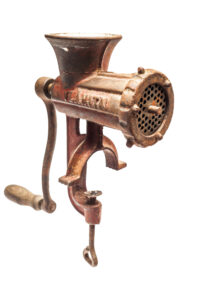
The machine typically includes a metal housing, a feeding tube, an internal screw mechanism, a cutting blade, and a perforated plate through which the processed meat exits.
As meat passes through the machine, it is cut and compressed before emerging in small strands. The process creates a uniform texture that would otherwise require considerable time and effort to achieve manually.
Although modern consumers often associate meat processing with electric appliances, earlier generations relied almost entirely on manually operated grinders.
For many households, this tool represented one of the most useful innovations available in the kitchen.
The Rise of Mechanical Food Processing
The development of meat mincers coincided with a period of rapid technological progress during the nineteenth century. Inventors and manufacturers sought ways to simplify everyday tasks and improve efficiency in homes and businesses.
During this era, numerous mechanical devices were introduced to assist with cooking, cleaning, farming, and manufacturing.
The concept of mechanically processing meat emerged as part of this broader movement toward practical innovation.
Early meat grinders offered a solution to a challenge that had long existed in food preparation. Before such devices became available, finely chopping meat often required extensive work with knives.
This method demanded patience, skill, and significant time, especially when preparing larger quantities.
Mechanical grinders dramatically reduced the effort required while producing more consistent results.
The introduction of these devices quickly changed how meat was prepared in homes, butcher shops, and small food businesses.
Early Construction and Design
The earliest meat mincers were built with durability in mind. Most were manufactured from cast iron, steel, or other strong metals capable of withstanding years of frequent use.
These machines were designed to be attached securely to tables or countertops using a clamp mechanism.
Once fixed in place, they could remain stable while the user turned the handle and processed meat.
The robust construction helped explain why many antique meat grinders continue to survive today. Numerous examples remain functional even after decades of service.
Their longevity has contributed to their continued appearance in antique collections, secondhand markets, and family storage spaces.
As a result, modern generations occasionally encounter them without immediately recognizing their purpose.
How the Manual Mechanism Operates
One reason the meat mincer has remained admired for so long is the simplicity of its engineering.
The operation begins when pieces of meat are placed into the feeding chamber located at the top of the device.
The user then turns a handle attached to the side of the grinder.
This movement rotates a screw-like mechanism inside the machine. As the screw turns, it gradually moves the meat forward toward a cutting blade.
The blade slices the meat into smaller pieces and pushes it against a perforated metal plate positioned at the front of the grinder.
The holes in this plate determine the texture of the final product.
Smaller holes create finer minced meat, while larger openings produce a coarser result.
The process continues as long as the handle is turned and additional meat is fed into the chamber.
Despite requiring physical effort, the system proved highly effective and remarkably reliable.
Why Households Valued Meat Mincers
For families living before the widespread availability of electric appliances, efficiency in the kitchen was extremely important.
Preparing meals often involved lengthy manual labor, making any device that reduced workload especially valuable.
The meat mincer allowed households to prepare fresh minced meat whenever needed.
Rather than purchasing pre-processed products, families could select and grind their own ingredients.
This provided greater control over freshness, quality, and texture.
Many recipes that are now considered traditional benefited from the convenience offered by meat grinders.
Items such as sausages, meatballs, stuffed vegetables, and various regional dishes became easier to prepare at home.
The tool eventually became a familiar fixture in kitchens throughout many parts of Europe and North America.
Expansion Into Commercial Use
The usefulness of meat mincers extended beyond private households.
Butchers, market vendors, and small restaurants quickly recognized the advantages offered by mechanical grinding equipment.
The machines enabled workers to process larger quantities of meat more efficiently than traditional hand-chopping methods.
This increased productivity while helping maintain consistency in the final product.
As customer demand grew, reliable equipment became increasingly important for food businesses seeking to improve operations.
The meat grinder emerged as one of the most practical tools available for meeting those needs.
Its widespread adoption reflected both its effectiveness and its durability.
The Arrival of Electric Models
The twentieth century brought significant changes to household technology as electricity became increasingly common.
Kitchen appliances evolved rapidly, and meat grinders were among the many devices transformed by electrical power.
Manufacturers began replacing manual crank systems with electric motors.
Although the fundamental grinding process remained the same, the motor eliminated the need for continuous physical effort.
This innovation made it possible to process much larger quantities of meat in less time.
Electric grinders quickly gained popularity among both households and commercial operations.
Users appreciated the increased speed, convenience, and efficiency.
The transition represented an important milestone in the evolution of food preparation technology.
Modern Features and Capabilities
Today’s meat grinders are far more versatile than their early predecessors.
Many models include multiple attachments and accessories designed for a variety of culinary tasks.
Beyond grinding meat, modern machines may assist with sausage preparation, vegetable processing, and other specialized food applications.
Manufacturers often provide interchangeable grinding plates that allow users to select different textures.
Advanced units may also feature variable speed controls, enhanced safety mechanisms, and components designed for easier cleaning.
Stainless-steel construction has become common due to its durability and resistance to corrosion.
Despite these technological improvements, the basic principle remains remarkably similar to that of the earliest manual grinders.
The enduring design demonstrates the effectiveness of the original concept.
Why Modern Audiences Find Them Confusing
For many younger people, manual meat grinders belong to a world they have never experienced.
Most households today rely on electric appliances, and many consumers purchase meat that has already been processed.
As a result, encounters with older grinders often create confusion.
The device’s appearance contributes significantly to the mystery.
Heavy metal construction, exposed mechanical parts, and industrial styling make it look more like workshop equipment than a kitchen utensil.
Without historical context, it can be difficult to imagine how the machine was used.
This unfamiliarity explains why photographs of antique meat grinders frequently generate questions online.
Many people are genuinely surprised when they learn that the object once served a routine culinary purpose.
The Internet’s Role in Solving Everyday Mysteries
One of the most fascinating aspects of modern online culture is the speed at which collective knowledge can solve identification puzzles.
A single image of an unknown object can attract responses from hundreds of individuals within hours.
People contribute personal memories, technical expertise, historical information, and practical explanations.
Together, these contributions often reveal the identity and function of objects that might otherwise remain mysterious.
The process demonstrates how digital communities can preserve knowledge that might otherwise fade over time.
Older tools, technologies, and household items gain renewed attention through these discussions.
In many cases, what begins as curiosity becomes an educational experience for thousands of participants.
The meat mincer represents one of the most frequently identified examples of this phenomenon.
A Lasting Legacy in Culinary History
Although technology has advanced significantly since the nineteenth century, the meat mincer remains an important symbol of practical innovation.
Its invention simplified food preparation, increased efficiency, and helped shape countless cooking traditions.
From small family kitchens to busy butcher shops, the device served generations of users who depended on its reliability.
The transition from manual operation to electric power expanded its usefulness while preserving its original purpose.
Even today, many people continue to use both traditional and modern versions for food preparation.
The longevity of the design reflects the success of the concept behind it.
What initially appears to be a strange metal object from another era is actually a remarkable example of functional engineering.
The meat mincer’s story illustrates how ordinary household tools can possess rich histories that connect past and present generations.
As more people encounter these devices through family heirlooms, antique collections, and online discussions, appreciation for their role in culinary history continues to grow.
Far from being an obsolete curiosity, the meat mincer remains a reminder of how simple inventions can leave a lasting impact on everyday life.