
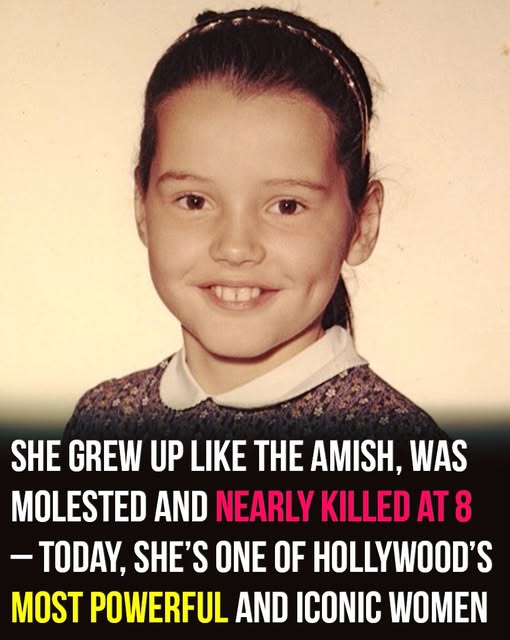
Geena Davis is one of Hollywood’s most influential figures, a star whose career has spanned decades and whose impact extends far beyond the silver screen. Known for her commanding presence, nuanced performances, and advocacy for gender equality, Davis has defied the typical trajectory of a model-turned-actress to become an Academy Award winner and a champion for systemic change in media. Yet behind the fame and accolades lies a childhood shaped by strict discipline, a brush with death, and experiences that would inform her resilience and determination for years to come.
A Childhood Rooted in Discipline
Born on January 21, 1958, in Wareham, Massachusetts, Davis grew up in a household far removed from the countercultural shifts of the 1960s. Her parents, Bill and Lucille Davis, embodied a strict, self-reliant ethos typical of old-fashioned New England values. Davis has remarked that her family “would have been Amish had they heard of being Amish,” a nod to their austere, self-sufficient lifestyle.
The family home was heated with wood chopped by her father, and meals were grown entirely by her mother. Entertainment and exposure to pop culture were limited, with Davis’s earliest glimpses of performance coming from Disney animated films. Despite this isolation, she discovered a love for performance by the age of three, though at the time she had no concept of how “pretending” could evolve into a professional pursuit.
A Near-Fatal Lesson in Politeness
Her childhood took a terrifying turn at age eight. Riding with her 99-year-old great-uncle Jack, Davis was confronted with imminent danger when Jack veered into oncoming traffic. Bound by a strict cultural expectation of respect for elders, neither Davis nor her parents voiced concern, even as a head-on collision became imminent. Jack managed to swerve just in time, averting disaster. This incident profoundly affected Davis and became a central theme in her 2022 memoir, Dying of Politeness, where she explores how excessive politeness can become a form of self-erasure.
Early Trauma and the Weight of Silence
As a young girl, Davis faced additional challenges that would leave lasting psychological scars. While delivering newspapers, she was molested by a neighbor, an experience she could not fully understand at the time. The incident left her with deep shame and a sense that complaining or speaking up was wrong. Even when her mother confronted the perpetrator, the absence of formal legal action reinforced Davis’s feeling of personal fault. She carried this trauma as a “horrible secret” for years, reflecting on the early lessons of silence and restraint imposed by her upbringing.
Tall, Talented, and Misunderstood
Davis’s remarkable height set her apart from her peers. From a young age, she stood out as the tallest girl in her class, drawing teasing nicknames like “Kareem Abdul-Jabbar.” While she excelled in track and field, the social pressures of adolescence were difficult to navigate. Music offered a creative outlet, and she played the flute in her school marching band. Seeking independence, she later became an exchange student in Sweden, an experience that provided both personal growth and fluency in Swedish, laying the foundation for her eventual pursuit of a drama degree at Boston University—a decision her parents considered a risky gamble.
Interestingly, Davis later revealed that she never actually graduated, a detail unknown to her parents until after their passing. Despite this, her academic detour did not hinder her eventual rise to stardom.
From Modeling to Hollywood Stardom
Davis’s first professional steps came in 1977 in New York City, where she worked as a sales clerk, waitress, and living window mannequin before signing with the Zoli Agency. Modeling—including a stint in the Victoria’s Secret catalog—served as a strategic entry point into acting. “I decided I would try becoming a model first because, at that time, Christie Brinkley and Lauren Hutton were being offered parts in movies,” Davis explained.
Her transition from modeling to acting was swift. In 1982, Sydney Pollack cast her in Tootsie alongside Dustin Hoffman, launching her film career. This performance drew immediate critical attention and set her on a path toward becoming a leading figure in Hollywood. Over the next decade, Davis built an impressive filmography, showcasing her versatility in both comedic and dramatic roles.
Breaking Ground in the 1980s
The mid-1980s solidified Davis’s status as a rising star. Early television work included the 1983 series Buffalo Bill and her own 1985 show Sara, before she pivoted fully to film. While Transylvania 6-5000 (1985) did not perform well commercially, it facilitated a crucial collaboration with Jeff Goldblum in David Cronenberg’s 1986 remake of The Fly, a role that highlighted her talent for complex characters.
By 1988, she captivated audiences in Tim Burton’s Beetlejuice, and in 1989, Davis won the Academy Award for Best Supporting Actress for The Accidental Tourist. She reached another pinnacle with Ridley Scott’s Thelma & Louise, a landmark feminist film that cemented her reputation as an actor unafraid to challenge Hollywood norms. Collaborating with Susan Sarandon on the project, Davis learned the value of asserting her voice—a lesson that informed her subsequent choices both on and off screen. Her role in A League of Their Own further reinforced her commitment to portraying women-centered narratives, proving that stories led by women could achieve critical and commercial success.
Life Beyond the Screen
Despite a successful career, Davis faced the harsh realities of Hollywood’s treatment of women over 40. “I fell off the cliff,” she noted in 2020, describing how opportunities for complex roles diminished with age. Rather than retreating, she focused on her personal life, including four marriages, most notably with Jeff Goldblum, before meeting plastic surgeon Reza Jarrahy. Their marriage in 2001 led to the birth of three children: Alizeh in 2002 and twins Kaiis and Kian in 2004, all while Davis navigated motherhood in her mid-forties.
This period sparked her most enduring contribution outside of acting. Observing children’s media with her young children, Davis noticed the severe underrepresentation of female characters, inspiring her to found the Geena Davis Institute on Gender in Media in 2004. The organization advocates for equality on screen and has influenced policy and research, challenging systemic bias in an industry where 96% of films are directed by men. While protective of her children, Davis continues to encourage their artistic pursuits, with her daughter Alizeh following a path in music and cinema at USC.
The Next Chapter
At 69, Geena Davis remains a force in Hollywood and beyond. Her advocacy continues to reshape media representation, while she prepares to return to acting in the Duffer Brothers’ Netflix series The Boroughs, set in a retirement community facing a mysterious threat. The role is a poetic nod to Davis’s career-long themes of time, resilience, and reinvention. From a small-town girl navigating a restrictive upbringing to an Academy Award-winning star and influential advocate, Geena Davis exemplifies the power of talent, perseverance, and principled action.
Her story demonstrates that challenges—whether near-death experiences, trauma, or systemic bias—can be transformed into purpose and influence. Davis’s career is not simply a testament to personal achievement but a blueprint for how dedication, courage, and advocacy can redefine industries and inspire generations.