
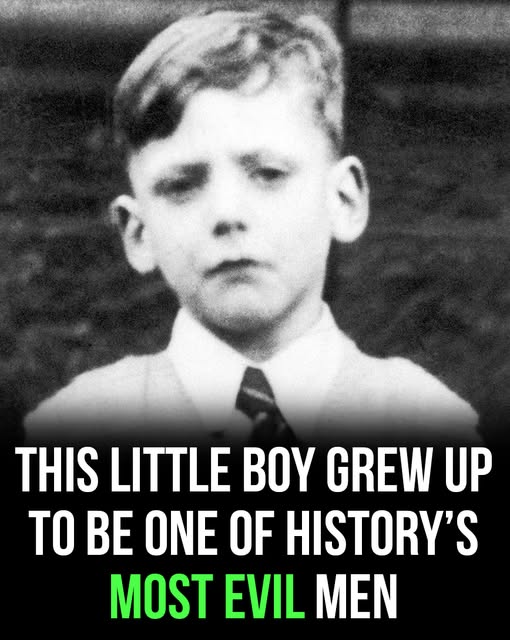
The boy in this photograph, seemingly ordinary and fragile, would grow into one of the most notorious figures in British criminal history. Even as a child, he exhibited alarming behavior, often lashing out with intense temper tantrums and repeatedly banging his head on the floor. Few at the time could have predicted the scale of the horrors he would later commit.
Born on January 2, 1938, in Glasgow, Scotland, his early life was marked by instability and uncertainty. His mother, Peggy Stewart, was an unmarried tea room waitress struggling to make ends meet. The identity of his father remains shrouded in mystery; Peggy claimed he was a journalist who died three months before her son’s birth, leaving lingering questions about the boy’s origins.
Within months of his birth, he was placed into foster care with John and Mary Sloan in Glasgow’s working-class Gorbals district. He was given the name Ian Sloan during this time, though it was a name he would later abandon for the one that would become infamous. Despite the foster arrangement, his mother continued to maintain contact throughout his childhood.
The Sloans were strict, valuing discipline, routine, and propriety. Observers noted that the boy was intelligent and articulate but withdrawn, often observing the world around him rather than engaging with it. Beneath this seemingly controlled demeanor, darker tendencies were quietly emerging. From a young age, he displayed a fascination with horror films and morbid imagery, earning the nickname “Dracula” among neighborhood children in Glasgow. Years later, in the Hattersley Estate of Greater Manchester, locals who spotted him in a long trench coat referred to him as “the Undertaker.”
Early Signs of a Troubled Mind
During his early teenage years, he began rebelling in subtle but concerning ways. Violent outbursts, including head-banging tantrums and verbal abuse toward his foster parents, became increasingly frequent. He skipped school, engaged in petty theft, and exhibited a strong fascination with power and dominance.
Accounts suggest that he boasted about killing his first cat at age ten, later burning another cat, stoning dogs, and decapitating rabbits. However, he later denied these claims of animal cruelty. He was a voracious reader, exploring not only literature and philosophy but also texts on Nazi ideology and works that glorified violence and supremacy.
By 17, his adolescence had already taken a darker turn. Alcohol abuse, theft, and other minor crimes culminated in a conviction for burglary and a stint in prison. Rather than reforming him, incarceration appears to have hardened his sense of superiority and disdain for others. After his release, he drifted through low-paying jobs and petty offenses before relocating to Manchester in the early 1960s—a move that would mark a turning point in British criminal history.
The Fateful Meeting with Myra Hindley
In 1961, he encountered a young woman named Myra Hindley while employed at Millwards Merchandising in Gorton. Introducing himself as Ian Brady, he soon drew Hindley into a complex, psychologically manipulative relationship.
Brady exerted a powerful influence over Hindley, sharing his extremist beliefs and obsession with control and violence. On their first outing together, the couple watched footage of the Nuremberg Trials in a cinema, marking the beginning of a disturbing pattern. They often spent evenings at the movies, sometimes viewing X-rated films, and returned to Hindley’s home to drink German wine.
Brady also supplied Hindley with reading material, which they studied together during lunch breaks, delving into accounts of Nazi atrocities. Hindley became enamored with ideas of Aryan supremacy, bleaching her hair platinum blonde and emphasizing her appearance with striking makeup.
Despite occasional misgivings, Hindley found herself captivated by Brady. In correspondence with a childhood friend, she recounted an instance where Brady had drugged her but simultaneously acknowledged her intense obsession with him. She later asked her friend to destroy the letter, indicating her awareness of the dark path she was following.
“Within months he had convinced me that there was no God at all: he could have told me that the earth was flat, the moon was made of green cheese and the sun rose in the west, I would have believed him, such was his power of persuasion,” Hindley wrote later.
Observers noted dramatic changes in Hindley’s appearance, behavior, and attitudes as she fell under Brady’s sway, creating a closed, secretive world dominated by manipulation and shared depravity.
The Moors Murders
Between 1963 and 1965, Brady and Hindley committed a series of murders that would come to be known as the Moors Murders, named after the remote Saddleworth Moor where several victims’ bodies were concealed.
Their five known victims—Pauline Reade, John Kilbride, Keith Bennett, Lesley Ann Downey, and Edward Evans—ranged from 10 to 17 years old, with at least four subjected to sexual assault. The crimes stunned the nation not only because of their brutality but also due to the calculated and methodical manner in which they were carried out. Brady orchestrated the murders, while Hindley played a crucial enabling role. Their outwardly ordinary appearances made the revelations even more chilling.
For months, the duo successfully avoided suspicion. However, in October 1965, Brady murdered 17-year-old Edward Evans in Hindley’s presence. David Smith, Hindley’s brother-in-law, witnessed the aftermath and reported the crime to police the same night.
Investigation and Trial
Police investigations uncovered disturbing evidence, including recordings, photographs, and items linked to multiple victims. Initially, Hindley attempted to distance herself from the crimes, but the full extent of their actions gradually came to light.
In 1966, Brady and Hindley faced trial, capturing nationwide attention. Their mugshots—Hindley with a blank stare and platinum hair—became enduring symbols of shock and betrayal. The fourteen-day court proceedings revealed the cold calculation behind their actions. Due to public outrage, bulletproof glass was installed in the courtroom to protect the defendants from potential attacks.
Brady openly embraced his role as a villain, describing himself as “evil” and showing no remorse. Both were convicted of murder and sentenced to life imprisonment. Hindley, labeled by the press as “the most evil woman in Britain,” maintained that she had reformed and was no longer a threat, yet she remained in prison until her death in 2002 at age 60. At her cremation, a public attendee displayed a banner declaring, “Burn in hell.”
Life Behind Bars
Brady, diagnosed as a psychopath in 1985, was confined to the high-security Ashworth Hospital. The severity of his crimes put him at constant risk of attack from other inmates, necessitating prolonged periods of solitary confinement and repeated transfers between maximum-security facilities.
Throughout his incarceration, he refused rehabilitation programs, showed no interest in release, and consistently requested permission to die rather than continue living. In 2013, he minimized his own actions, referring to himself as a “petty criminal” compared to other global figures involved in large-scale crimes.
Brady died in 2017 at Ashworth Hospital at the age of 79, after serving fifty-one years in custody. His life and crimes remain a dark chapter in British history, illustrating a disturbing progression from a troubled childhood to acts of extreme violence that left a lasting mark on the nation.
The story of Ian Brady serves as a chilling reminder of the consequences of unchecked psychological disturbance, manipulation, and moral corruption, highlighting the complexities of criminal behavior and the devastating impact on victims and society alike.