
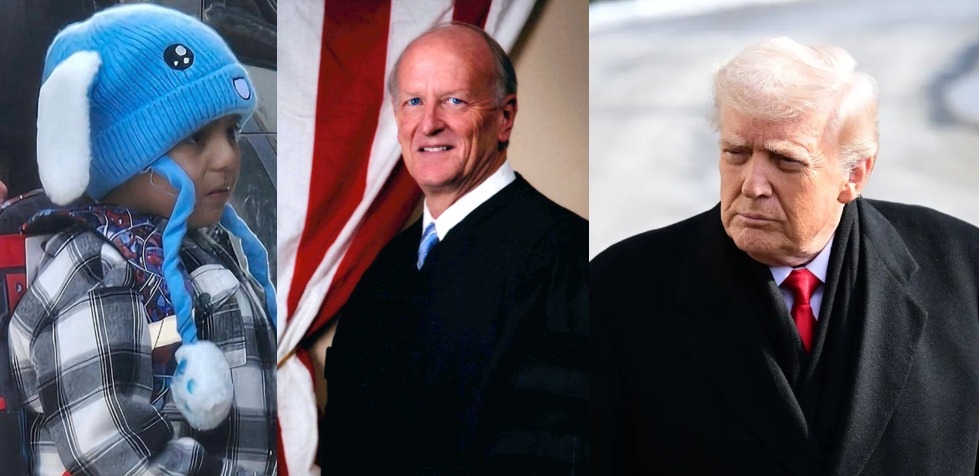
A federal judge has ordered the release of five-year-old Liam Ramos, ruling that his detention by immigration authorities was unconstitutional and sharply criticizing the federal government’s handling of the case. The decision, issued by Judge Fred Biery, concludes that the child’s confinement and the detention of his father, Adrian Conejo Arias, failed to meet constitutional standards and relied on procedures that did not satisfy requirements for independent judicial review.
The case drew national attention after images circulated of the young boy wearing a blue hat and a small backpack following his detention in Minnesota. The child had been taken into custody while traveling home from school, and authorities subsequently detained his father as well. The circumstances of the arrest and the decision to hold a minor in federal custody prompted widespread concern across legal, political, and community groups.
Liam was transferred to a family detention facility in Dilley, Texas, a site that has long been associated with intense scrutiny over conditions and the treatment of detainees. During his confinement, reports indicated that the child became ill and experienced emotional distress after being separated from his mother and his school environment. The court record reflects that the detention disrupted his education and daily life, placing him in a setting designed for immigration custody rather than child welfare.
Judge Biery, who was appointed to the federal bench by President Bill Clinton, issued an order that not only directed the immediate release of the child but also addressed broader constitutional issues raised by the government’s approach to immigration enforcement. The ruling frames the case as an example of the risks posed when administrative procedures are used without sufficient judicial oversight.
In the written order, the judge addressed the underlying policy context and the impact on families, writing: “The case has its genesis in the ill-conceived and incompetently-implemented government pursuit of daily deportation quotas, apparently even if it requires traumatizing children,”. The statement sets the tone for a decision that goes beyond the specific facts of one family and examines the structural issues involved in the detention process.
Judge Biery also referenced foundational principles of American governance and the country’s historical resistance to unchecked authority. In a passage that situates the ruling within a broader constitutional framework, he wrote: “Apparent also is the government’s ignorance of an American historical document called the Declaration of Independence. Thirty-three-year-old Thomas Jefferson enumerated grievances against a would-be authoritarian king over our nascent nation. Among others were:”
He then listed four grievances, quoting them directly in the order:
-
“He has sent hither Swarms of Officers to harass our People.”
-
“He has excited domestic Insurrection among us.”
-
“For quartering large Bodies of Armed Troops among us.”
-
“He has kept among us, in Times of Peace, Standing Armies without the consent of our Legislatures.”
Following those citations, the order states: “’We the people’ are hearing echos of that history.”
The ruling continued with a direct rebuke of the process used to authorize the detentions. “Civics lesson to the government!” the judge wrote, before addressing the legal standard required for warrants and custody decisions. “Administrative warrants issued by the executive branch to itself do not pass probable cause muster. That is called the fox guarding the henhouse.”
Judge Biery then summarized the court’s conclusion in constitutional terms: “The Constitution requires an independent judicial officer. Accordingly, the Court finds that the Constitution of these United States trumps this administration’s detention of petitioner Adrian Conejo Arias and his minor son.”
The order concluded with a statement emphasizing the court’s role in enforcing constitutional limits: “with a judicial finger in the constitutional dike, it is so ORDERED.”
The decision centers on the principle that detention, particularly of a minor, must be grounded in procedures that satisfy constitutional protections. The judge’s analysis underscores that executive branch actions, even when framed as administrative or policy-driven, cannot replace the role of an independent judiciary in determining whether probable cause exists and whether custody is lawful.
The case unfolded against the backdrop of aggressive immigration enforcement policies that prioritize rapid processing and high numbers of removals. In this instance, the court found that the pursuit of such objectives did not justify the methods used, especially when those methods involved the detention of a young child who posed no threat and whose presence in custody served no public safety purpose.
Liam’s detention began in Minnesota, where immigration officers took him into custody while he was returning home from school. The action also led to the arrest of his father. The sequence of events raised questions about how and why a child was swept into enforcement actions aimed at adults and whether alternative measures could have been used to avoid placing a minor in detention.
After being transported to Texas, Liam was held at the Dilley facility, a large complex used for family detention. The site has been the subject of ongoing debate about conditions, access to legal counsel, and the impact of detention on children. In this case, the court record indicates that the child’s health and emotional well-being deteriorated during his time in custody, reinforcing concerns about the suitability of such facilities for young detainees.
The ruling also addressed the legal mechanism used to justify the detention. The judge found that administrative warrants, issued within the executive branch without review by an independent judicial officer, did not meet constitutional standards. This finding goes to the heart of the separation of powers, a principle that requires checks and balances between branches of government to prevent overreach.
By stating that the Constitution “trumps” the detention in this case, the court emphasized that policy goals cannot override fundamental rights. The decision signals that, at least in this instance, the judiciary is prepared to intervene when enforcement practices conflict with constitutional protections.
The case has broader implications for how immigration authorities handle families and children. While the ruling applies directly to Liam Ramos and his father, its reasoning addresses systemic issues related to warrants, due process, and the role of courts in reviewing executive actions. The language used by Judge Biery reflects a view that the stakes extend beyond a single family to the integrity of constitutional governance.
The decision also highlights the tension between enforcement priorities and humanitarian considerations. Detaining a five-year-old child, particularly under circumstances that disrupt education and family stability, raises questions about proportionality and necessity. The court’s order suggests that such measures require especially strong legal justification, which was not present in this case.
Following the ruling, the immediate effect is the release of Liam and his father from custody. The court’s order restores their freedom and ends the child’s confinement in a detention facility. It also sets a legal precedent within the jurisdiction by clarifying that administrative processes cannot substitute for independent judicial review when constitutional rights are at stake.
The judge’s references to historical documents and foundational principles serve to place the decision within a longer tradition of American legal thought. By invoking the Declaration of Independence and its list of grievances, the order frames the dispute as one about the limits of government power and the protection of individual liberties.
The language used in the ruling is notable for its directness and for the way it addresses the broader policy environment. Rather than confining the analysis to narrow procedural points, the decision speaks to the real-world consequences of enforcement strategies and the human impact of detention, especially on children.
For families affected by similar situations, the ruling may provide a basis for challenging detentions that rely on administrative warrants without judicial oversight. It also reinforces the principle that minors require special consideration in any legal process that restricts liberty.
The case has become a focal point in discussions about immigration enforcement, due process, and the role of the courts. While the decision does not resolve all questions surrounding policy and practice, it establishes clear boundaries for the use of executive authority in detaining individuals, particularly when children are involved.
Judge Biery’s order stands as a detailed judicial statement on constitutional limits, the necessity of independent review, and the obligation of the government to adhere to established legal standards even in the pursuit of policy objectives. By ordering the release of Liam Ramos and his father, the court affirmed that those standards remain binding and that departures from them will be subject to correction through the judicial process.