
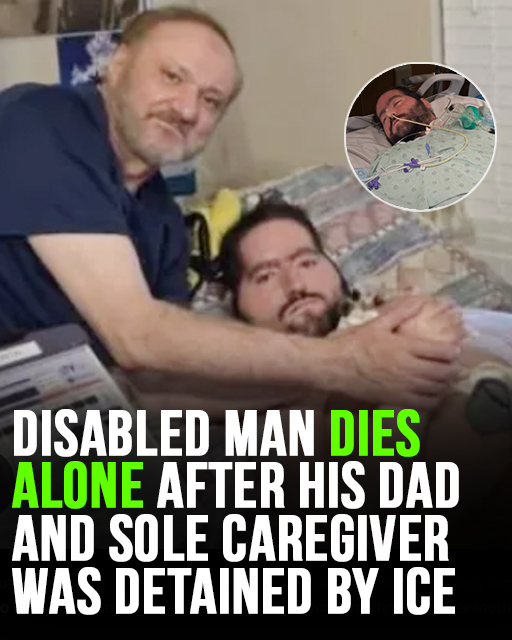
A U.S. immigration case involving a seriously ill man and his detained father has drawn widespread criticism after the father was denied release to care for his son or attend his funeral, prompting accusations of a “lack of humanity” within federal immigration enforcement.
Wael Tarabishi, a 30-year-old man diagnosed with Pompe disease, died last Friday after years of living with the rare and progressive genetic condition. Pompe disease is a lifelong inherited disorder that causes a buildup of glycogen in muscles and organs, leading to severe muscle weakness, respiratory failure, and complex medical needs that often require constant care.
In the final months of Wael’s life, his condition deteriorated significantly. His death came three months after his father, Maher Tarabishi, was taken into custody by Immigration and Customs Enforcement during a routine immigration check-in in Dallas, Texas.
Maher Tarabishi was Wael’s sole caregiver prior to his detention. Family members and legal representatives have stated that he was specially trained to manage his son’s extensive medical needs, which included administering medication and nutrition through a feeding tube, assisting with bathing, and responding to medical emergencies.
After Maher was detained and transferred to the Bluebonnet Detention Facility in Anson, Texas, the family immediately sought his temporary release. Their request was based on Wael’s medical condition and Maher’s essential role in providing specialized, round-the-clock care. Those requests were denied.
As Wael’s health worsened, the family escalated their appeals, asking that Maher at least be permitted to visit his son to say goodbye. According to family representatives, that request was also refused. Wael ultimately passed away without his father present, and reports indicate that he was laid to rest without Maher being allowed to attend the funeral.
The Tarabishi family’s attorney, Ali Elhoor, has publicly criticized ICE for its handling of the case. He argued that the agency failed to apply its own standards regarding family emergencies and compassionate release.
ICE detention standards state that detainees should be allowed to “maintain ties with their families through emergency staff-escorted trips into the community to visit critically ill members of the immediate family or to attend their funerals.” Despite this policy language, Elhoor said ICE declined the family’s request for Maher to attend Wael’s funeral, which was scheduled two days after the decision was communicated.
“We are profoundly disappointed with ICE’s decision to deny Maher Tarabishi the opportunity to say his final goodbye to his beloved son, Wael,” Elhoor said in a statement.
“Today’s decision to keep him from saying goodbye is a reflection of the tragic lack of humanity by those in charge.”
The impact of Maher’s detention extended beyond emotional distress and directly affected Wael’s medical care, according to family members. Shahd Arnaout, Wael’s sister-in-law, explained that the family struggled to assume caregiving responsibilities after Maher was detained.
She said Wael required constant attention, including assistance with feeding, hygiene, medication management, and emergency interventions. While healthcare professionals provided guidance, the family lacked the training and experience Maher had developed over years of caring for his son.
Arnaout told CNN that Wael’s physical health declined after his father was taken into custody, but she emphasized that the emotional toll was equally severe.
“Mentally, he started to recognize that ‘I don’t feel safe anymore.’ The one person that makes me feel safe and gives me hope that I will live to the next day and makes me feel like I’m a normal person is not there anymore for me,” Arnaout said.
Medical records and family accounts detail a series of hospitalizations in the months following Maher’s detention. In November, Wael was admitted to the hospital with sepsis and pneumonia. In December, he was hospitalized again after developing a stomach infection caused by the displacement of his feeding tube.
The second hospitalization resulted in Wael being admitted to the intensive care unit at Methodist Mansfield Medical Center. He remained there for approximately one month before dying on January 23.
Before his death, Wael reportedly wrote a statement describing the central role his father played in his survival and sense of security. His words, shared by the Fort Worth Star-Telegram, underscored the depth of their bond and Maher’s importance in his daily life.
He described his father as the person who was the “one who keeps me alive when I’m at my weakest.”
“Without him, I am nothing,” Wael wrote. “Without him, I cannot survive.”
The case has also drawn attention to Maher Tarabishi’s immigration history. According to statements from the Department of Homeland Security, Maher arrived in the United States from Kuwait in 1994. Tricia McLaughlin, Assistant Secretary for Public Affairs at DHS, said Maher was a “self-admitted member” of the Palestine Liberation Organization.
McLaughlin stated that Maher remained in the United States illegally for nearly 20 years after the Board of Immigration Appeals ordered him to leave the country in 2006. Despite that order, he was permitted to remain in the U.S. in subsequent years to care for his medically fragile son.
Following Wael’s death, Maher now faces the possibility of deportation to Jordan, according to the latest available information. His family and supporters argue that his prolonged presence in the U.S. was directly tied to his role as Wael’s caregiver and that his detention removed a critical support system from a man who was entirely dependent on him.
An Instagram page created to advocate for Maher’s release has become a focal point for public support and expressions of grief. In a post shared after Wael’s death, the family described their anguish over being forced to say goodbye without Maher present.
“Today is a day that should NOT have happened, and now we have to say goodbye without his father, Maher Tarabishi, by our side,” the post reads.
“We have to say goodbye while Maher Tarabishi is alone in a detention facility – the person who was his best friend and caretaker. This isn’t fair. This is cruel, beyond words scan describe.”
The case has fueled broader criticism of immigration enforcement practices, particularly in situations involving humanitarian concerns and medically vulnerable individuals. Advocates argue that discretion and compassion should play a greater role when detention decisions directly affect the health and survival of dependent family members.
For Wael’s family, the focus remains on the loss of a son, brother, and loved one whose final months were marked by both physical suffering and emotional distress. They continue to mourn not only his death, but the circumstances that prevented his father from being by his side during his final moments and burial.
As Maher remains in detention and faces potential deportation, the Tarabishi family’s story has become a stark example of the human consequences that can arise at the intersection of immigration enforcement and medical vulnerability.