
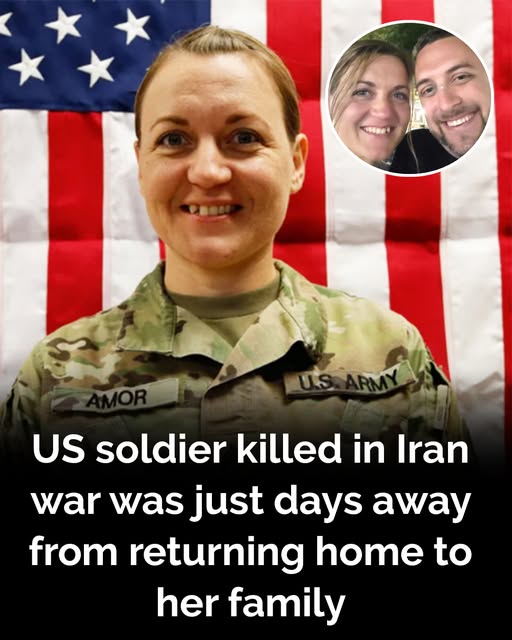
Drone Strike in Kuwait Kills Sgt. 1st Class Nicole Amor Days Before Planned Return Home
A Homecoming Nearing Its End
The final stretch of an overseas deployment can carry a particular kind of strain, marked by exhaustion, anticipation, and an intense focus on making it through the last days safely. For the family of Sgt. 1st Class Nicole Amor, that narrow window became the point where everything changed.
Amor, a 39-year-old mother from White Bear Lake, Minnesota, was close to returning home when a drone strike at the Port of Shuaiba, Kuwait, turned a routine logistics assignment into a fatal event. The attack ended her life just days before she was expected back in Minnesota.
She was among six U.S. service members killed during the opening phase of Operation Epic Fury, described as a massive joint military offensive launched by the United States and Israel against Iranian interests. As the broader operation continues to shape events across the region, the personal details emerging from Amor’s last hours have sharpened the focus on how quickly a deployment can shift from routine to catastrophe.

The Strike at the Port of Shuaiba
The fatal attack took place at the Port of Shuaiba in Kuwait and involved a drone strike. The timing was particularly stark, coming one day after the launch of Operation Epic Fury.
Kuwait has often been viewed as a stable logistical hub compared with more volatile combat zones, a place associated with movement of supplies and support rather than direct danger. For Amor’s family, that understanding made the loss even more difficult to absorb.
Her husband, Joey Amor, expressed that disbelief in a short statement that captured the shock of the location and the timing. “You don’t go to Kuwait thinking something’s going to happen,” he said. “And for her to be one of the first—it hurts.”
The deaths at the port underscored a reality that has become more apparent as the operation unfolds: risk can exist far beyond the places traditionally assumed to be most exposed, and the term “front line” can shift without warning.
The Last Messages
In the final days before the strike, Nicole Amor and her husband relied on text messages to maintain a sense of normal life. That kind of connection can become a daily ritual for families separated by deployment, with short updates serving as proof of presence and a reminder of home.
Joey Amor said they exchanged messages just hours before the deadly strike. Their final conversation was ordinary, centered on a small mishap he had experienced the previous night, the kind of everyday detail that can carry outsized meaning when time together is limited.
When morning came, the routine ended abruptly. “She just never responded in the morning,” Joey said.
That silence became the dividing line between expectation and reality, between the homecoming the family was preparing for and the news that would replace it.
A Routine Assignment Becomes a Tragedy
The account from Amor’s family emphasized that she was only days from returning to Minnesota. The nearness of that date is central to how the loss is being felt, because it places her death at the threshold of reunion rather than deep in the middle of a deployment.
For many military families, the final days are measured in small plans and small preparations, the beginning of routines that will soon be shared again. Amor’s death interrupted that transition and left her family confronting not only grief, but the abrupt disappearance of a future that seemed imminent.
The attack also highlighted how logistical work, often described as support rather than combat, can still occur under threats that evolve quickly. The mission may be categorized as routine, but the environment can change with little notice.
Dispersal and a Change in Living Conditions
Joey Amor also described a tactical shift that took place shortly before the strike. About a week earlier, Nicole and a small group of personnel had been relocated away from the main base.
The move was described as an effort to reduce the chance of a mass casualty event at a primary installation, with personnel spread into smaller groups in separate locations. The intent was to lower risk by avoiding a single concentrated target.
“They were dispersing because they were in fear that the base they were on was going to get attacked and they felt it was safer,” Joey said.
The relocation changed the nature of their living conditions. Nicole’s new quarters were described as a makeshift, shipping container-style building. The structure lacked the reinforced protective defenses typically associated with larger bases.
That detail added another layer to the story of her final days, illustrating how strategies designed to reduce one type of risk can alter exposure in other ways.
Her Role in Military Service
Nicole Amor had a long history in uniform and was described as experienced with the demands and routines of service. Her military career began in the National Guard in 2005, where she served as an automated logistics specialist.
In 2006, she transferred to the Army Reserve. Over nearly two decades, she deployed to Iraq and Kuwait, working in roles tied to sustaining operations and supporting troops through the movement of supplies.
She served as part of the 103rd Sustainment Command, a unit whose work is rooted in logistics. In military operations, logistics units coordinate transportation, supplies, maintenance needs, and the infrastructure that keeps missions running.
Amor’s work was described as a vital link in that supply chain, ensuring that troops on the ground remained fed and equipped. That type of duty often occurs far from headlines, but it forms a foundation without which deployed forces cannot function.
Her death during an assignment connected to that mission underscored that logistical roles, while often perceived as removed from direct combat, can still be exposed to threats tied to wider operational dynamics.
Life in White Bear Lake
While her military duties took her overseas, Nicole Amor’s life at home in White Bear Lake was framed by family routines and personal interests that grounded her identity beyond the uniform.
She was described as a mother and a gardener, known for homemade salsa made from vegetables she grew herself. That detail reflects the kind of daily life her family was preparing to welcome her back into.
She was also described as someone with a zest for life, spending time rollerblading and biking with her young daughter. Those activities were part of the rhythm of family life that her deployment had interrupted and that her return would have restored.
She leaves behind two children: a son who is currently a high school senior and a daughter in the fourth grade. Their ages underscore the family’s position in a period of transition, with one child nearing adulthood and the other still in elementary school.
For families in that stage, the presence of a parent can anchor routines, school schedules, and the daily texture of home. Amor’s death removed that presence in an instant.
The Other Service Members Killed
The strike at the Port of Shuaiba did not claim only one life. Five other U.S. service members were killed in the same attack during the early stages of Operation Epic Fury.
Among those killed was Capt. Cody Khork, 35, of Winter Haven, Florida.
Also killed was Sgt. 1st Class Noah Tietjens, 42, of Bellevue, Nebraska.
The attack also took the life of Sgt. Declan Coady, 20, of West Des Moines, Iowa.
The names of two additional service members killed in the strike were still being withheld pending next-of-kin notification at the time the information was released.
That process, which delays public identification until families have been formally notified, reflects the structured way the military handles casualty reporting, even as news of the event spreads quickly.
A Broader Operation With Immediate Consequences
Operation Epic Fury was described as a massive joint offensive launched by the United States and Israel against Iranian interests. The strike at Port of Shuaiba occurred during the opening stages of that operation.
In the first days of a major military effort, the operational environment can shift rapidly, with heightened alert levels, changes to basing and movement patterns, and increased concern about retaliatory threats.
The attack in Kuwait, taking place soon after the operation began, illustrated how quickly those concerns can become reality. The deaths of the service members linked the broader conflict directly to households thousands of miles away.
As the geopolitical situation continues to develop, the details emerging from Amor’s final days have given a personal face to the broader military headlines, showing how strategic decisions translate into lived experience for families.
The Fragility of “Safe” Locations
For many families, location is used as a rough measure of danger. Some deployments are understood to involve high exposure, while others are assumed to be comparatively stable.
In this case, the perception of Kuwait as a safer logistical hub shaped expectations at home. Joey Amor’s words reflected that assumption, and the shock that followed when it proved insufficient protection.
The account also highlighted how the routine aspects of deployment can sit alongside sudden vulnerability. A service member can be focused on schedules, supplies, and daily responsibilities, and still face threats that arrive without warning.
The description of relocation to smaller groups and to a makeshift building illustrated the way risk assessments can lead to rapid adjustments. Even when such decisions are made with protection in mind, they can bring new uncertainties.
What Her Service Meant
Nicole Amor’s career placed her in roles that support and sustain military missions. Automated logistics, reserve service, and multiple deployments marked a long commitment that spanned nearly two decades.
That length of service suggests familiarity with the rhythms of military life, including training cycles, deployment schedules, and the repeated process of leaving and returning. It also suggests the repeated strain on family life that comes with long-term military commitments.
Her deployment to Kuwait placed her far from home, but still in a setting associated with the supporting structure that keeps operations moving. The strike that killed her demonstrated that support roles remain directly connected to the security environment around them.
Her story also showed how military service intersects with family identity. She was not only a service member, but also a mother planning to return to a son finishing high school and a daughter in elementary school.
Her home life, described through gardening, homemade salsa, and time spent biking and rollerblading with her child, reflected the ordinary routines that often sit just beyond the reach of deployed families.
A Loss Felt Across Home and Service
In military communities, death during deployment is experienced in multiple circles at once: within the unit that served together, within the broader force that shares the risk, and within the household that waited for the return.
For Joey Amor, the loss is encapsulated in the moment when communication stopped, when the ordinary rhythm of texting ended and became a sign that something had gone wrong.
For her children, the loss is tied to the reality that a return home that was only days away will not happen, and that the routines they expected to resume will not be restored in the way they imagined.
For the wider public, the details of her final days have offered a stark reminder that military operations are measured not only by objectives and timelines, but also by names, families, and lives interrupted at the edge of homecoming.
An Ongoing Process of Identification and Investigation
The Pentagon’s decision to withhold two names pending next-of-kin notification indicates that the aftermath of the strike remains active, with families still in the process of receiving official word and public reporting still incomplete.
The broader operation remains ongoing as well, with the events in Kuwait occurring at the beginning of a campaign described as large in scale. As that situation evolves, the strike at Port of Shuaiba stands as an early and deadly marker of the risks involved.
For those closest to Nicole Amor, the focus remains on the narrow timeline that defined her final days: a planned return within reach, a routine assignment in a place viewed as stable, a late-night text exchange, and the morning when no reply arrived.
Her death, and the deaths of the five other service members killed in the same strike, has placed the human cost of the operation into sharp relief and left families facing a future reshaped by a single moment.