
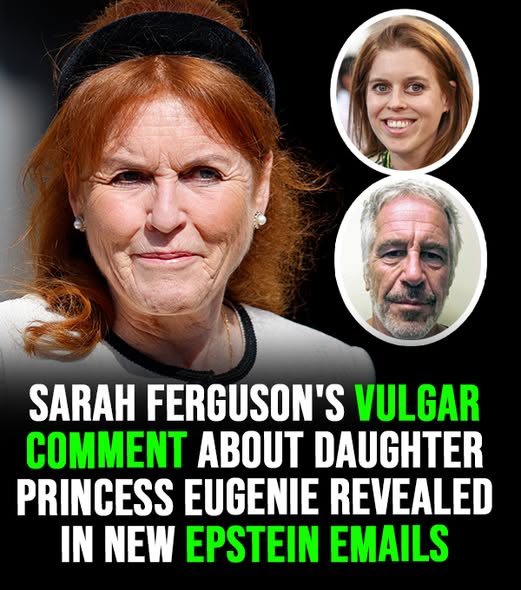
A newly released trove of documents tied to the Jeffrey Epstein case has brought fresh attention to a series of emails involving Sarah Ferguson, widely known as Fergie. Among the materials is a message that includes a crude reference to her youngest daughter, Princess Eugenie, a detail that has now become a focus of public discussion. The disclosures arrive as part of a massive document release that continues to reshape understanding of Epstein’s network and the reach of his personal relationships.
On Friday, the Department of Justice made public roughly three million documents connected to the files of Jeffrey Epstein, a disgraced and convicted sex offender. The scale of the release has ensured renewed scrutiny of individuals who appeared in Epstein’s correspondence and contact lists. The British Royal Family has already been part of that broader conversation because Andrew Mountbatten, formerly known as Prince Andrew, has been associated with Epstein in public discussions for years.
The new material shifts attention to Ferguson, the former wife of Andrew Mountbatten and the mother of Princess Beatrice and Princess Eugenie. The documents do not present allegations of criminal conduct against her, but they do reveal a pattern of communication that has drawn notice for its tone and content. The emails, now part of the public record, show exchanges that took place after Epstein had served time in prison and had re-entered social circles.
One message dated January 2010 stands out. In that email, Ferguson tells Eps”ein to “just m”rry me.” The note was sent approximately six months after Epstein’s release from custody. At that point, he had recently completed 13 months of an 18-month sentence at Palm Beach County Jail for soliciting sex from girls as young as 14. The timing of the email places it in a period when Epstein was attempting to reestablish relationships that had existed before his conviction.
The language of the message is striking for its warmth. In the same exchange, Ferguson wrote: “You are a legend. I don’t have the words to describe, my love, gratitude for your generosity and kindness. Xx I am at your service. Just marry me.” The email was released without further context, and the documents do not explain what prompted it or what specific circumstances surrounded the exchange. The wording, however, has fueled discussion about the nature of their relationship at that time.
Other communications included in the newly opened files suggest that Ferguson also discussed facilitating access during visits to the United Kingdom. In one exchange, Epstein asked about arranging an IP tour or obtaining access to something special in London for the daughter of his lawyer, Alan Dershowitz. While Epstein was still serving his sentence, Ferguson reportedly replied: “I can organise a ‘ything.” The documents do not clarify whether any such visit or special access ever occurred.
The email record also includes private references to Ferguson’s youngest daughter, Princess Eugenie. In a message dated March 2010, Epstein appears to ask about a possible trip to New York by writing “imp”y: “ny?” Ferguson’s reply reads: “Not sure yet. Just waiting for Eugenie to come back from a sh*****g “eekend.” The phrasing of that response has drawn attention because of its crude wording and because it involves a member of the Royal Family in a private exchange with Epstein.
The timing of that email is also notable. It was sent around the period of Eugenie’s 20th birthday. At the time, she reportedly spent that weekend with her then-boyfriend, now husband, Jack Brooksbank. The documents do not indicate that Epstein had any involvement in that trip or in her personal life, but the reference itself has become a point of public interest due to the context in which it was written.
Additional emails in the collection show Ferguson speaking about Epstein in highly complimentary terms. In one message dated August 3, 2009, she described him as “the brother I have always wished for.” In that same month, she again referred to him as a “legend.” In another message from August 2009, she wrote: “In just a week, after your lunch, it seems the energy has lifted. I have never been more touched by a friends kindness than your compliment to me in front of my girls. Thank you, Jeffrey, for being the brother I have always wished for.” The tone of these emails suggests a close and appreciative relationship, at least from her side.
The file also includes a later message from April 2011 in which Ferguson called Epst”in her “suprem” friend.” That wording has attracted attention because it was sent only weeks after she publicly told reporters that she” would “never have anything to”do with” him again. The contrast between the public statement and the private message has become part of the ongoing debate about how individuals managed their associations with Epstein after his conviction.
Last year, a spokesperson for Ferguson stated that those messages were”e sent “in the context of advice the duchess was given to try to assuage Epstein and his “threats,” as Epstein had allegedly threatened legal action against her. The newly released documents do not provide additional detail about the nature of those alleged threats or the legal context surrounding them, but the explanation has been cited in discussions about why such language appeared in private correspondence.
The document release also included photographs of Princess Beatrice and Princess Eugenie. These images were reportedly sent to Epstein by their father, Prince Andrew, whose full name is Andrew Mountbatten-Windsor. The presence of the photographs in the file does not, by itself, establish any improper conduct by the sisters. It does, however, add to the broader picture of how Epstein maintained contact with influential figures and their families.
It is important to note that appearing in the Epstein files does not automatically suggest guilt or wrongdoing. The files contain a wide range of names, messages, and materials gathered over many years, and their inclusion often reflects contact or communication rather than criminal behavior. The release of such documents, however, inevitably leads to renewed scrutiny of relationships that were once private.
The scale of the disclosure has ensured that many individuals and institutions are once again being examined in connection with Epstein’s activities. His crimes and the network of contacts surrounding him have remained a subject of public concern long after his conviction and death. Each new release of material adds layers to an already complex narrative about influence, access, and the ways in which powerful figures interacted with him.
For the Royal Family, the renewed focus underscores how long-standing associations continue to generate attention. Prince Andrew has faced sustained public scrutiny over his past relationship with Epstein, and the emergence of emails involving his former wife adds another dimension to that history. While the documents do not accuse Ferguson of criminal conduct, they do reveal a level of familiarity that many find surprising given Epstein’s criminal record.
The January 2010 email, in particular, stands as a marker of how some relationships continued after Epstein’s release from prison. At that time, he had served most of his sentence related to offenses involving underage girls, yet he was still in contact with a range of prominent figures. The wording of the message suggests gratitude and affection, elements that contrast sharply with the public understanding of his crimes.
The March 2010 exchange referencing Princess Eugenie has been singled out because of its personal nature and its coarse language. While there is no indication of any wrongdoing involving the princess, the inclusion of such a remark in correspondence with Epstein has drawn attention simply because of the individuals involved and the broader context of the case.
The August 2009 messages further illustrate how Epstein was described in private communications by some within elite circles. Being called “the brother I have always wished for” and a “legend” points to a relationship that, at least at that moment, was framed in positive and even affectionate terms. Those descriptions have become part of the public discussion as observers try to understand how Epstein maintained social ties despite his criminal conviction.
The April 2011 message adds another layer of complexity. Referring to him as a “suprem” friend” so soon after publicly distancing herself creates a tension between public statements and private communication. The explanation offered by her spokesperson centers on the idea that the messages were part of an effort to manage a difficult situation involving alleged legal threats. The documents themselves do not resolve that question, leaving room for continued debate.
The inclusion of photographs of Princess Beatrice and Princess Eugenie in the file has also been noted, particularly because they were reportedly sent by their father. The images’ presence highlights how Epstein’s collection of materials extended into the personal and family spheres of influential people. As with other elements of the file, their inclusion does not establish misconduct by the subjects of the photos, but it does contribute to the sense of how wide Epstein’s circle of contacts was.
The release of millions of documents ensures that analysis will continue for some time. Legal experts, journalists, and the public are examining the materials to understand what they reveal and what they do not. The process is likely to bring forward more names, more messages, and more questions about how Epstein operated and how he was able to maintain relationships after his conviction.
Years after his crimes first became widely known, Epstein’s connections remain a subject of intense interest. The latest disclosures reinforce the idea that the full scope of his network is still being mapped. They also demonstrate how personal correspondence, once private, can take on new significance when placed in a broader historical and legal context.
As these documents are reviewed, the distinction between contact and culpability remains critical. The files capture interactions and relationships, but they do not, on their own, determine legal responsibility. That principle is especially important as public attention focuses on well-known figures whose names appear in the records.
The emergence of emails involving Sarah Ferguson, along with references to Princess Eugenie and Princess Beatrice, has added another chapter to an already complex story. It has also renewed discussion about the enduring impact of Epstein’s crimes and the long shadow they cast over those who moved within his orbit. Whether further details will emerge from the newly released materials remains to be seen, but the documents have ensured that the conversation is far from over.