
Most couples celebrating their 40th wedding anniversary might choose a relaxing getaway, but for South African pair Marius and Michelle Nortje, nothing could compare to the wild beauty of Kruger National Park. Over the years, the couple has visited the park countless times — sometimes up to four times a year — making it a place deeply intertwined with their lives and love story.
During their December anniversary trip, what began as an ordinary safari drive turned into an unforgettable experience that would soon capture global attention. Initially, the couple drove along a main tar road in search of lions but decided to switch to a quieter gravel path when they came up empty.
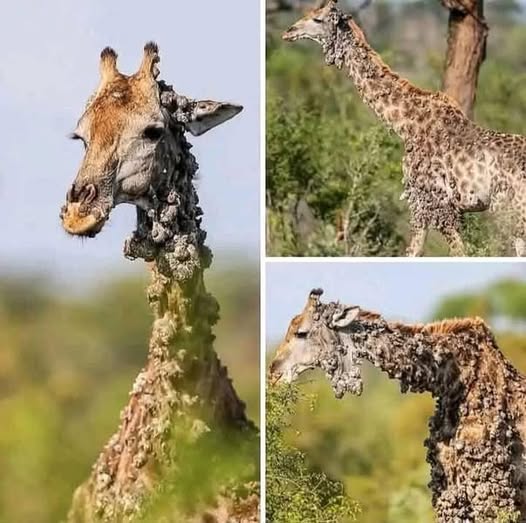
It was along this path that Marius spotted two giraffes emerging from the bush, followed by a third that immediately stood out. This giraffe was unlike any he had ever seen, her body covered in strange, bulbous growths.
Marius, an avid wildlife photographer, quickly grabbed his camera and took several photos. Later, he shared the images on Facebook, where they sparked widespread concern and curiosity. Viewers wondered whether the giraffe was in pain or suffering due to the unusual lumps. While the giraffe’s appearance was startling, Marius noted that she seemed calm and was grazing normally, showing no clear signs of distress. He tagged South African National Parks (SANParks) to raise awareness, though he had not yet received an official response at the time.
The images soon reached WorldWide Vets, an international animal welfare organization focused on wildlife health. Dr. Gemna Campling, the group’s founder and director, identified the condition as a rare case of papillomavirus infection. She explained that papillomavirus occurs in many species, with different strains affecting different animals. In this instance, the giraffe likely contracted a strain known as bovine papillomavirus (BPV).
The virus spreads primarily through direct contact. In the wild, oxpecker birds — which feed on parasites living on giraffes’ skin — can inadvertently transfer the virus between animals. Interestingly, the rest of the herd appeared completely healthy, a pattern commonly seen with this type of infection.
Though visually alarming, Dr. Campling emphasized that the disease is not fatal. Many cases of BPV resolve on their own over time, with the animal’s body healing naturally. However, there is currently no treatment for the condition in giraffes, leaving veterinarians to closely monitor affected individuals.
Importantly, the virus poses no risk to humans, though humans have their own separate forms of papillomavirus. While the condition is not life-threatening, the size and number of growths likely cause some discomfort for the giraffe. Despite this, she appeared serene and undisturbed while grazing, a sight that resonated deeply with those who saw the images.
The story quickly spread online, inspiring empathy and raising awareness about wildlife health and conservation.
For Marius and Michelle, the encounter was a powerful reminder of why they return to Kruger again and again. In the unpredictability of the wild, they witnessed both the resilience and fragility of nature — a poignant moment that made their anniversary trip truly unforgettable.